Cans, Lunch Boxes or a Grocery Run? Sizing a Custom Cooler Bag Order for Malaysia
The most expensive mistake in a cooler bag order is not the wrong colour or the wrong print. It is the wrong size — because a cooler that is too small gets left in a drawer, and a cooler that is too big performs worse than the smaller one you rejected. Empty space inside an insulated bag is not free storage. It is air your ice pack has to keep cooling.
Yet almost every brief that reaches us arrives in litres, or in nothing at all: “a medium cooler bag, around 10 litres.” Litres are a manufacturing measurement, not a usage one. Nobody at a family day says “pass me the ten litres.” They say “will a dozen cans and two ice packs fit?” This article converts between the two, using the payload maths our team uses when advising on a build, and then maps the six Malaysian use cases that actually drive cooler bag demand onto the sizes that suit them.
Litres tell you nothing until you name the payload
Volume figures assume perfect packing, and nothing you put in a cooler packs perfectly. Cylinders leave gaps at every contact point; rectangular lunch boxes waste the curve of the bag; a bunch of grocery items is mostly air. As a working rule we allow roughly 0.6–0.7 litres of internal volume for every 320–330 ml can once that packing air is counted, which is why a bag sold as a “12-can cooler” measures somewhere around 8–9 litres rather than the 4 litres the arithmetic suggests.
The table below is the conversion we work from when a client tells us what goes inside. Treat the counts as indicative planning figures for briefing, confirmed against a physical sample — bottle shapes and lunch box footprints vary enough to move a row.
| Internal volume | Cans (330 ml) | 500 ml bottles | Lunch containers | Grocery equivalent | Usual format |
|---|---|---|---|---|---|
| 4–6 litres | 6–8 | 4–5 | One box plus a drink | A couple of chilled items | Lunch cooler, top-handle |
| 8–10 litres | 12–14 | 7–8 | Two boxes plus drinks | A small chilled top-up shop | Shoulder-strap cooler tote |
| 12–15 litres | 18–20 | 10–12 | Three to four boxes | One supermarket chiller run | Large tote or cooler backpack |
| 20–25 litres | 24–30 | 16–20 | Catering trays, stacked | A full chilled weekly shop | Picnic cooler or trolley build |
The ice-pack tax: reserve the volume before you size
Every count in that table assumes the bag holds only your payload. In reality something has to supply the cold, and gel packs are not small: a slim office-lunch pack occupies roughly a quarter of a litre, and a substantial 500 g pack more like half a litre or more. For a bag expected to hold temperature for several hours you will want two.
So reserve 15–20 per cent of the internal volume for coolant before you count a single can. A 10-litre bag briefed for twelve cans is really an eight-litre bag once packed properly, which lands it at ten or eleven cans in practice. Get this wrong and recipients solve it by leaving the ice packs at home — at which point you have distributed an expensive, well-insulated shopping bag. The relationship between fill level, coolant and hold time is exactly what the six-hour hold-time test is designed to expose before you order.
Four ways a cooler bag brief gets mis-sized
1. Sizing for the maximum, using at the minimum
Someone imagines the biggest possible outing and specifies for that. Ninety per cent of actual use is one lunch and a bottle, in a bag with three-quarters of its volume full of warm air. Size for the typical trip and let the rare big one be a two-bag trip.
2. Quoting external dimensions
An 8 mm insulated wall takes about 16 mm off each internal dimension, plus the liner. A bag measured 30 × 20 × 20 cm outside is meaningfully smaller inside, and on a thick-walled build the loss is the difference between three lunch boxes and two. Always confirm internal dimensions.
3. Ignoring the tallest item
A 1.5-litre bottle stands roughly 32 cm tall. A bag with the right litreage but a 25 cm internal height simply will not close over it, and a cooler carried unzipped is not a cooler. If a specific bottle, tray or box must fit upright, put its height in the brief in millimetres.
4. Forgetting who carries it, and how far
Water and ice are heavy. A 20-litre cooler packed with drinks and coolant is a serious load on one shoulder across a car park in the afternoon sun. Past roughly 15 litres, a single shoulder strap stops being the right answer.
Carry format decides more than volume does
Two bags of identical capacity can suit completely different programmes depending on how they are carried, and this is where a gift is won or lost. A tall, narrow shape carries comfortably against the body and fits a footwell; a wide, shallow shape stacks in a boot and lets you find things without unpacking.
- Top-handle lunch cooler — up to about 6 litres. Desk-side, one hand, fits a locker.
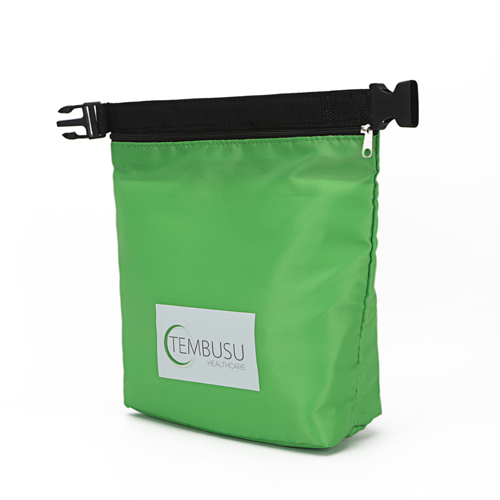
- Shoulder-strap cooler tote — the corporate-gift sweet spot at 8–12 litres. Wide enough to brand, light enough to enjoy carrying, useful for both lunches and a chiller run.
- Cooler backpack — 12–20 litres with the weight on two shoulders. The right answer for riders, delivery crews, site teams and anyone walking any distance in the heat, and it keeps hands free at a bazaar.
- Large picnic cooler — 20 litres and up, twin handles plus strap, usually carried two-handed for short distances between car and table.
- Trolley cooler — the answer past the point where anybody should be carrying it. Heavier and bulkier to store, but the only sensible build for repeated catering, market-stall or event-day loads.
Format also reshapes your branding canvas: a backpack gives you a tall front panel and a slim lid, while a wide tote gives you a broad landscape area. Because those surfaces differ in fabric as well as shape, it pays to check the decoration heat limits for each shell fabric before committing a design to a format.
Six Malaysian use cases, and the size each one needs
| Use case | Real payload | Size & format | The spec that matters most |
|---|---|---|---|
| Ramadan bazaar & buka puasa deliveries | Packed meals, kuih, cold drinks, short repeated runs | 12–20 litres, backpack or wide tote | Wipe-clean liner and a flat base — gravy travels |
| Weekly grocery run | Chilled and frozen items, 20–40 minutes home | 12–15 litres, shoulder tote that stands up | Structure — a bag that collapses spills the load |
| Company family day | Drinks and snacks for a family, outdoors, half a day | 8–12 litres, shoulder strap | Thicker foam — it will sit in the sun |
| Clinic & pharma sample transfer | Small, dense, temperature-sensitive items | 6–10 litres, compact shoulder build | Small volume, maximum foam — never over-size |
| F&B sampling roadshow | Chilled stock replenished from a central cooler | 4–8 litre carriers plus one 20-litre base | Big print panel — the bag is the media |
| Daily staff lunch gift | One meal container, one drink, one slim pack | 4–6 litres, top handle | Light weight and easy cleaning |
If it is a Ramadan programme, work backwards now
Ramadan is expected to begin around 8 February 2027, which puts the bazaar and buka puasa season across February and March. Count back from that: roughly 15 days shipping, 20–30 working days production after artwork approval, and a week or two for mockups and internal sign-off. That places the brief in early to mid-November 2026 for comfortable delivery — and earlier still if your artwork needs panel-stage printing. Express production in 7 working days exists for limited styles and quantities, but it should be your contingency, not your plan.
The one-page sizing brief to send with your request for quotation
Copy these seven lines into your email and you will get a usable quotation first time instead of three rounds of clarification:
- The payload, in items: “two lunch containers and two 500 ml bottles”, not “medium”.
- The tallest single item that must stand upright, in millimetres.
- How many ice packs travel with it, and their size.
- Hours the contents must stay cold, and where the bag sits meanwhile — cabin, boot or open air.
- Who carries it and how far: hand, shoulder, back or wheels.
- Whether it must stand up unsupported when loaded, and whether it must fold flat for storage.
- Quantity and the date it is needed on site — not the date you would like to order.
Two lines on that list catch nearly all the trouble: number four, because a bag that lives in a boot needs a different build entirely, and number six, because folding flat and standing up loaded pull in opposite directions. Once those are settled, choosing from the cooler bag sizes and shapes we produce becomes a five-minute conversation instead of a fortnight of samples.
One last thing worth deciding at the same time. A bag sized for wet groceries or gravy-carrying deliveries will need rinsing regularly, and in Malaysian humidity that has consequences for how it should be stored between uses — so agree the liner and drainage spec alongside the size, and read up on cleaning and drying a lined bag between uses before you finalise the build.
Frequently asked questions
What size cooler bag holds 12 cans?
Around 8–10 litres of internal volume, allowing for packing air. Add an ice pack or two and the practical count drops to ten or eleven cans, so specify 10 litres if a full dozen must travel cold.
Is a cooler backpack better than a shoulder bag?
Past roughly 12–15 litres, or any distance walked in the heat, yes — two shoulders beat one and your hands stay free. Below that, a shoulder tote is easier to load, easier to brand and reads better as a corporate gift.
Can one cooler bag suit both office lunches and grocery runs?
A 10-litre shoulder tote is the usual compromise and it works. Just accept that it will be slightly large for a single lunch, and pad the empty space rather than leaving it hollow.
Can we order mixed sizes in one order?
Usually yes, where the styles share a build and artwork. Tell us the split at briefing stage — mixing sizes affects panel layouts and carton planning, so it is far easier to allow for at the start than after approval.
What is the minimum order?
From 300 pcs per design. Production runs 20–30 working days after artwork approval plus around 15 days shipping, with 7-working-day express on limited styles and quantities. Quote-only with SST invoicing, and ePerolehan documentation for government buyers.
Tell us the payload, we will tell you the litres
Send the seven-line brief above and you will get a recommended size, format and build with a free digital mockup, usually within one business day. Aquaholic Gifts is a Singapore-based corporate gifting specialist since 2003, now serving Malaysia from Kuala Lumpur, with nationwide delivery.
Planning a large programme? Get a wholesale cooler bag quote with sizes matched to how your recipients will really use them.
WhatsApp +60 10 717 5924 · Send your brief through our contact page
Aquaholic Gifts Malaysia — AS80, Jalan Hang Tuah 4, Taman Salak Selatan, 57100 Kuala Lumpur. MOQ from 300 pcs.