Custom Scarf Printing Methods Malaysia: Digital, Silkscreen & More
Custom Scarf Printing Methods Malaysia — Digital Print vs Silkscreen vs Embroidery vs Jacquard
A clear breakdown of every customisation method for printed scarves in Malaysia — what each technique produces, what it costs, and which use cases it suits best.
The printing method you choose is just as important as the material. The wrong method for your design or volume can result in disappointing print quality, unexpectedly high costs, or a finish that looks cheap. This guide breaks down every common scarf customisation technique so you can make an informed decision before placing your order.
Quick Comparison: Scarf Printing Methods
| Method | Colour Range | Print Quality | Best Material | Cost at Scale | Best For |
|---|---|---|---|---|---|
| Digital Sublimation | Unlimited | Photographic | Polyester, Chiffon, Satin | Mid | Full-colour logos, complex designs |
| Silkscreen | 1–6 spot colours | Sharp & clean | Polyester, Cotton | Low at high volume | Simple logos at high volume |
| Embroidery | Up to 15 thread colours | Premium raised texture | Cotton, Polyester Blend | Mid–High | Logo-only, premium uniforms |
| Heat Transfer | Full colour | Good | Polyester, Cotton | Low–Mid | Small batches, simple logo placement |
| Jacquard Weave | 4–8 colours (woven) | Premium, woven-in | Knitted / Wool | High | Sports fan scarves, premium gifts |
1. Digital Sublimation Printing — Full-Colour, No Limits
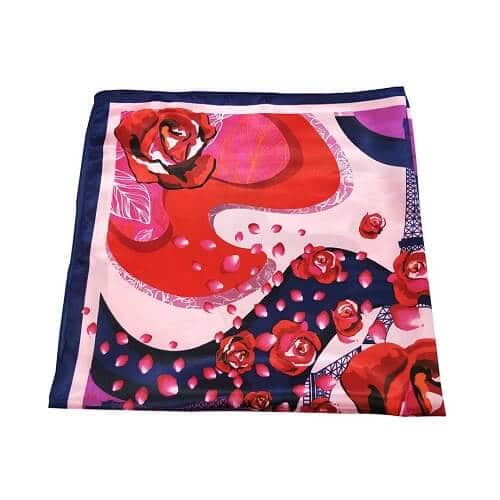
Digital sublimation is the dominant printing method for custom scarves in Malaysia, and it’s easy to understand why. The process uses heat to convert dye into gas, which then bonds permanently with the synthetic fibres of the fabric — the colour becomes part of the fabric itself, not a layer on top of it.
What It Produces
Photographic-quality, full-colour prints with unlimited colours, gradients, and fine detail. The entire scarf surface can be printed edge to edge with no colour limitations.
Best Use Cases
Complex logos with multiple colours, batik-inspired designs, full-surface pattern printing (all-over print), Hari Raya shawls with intricate designs, and any application where design richness is important.
Limitations
Only works on synthetic fabrics (polyester, chiffon, satin). Does not work on natural fibres like cotton or genuine silk. Requires white or light base fabric for accurate colour reproduction.
2. Silkscreen Printing — Economical for Simple Logos at Scale
Silkscreen (screen printing) applies ink directly onto the fabric surface through a mesh stencil. Each colour requires a separate screen, making it economical for 1–4 colour designs at high volume, but less practical for complex multi-colour artwork.
💡 When Silkscreen Makes Sense
- Your logo is a simple 1–3 colour mark (not a complex gradient or photographic image)
- You’re ordering 300+ units — the per-unit cost drops significantly at scale
- You want the ink to sit on top of the fabric with a slight raised texture (different feel from sublimation)
- Your fabric is polyester or cotton — both accept silkscreen printing well
Advantages
Most cost-effective method at high volume for simple logos. Very sharp, clean edge definition. Works on both polyester and cotton. Proven, reliable technology with consistent output.
Limitations
Cannot reproduce gradients, photographic images, or designs with many colours. Additional colours increase cost significantly. Not suitable for all-over or full-surface printing.
3. Embroidery — Premium Texture for Corporate Logos
Embroidery stitches the logo or design into the fabric using thread. The result is a raised, textured finish that looks and feels premium — it’s associated with quality, durability, and professionalism. Embroidery is the preferred method for many corporate uniform programs and executive gifting applications.
What It Produces
A raised, three-dimensional logo with precise thread colour matching. The design is physically stitched into the fabric — it cannot fade, peel, or crack. Thread colours can be matched to Pantone specifications.
Limitations
Best for simple logos — complex artwork with fine detail or gradients cannot be reproduced in embroidery. Not suitable for lightweight chiffon or thin satin (fabric may distort). Higher cost per unit than silkscreen or digital print.
4. Jacquard Weave — The Premium Sports & Knitted Scarf Standard
Jacquard weaving creates patterns by programming a loom to weave different coloured threads in precise patterns directly into the fabric structure. The design is part of the fabric — there is no ink, no dye, and no surface treatment. This makes jacquard the most durable of all customisation methods.
Jacquard is most commonly used for custom knitted sports scarves — the classic football fan scarf — as well as premium wool or acrylic scarves for corporate gifts and events.
💡 When to Choose Jacquard
- Sports clubs, school teams, and event organisations ordering fan scarves or team merchandise
- Corporate events where a premium branded knitted scarf is the desired gift
- Any application where maximum durability is required — jacquard designs will outlast the scarf itself
- Budget of RM30–50+/pc is acceptable — jacquard has higher tooling costs than print methods
Which Method Should You Choose?
| Your Situation | Recommended Method |
|---|---|
| Full-colour logo or batik design on chiffon/satin shawl | Digital Sublimation |
| Simple 1–3 colour logo, 300+ units, polyester | Silkscreen |
| Premium uniform scarf with raised logo, cotton or poly-blend | Embroidery |
| Small batch (under 50 units), simple logo, quick turnaround | Heat Transfer |
| Knitted fan scarf for sports club or corporate event | Jacquard Weave |
| Batik all-over print on polyester scarf | Digital Sublimation |
| VIP gift with logo on silk scarf | Digital Print or Embroidery |