Woven Tie vs Printed Tie Malaysia — Which Is Better for Your Brand?
[et_pb_section fb_built=”1″ theme_builder_area=”post_content” _builder_version=”4.27.5″ _module_preset=”default” custom_padding=”0px||0px||true|false” hover_enabled=”0″ sticky_enabled=”0″][et_pb_row _builder_version=”4.27.5″ _module_preset=”default” theme_builder_area=”post_content”][et_pb_column _builder_version=”4.27.5″ _module_preset=”default” type=”4_4″ theme_builder_area=”post_content”][et_pb_code _builder_version=”4.27.5″ _module_preset=”default” theme_builder_area=”post_content” custom_padding=”0px||0px||true|false” hover_enabled=”0″ sticky_enabled=”0″]
Woven Tie vs Printed Tie Malaysia — Which Is Better for Your Brand?
Choosing between a woven jacquard tie and a printed tie isn’t just about aesthetics—it affects durability, cost per unit, colour range, and how your brand looks to clients and staff. This guide compares both methods so you can decide what’s right for your organisation.
In Malaysia’s corporate landscape, the tie remains a non-negotiable symbol of professionalism — whether for bank staff, hotel receptionists, airline crews, or government employees. But when you’re ordering custom ties for your organisation, you face a critical choice: woven or printed? The method you choose ripples through durability, perceived quality, cost, and how the tie holds up over years of wear.
Quick Comparison: Woven Tie vs Printed Tie at a Glance
| Factor | Woven Tie | Printed Tie |
|---|---|---|
| Method | Design woven into threads via jacquard loom | Design applied to fabric surface (digital sublimation or silkscreen) |
| Durability | Permanent — will not crack, peel, or fade | Good (sublimation) — colour embedded in polyester |
| Colour Range | 2–4 colours max, repeating pattern | Unlimited — full-colour, photographic quality |
| Feel & Texture | Premium, distinctly textured surface | Smooth finish, may feel like regular tie |
| Minimum Order | 50–100 units | 30–50 units (lower with some suppliers) |
| Unit Price | RM25–40/pc (MOQ 100) | RM20–30/pc (MOQ 50) |
| Best For | Uniforms, longevity, premium branding | Events, lower MOQ, complex designs |
What Is a Jacquard Woven Tie?
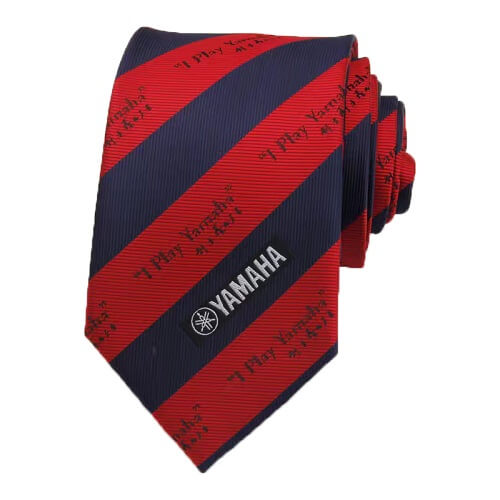
A jacquard woven tie is made using a jacquard loom—a specialised weaving machine that interlocks coloured threads during production to create a design. Instead of printing onto the surface, the pattern is woven directly into the fabric structure. This means your company logo, geometric pattern, or stripe design becomes a permanent, integral part of the tie’s material.
The result? A distinctive textured surface that you can feel as well as see. Executives and clients immediately recognise woven ties as premium—because they are. Banks, airlines, five-star hotels, and government departments in Malaysia have relied on woven ties for decades precisely because they signal durability and investment-quality branding.
Advantages of Woven Ties
Design is permanent — woven into the fabric, not applied to the surface. Distinctive textured feel signals premium quality. Colour-fast and will not crack, peel, or fade even after 5+ years of daily wear. Best choice for uniform applications requiring long-term durability and consistent brand appearance.
Limitations of Woven
Limited to 2–4 colours due to weaving constraints—cannot produce photographic or full-colour designs. Higher minimum order (50–100 units). Longer production lead time (4–6 weeks) compared to printed. Design must be finalized early; last-minute changes are costly.
💡 When to Choose Woven Ties
- Bank staff, airline, or hotel uniforms where ties are worn daily and durability is critical
- Government or GLC employees requiring professional, premium appearance that lasts years
- Orders of 50+ units where cost per piece becomes competitive
- Organisations wanting to signal investment in quality—woven ties feel luxury-tier compared to printed
- Annual uniform refresh programs where consistency across multiple batches is required
What Is a Printed Tie?
A printed tie starts with a plain base fabric—typically polyester—and then applies the design via one of two printing methods: digital sublimation or silkscreen printing. The design sits on the surface of the fabric, giving the tie a smooth finish rather than the textured feel of woven.
Printed ties are faster to produce, support much lower minimum orders, and allow unlimited colours. This makes them ideal for event merchandise, seasonal promotions, or organisations that need flexibility in small batches.
Digital Sublimation Print
Uses heat and pressure to embed dye directly into polyester fibres. Produces photographic-quality, full-colour designs. Colours are vibrant and will not crack or peel. Ideal for logos with gradients, photographs, or multi-colour artwork. MOQ from 30 units. Cost: RM18–25/pc.
Silkscreen Print
Traditional method using colour-separated screens—best for 1–3 colour designs. Economical and long-lasting on polyester. Produces a slightly raised, textured feel (not as tactile as woven). MOQ 50–100 units. Cost: RM15–22/pc for larger orders. Best for simple, bold logos.
💡 When to Choose Printed Ties
- Event-specific or limited-edition ties where lower MOQ (30 units) is essential
- Complex logo designs, photographs, or full-colour artwork that cannot be woven
- Testing new tie designs before committing to large woven orders
- Corporate events, conferences, or giveaways where ties are worn short-term
- Budget-conscious departments where cost per unit must be minimised
Side-by-Side: When to Choose Each Method
The choice between woven and printed ultimately depends on your use case, budget, and the message you want your ties to send. Here are the scenarios where each method shines:
📌 Choose Woven Jacquard If…
- You’re ordering for customer-facing staff (hotel reception, airlines, banks) who wear ties daily
- You need uniforms that must maintain consistent appearance and durability over 3+ years
- Your order is 50+ units—economies of scale make woven cost-competitive
- You want staff and clients to immediately recognise the quality and investment in your brand
- You’re part of a government, GLC, or formal institution where traditional professional standards apply
- Annual school ties where consistency across cohorts is important (e.g., uniformed academies)
📌 Choose Printed If…
- You need a smaller batch (30–49 units) and MOQ flexibility is crucial
- Your design includes full-colour artwork, gradients, or photographic elements
- You’re running a one-off corporate event, conference, or team-building activity
- You want to test a new tie design before committing to a large woven order
- Your budget per unit must be minimised—printed starts at RM15–18/pc
- You need a faster turnaround (2–3 weeks vs 4–6 for woven)
Malaysian Use Cases:
- Woven: Maybank, Petronas, Malaysia Airlines, five-star hotel chains (Four Seasons KL, Petronas Twin Towers visitor staff), government ministries, Bank Negara Malaysia, uniformed educational institutions
- Printed: Corporate team events, Hari Raya office parties, training conference merchandise, startup & SME team gifts, sports clubs, short-term promotional activations
Can You Combine Both Methods?
Yes—and this is increasingly popular in Malaysian corporations with tiered gifting strategies. Many organisations use a two-tier approach:
- Executive & Customer-Facing Tier: Woven jacquard ties (50–100 units) for senior managers, board members, and staff in client-facing roles
- General Staff & Event Tier: Printed ties (200–500 units) for broader staff distribution, Hari Raya gifts, or company events
This approach allows you to signal premium, investment-quality branding at the executive level while still providing consistent, branded ties to the wider organisation. You maintain visual brand consistency across all tiers while optimising cost.
Many suppliers in Malaysia can coordinate both orders in a single project, ensuring that the base tie colour, width, and material compatibility work seamlessly together. Link to our full custom tie Malaysia range for tiered gifting examples.
FAQs — Woven vs Printed Ties in Malaysia
More Tie Guides for Malaysia
[/et_pb_code][/et_pb_column][/et_pb_row][/et_pb_section]