Custom Tie Pricing Malaysia: Bands, Cost Levers and How to Brief
Two companies ask us for 300 ties in the same week and the quotes come back nearly double one another. One is a printed polyester tie in a poly bag; the other is a woven jacquard with a branded keeper, tipping and individual gift boxes. Same word, same quantity, different product entirely.
Below are indicative bands so you can budget, followed by the seven things that decide where inside those bands your quote actually lands. If you only read one section, make it the quantity curve — it is where most tie budgets are won or lost. For the full range of constructions, see the customised tie collection.
Indicative price bands by type
| Tie type | Indicative per piece | Typically used for |
|---|---|---|
| Printed polyester tie | RM25 – RM35 | Uniforms, events, volume orders |
| Bow tie / clip-on | RM25 – RM35 | F&B, events, easy-wear settings |
| Knitted tie | RM32 – RM42 | Smart-casual uniforms, retail, gifting |
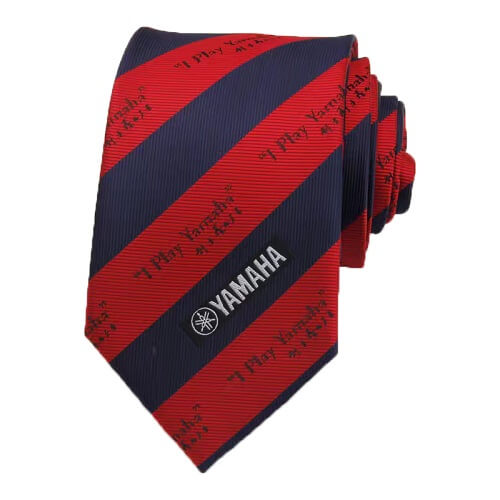
| Woven jacquard tie | RM45 – RM55 | Premium uniforms, banks, schools, corporate gifts |
| Real silk tie | RM45 – RM80 | VIP gifting, board-level, ceremonial |
These are indicative, before packaging, keeper labels, tipping, strike-offs and delivery. They are for budgeting, not for a purchase order — the figure that binds is the one written against your actual specification. Send the eight items further down this page and you will have that figure back the same working day wherever possible.
How quantity bends the price
| Quantity | Indicative range across all types |
|---|---|
| 100 pcs (minimum order) | RM25 – RM55 |
| 250 pcs | RM23 – RM53 |
| 500 pcs | RM20 – RM50 |
Real silk sits outside the quantity bands above — it is priced per enquiry because silk yarn cost moves independently of the rest of the range. Treat RM45 – RM80 as the indicative band at any quantity and ask us for a firm figure against your specification.
Two things to take from that curve. First, the movement is real but it is not dramatic — roughly RM5 per piece between the minimum and 500 units. Ties are a labour and materials product more than a setup-cost product, so volume does not collapse the price the way it does on printed flat goods.
Second, and more usefully: because the curve is shallow, ordering buffer stock is cheap. Going from 400 to 500 pieces costs you far less than it appears, and it removes the reorder colour-matching problem entirely. That is the single best-value decision available on a tie order.
- The minimum is per design, not per order. 100 pieces per design — and a second colourway counts as a second design, so it carries its own minimum. This is the most common way a tie budget quietly doubles.
- Splitting sizes or styles splits your leverage. 400 of one design prices better than 200 each of two.
- Ask for two figures. If you are hovering under a round number, ask for both. The step up is usually smaller than people expect and the spares cover new joiners.
The seven levers behind your quote
| Lever | Entry end | Premium end | Pull on the quote |
|---|---|---|---|
| 1. Construction | Printed polyester | Woven jacquard | Strongest — roughly doubles it |
| 2. Fabric | Polyester / microfibre | Real silk | Strong |
| 3. Quantity | At the 100-pc minimum | 500+ | Moderate — shallow curve |
| 4. Finishing | Standard keeper and tipping | Branded keeper, custom tipping | Small each, meaningful stacked |
| 5. Packaging | Poly bag, bulk carton | Rigid gift box, card, ribbon | Moderate — and it drives shipping |
| 6. Colour accuracy | Standard thread or dye | Strike-off and exact match | Small in money, real in days |
| 7. Lead time | Standard 21–45 days | Express 10 working days | Small on paper, large on availability |
Notice what is not on that list: colour count and design complexity. On a printed tie, a full-colour photographic pattern costs the same to print as one small logo. Be generous with the design — it is the one place where ambition is free. On a woven tie the constraint is different and structural, and it is explained in the woven versus printed comparison.
Lever 1 — construction does most of the work
If your quote came back higher than expected, construction is the first place to look. A woven jacquard tie has the design built into the cloth on a loom, which is a fundamentally more involved process than printing onto finished cloth. That is the RM25-to-RM45 gap in one sentence.
Whether it is worth it depends on what the tie is for. For a bank, school or government body issuing a uniform tie reordered over years, woven is usually the right answer — it reads institutional and its colour is far more stable across batches. For an event, launch or anniversary, printed is not a compromise, it is the better fit.
Levers 4 to 6 — where the quiet additions live
Finishing and packaging are individually small and collectively significant. A branded woven keeper label, custom tipping, individual poly bagging, a printed care card and a rigid gift box are each defensible; five of them together is a different quote from the one you were expecting.
Packaging in particular carries a second cost behind it: a rigid box adds to the unit and then multiplies the shipping volume, which matters if you are couriering to individual addresses across Sabah and Sarawak rather than delivering in bulk to one office. Ask for these itemised so you can see what each is worth to you.
A strike-off — a physical swatch approved before bulk — costs little and buys a great deal. If an exact brand colour matters, it is not optional; the full protocol is in the colour matching guide.
The brief that gets an accurate quote in one reply
Most enquiries say “how much for custom ties?” and the honest answer is a set of questions. Send these eight and you will get a real number rather than a range:
- Quantity — plus a second figure if you might scale up.
- Construction — printed, woven jacquard, knitted, bow or clip-on.
- Fabric or tier — polyester silk, microfibre, or real silk.
- Width and style — standard, slim 7cm, pre-tied.
- Your logo, ideally as vector.
- Branding intent — all-over repeat, single mark, keeper or tipping.
- Packaging — bulk, poly bag, or individual gift box.
- Delivery date and delivery point or points.
If branding placement is still open, settle it before commissioning a designer — only a narrow panel of a tie is ever seen, as set out in what is actually visible once a tie is knotted.
Where to spend, and where to save
| Worth paying for | Usually safe to trim |
|---|---|
| Woven construction on a long-life uniform tie | Woven on a one-off event tie |
| A strike-off when a brand colour must be exact | Rigid gift boxes when delivery is bulk to one office |
| Buffer stock — the curve is shallow, the insurance is real | A second colourway that halves your quantity leverage |
| A generous, well-designed pattern — on print it is free | Real silk on a frontline uniform worn daily |
That last one surprises people. For daily wear in this climate, polyester silk generally outlasts real silk — it handles perspiration and humidity better and recovers from creasing more readily. Real silk earns its place in ceremonial and VIP gift tiers, not on a frontline uniform. The wear evidence is in how long a uniform tie actually lasts here.
Lead time, and why it is the cheapest thing you can spend
Standard production runs 21–45 days by quantity after artwork approval, plus around 15 days shipping. Express at 10 working days exists but is limited by model and quantity — it is a capacity question, which is why it cannot always be bought at any price.
Count backwards from the date staff need the ties, not forwards from today. For a Hari Raya, Chinese New Year or Merdeka rollout, start roughly three months ahead. Teams that do get the full range of constructions to choose from; teams that start six weeks out get whatever can be produced in time, which constrains the quote in a way that has nothing to do with negotiation.
Frequently asked questions
What is the minimum order?
100 pieces per design. Per design, not per order — each distinct artwork or colourway carries its own minimum.
Why is woven so much more than printed?
Because the design is built into the cloth on a loom rather than printed onto finished cloth. You are paying for a different manufacturing process, not a markup — and in return you get texture, an institutional read and far better colour stability across reorders.
Does a more complex design cost more?
On a printed tie, no — colour count and coverage are free. On a woven tie, additional colours mean additional threads in the weave, so the palette does have a practical limit.
Do you charge for a mockup?
No. A digital mockup is free and comes with the quote. Ask for the knotted view as well as the flat one.
Are these prices inclusive of SST and delivery?
No — the bands are indicative unit prices before SST, packaging and delivery. Your written quote sets these out separately so you can see exactly what each element costs.
Get a real number, not a range
Send the eight items above — or just tell us headcount, occasion and date, and we will fill in the rest and come back with options at more than one tier. Minimum order 200 pieces per design, free digital mockup, nationwide delivery across Malaysia.
Still choosing a construction? See the full custom tie range across woven, printed, knitted and pre-tied.
WhatsApp +60 10 717 5924 | Request a quote
Aquaholic Gifts has specialised in corporate gifting since 2003 and now serves clients across Malaysia from Kuala Lumpur. Price bands above are indicative for budgeting and are not a quotation.