
Coasters for Bars, Cafes and Hotels: Buying for Service
There are two entirely different coaster buyers, and they should not be reading the same advice. One is buying a gift: a set of four in a box, handled a few times a month, expected to last years. The other is buying consumables for a service floor, where a coaster is wiped with sanitiser twenty times a night, stacked wet, dropped, and periodically walks out of the building in someone’s handbag.
If you are the second buyer, unit price is close to meaningless. What matters is cost per month of service, and once you calculate it the ranking of materials changes completely. This guide is written for venues, beverage brands and anyone ordering custom coasters bulk for a floor rather than for a shelf.
Cost per month of service, not cost per piece
The calculation is simple and almost nobody does it. Take the unit price, divide it by the number of months the coaster realistically stays in service, and compare that number instead.
A cheap printed MDF coaster that swells and delaminates in six weeks is not cheap. A ceramic coaster at several times the price that survives two years of nightly service is, on this measure, dramatically cheaper — until you factor in breakage, which is the other half of the equation and which is why ceramic is rarely the right answer for a busy bar.
Three numbers drive the calculation:
- Service life — how long before the coaster looks bad enough that you would not put it in front of a paying customer. This is usually much shorter than the point at which it stops working.
- Breakage rate — how many are physically destroyed per month. Ceramic in a bar is high; silicone is effectively zero.
- Attrition rate — how many simply disappear. This is the number venues consistently underestimate, and for an attractive branded coaster it is the largest of the three.
Attrition is a compliment and a budget line
A well-designed branded coaster gets taken home. In a busy venue with an appealing design, losing a meaningful share of stock every month is normal, and if your coaster is genuinely attractive it will be higher.
This is not a problem to solve. A coaster in someone’s kitchen is doing brand work for free, which is precisely why beverage brands invest in them. It is a problem to budget for. Two implications follow:
- Order for the reorder cycle, not for the opening. Work out your monthly loss rate honestly, decide how long you want to go between orders, and size the order to that. Ordering a two-year supply to chase a price break usually means storing coasters that go out of date when the menu or the logo changes.
- Do not over-engineer a consumable. If a third of your stock leaves every month regardless of quality, paying a premium for a five-year material is money spent on a benefit nobody will ever experience.
The exception is the premium venue where the coaster is part of the table setting rather than a giveaway. There, attrition is lower, service standards are higher, and the calculation flips back toward durable materials.
What actually destroys coasters on a service floor
Venue wear is not domestic wear scaled up. It is a different set of forces:
- Sanitiser. Coasters get wiped with the same alcohol or quat solution as the tables. Alcohol lifts surface inks, dulls gloss lacquers and, over months, hardens and cracks PU. Ask any supplier whether the print is alcohol-resistant, and treat a vague answer as a no.
- Stacking wet. At the end of service everything gets stacked. Absorbent coasters stacked damp do not dry, and by the next evening the bottom of the pile smells. This alone rules out cork for most late-night venues.
- The bus tub. Coasters go into the same tub as glassware, get knocked around, and go through a wash cycle they were never designed for. Anything with a glued backing loses that backing.
- Sunlight. Al fresco and window seating in Malaysia gets direct sun for hours. UV fades surface prints fast and yellows light PU. If part of the venue is outdoors, either specify a UV-stable print or accept that outdoor stock is a separate, faster-cycling pool.
Against that list, the materials that perform best in volume service are silicone and thick PU: both are unbreakable, both wipe clean, neither absorbs, and neither cares about being stacked wet. Sealed wood and glazed ceramic look better and cost more per month. Cork looks best of all and lasts the shortest time.
Order in two waves
The single most useful process change for a venue order is to split it. Take a modest first run — enough for a few weeks of real service — put it on the floor, and audit it after a month before committing to the full quantity.
The audit is quick. Count what you have left, look at the condition of what came back, and note which failure mode dominates. You will learn three things no quotation can tell you: your real attrition rate, whether the print survives your cleaning routine, and whether your staff find them practical to handle and stack.
Almost every venue that does this changes something before the main order — usually the material, occasionally the size, often the print placement. The cost of the trial run is trivial against the cost of discovering the same information across ten thousand pieces. For choosing what goes into that first wave, our guides to material and absorbency in Malaysian humidity and decoration that lasts on wet surfaces cover the two decisions that matter most.
Specifying for a venue rather than a gift
A venue specification looks different from a gifting one, and the differences are worth stating explicitly in the brief:
- Moulded or engraved branding rather than surface print, wherever the design allows.
- A moulded or stitched backing, not glued — glue fails in wash cycles.
- Alcohol-resistant inks, stated as a requirement, with a sample you can test by wiping it fifty times.
- No fine detail. On a floor item, detail is lost within weeks anyway and simplification improves legibility across a room.
- Stackability. Ask how a hundred of them stack. Coasters with a raised lip or an irregular edge stack badly and staff will resent them.
- Consistent reorder colour. If the coaster is part of your brand presentation, get a retained sample so wave two matches wave one.
Sizing deserves its own attention too, because venue glassware varies far more than domestic glassware — see sizing against your actual glassware. And for planning the two-wave budget, our coaster price bands by volume guide shows where the quantity breaks fall.
Storing wave two
If you order in two waves, or order a larger quantity against a price break, the stock you are not using still has to survive. In a Malaysian back-of-house that is not automatic.
Store cartons off the floor, away from any wall that gets afternoon sun, and out of the wash-up area where steam collects. Absorbent coasters in particular should stay in their cartons rather than being decanted into open tubs, and cork or wood should not be sealed inside airtight bags for months — trapped humidity is what raises surface spotting. Rotate oldest-first rather than pulling from whichever carton is nearest, and check the bottom of the stack every couple of months, because compression plus damp is what quietly ruins reserve stock.
Staff handling is part of the specification
A coaster that your floor staff find awkward will not stay in service, whatever the brief said. Two practical checks before the main order: hand a stack of fifty to whoever runs the floor and watch how they carry them, and ask how the coasters come off the tables at close. If they have to be collected individually, picked out of bus tubs, or laid out to dry, that labour is a real cost and staff will quietly stop using them.
This is also where size and shape decisions get tested for the first time under real conditions. Square coasters stack tidily and travel in a hand well; die-cut shapes do neither. Thick coasters take more shelf space behind the bar than anyone allowed for. None of this shows up in a quotation, and all of it shows up in month one.
When a disposable coaster is the right answer
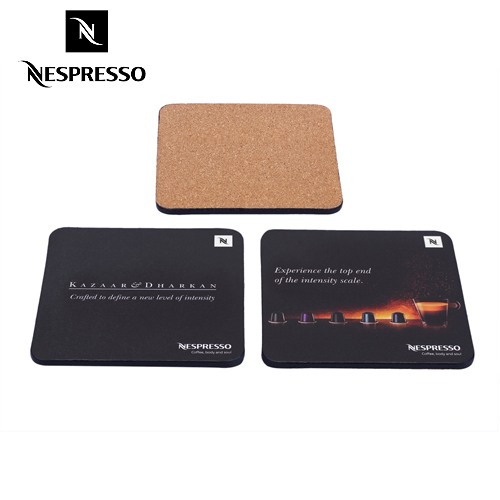
It is worth saying plainly: for some venue jobs a printed board coaster is the better buy. If the coaster exists to carry a campaign message for six weeks, or to support a beverage-brand activation, or to go out in enormous volume across many outlets, then a pulpboard coaster at a fraction of the unit cost does the job and the attrition question disappears entirely — they are meant to be taken.
The reusable coaster earns its place when it is part of the table setting, when the venue’s own brand is on it rather than a campaign, or when it will be handed to someone as a gift. Mixing the two — disposable board on the main floor, a durable branded coaster in the VIP area and for gifting — is a common and sensible split.
A note on lead time and campaign dates
Venue orders fail on dates more often than on quality. A branded coaster tied to a menu launch, a sponsorship or a festive campaign has a hard deadline, and coasters are usually the last item briefed because they feel simple. Build the schedule backwards from the launch: artwork approval, a physical sample on the production substrate, then production, then shipping and internal distribution to each outlet. The sample round is the step people skip when they are late, and it is the one that catches the sanitiser problem, the colour shift on a dark substrate and the size mismatch with your glassware. Brief coasters at the same time as the menu, not after it.
Frequently asked questions
What is the best coaster material for a busy bar?
Silicone or thick PU. Both are unbreakable, wipe clean, do not absorb and tolerate being stacked wet. Ceramic looks better but breaks; cork looks best and lasts least.
How many coasters should a venue order?
Size the order to your reorder cycle rather than to a price break. Estimate monthly losses from a trial run, decide how often you want to reorder, and multiply. Ordering years of stock risks obsolescence when branding or menus change.
Will the print survive sanitiser?
Only if it is specified to. Surface inks lift under repeated alcohol wiping. Engraved, debossed and moulded branding is unaffected. Ask for a sample and wipe it fifty times before committing.
Do branded coasters get stolen?
Regularly, and that is a sign the design is working. Treat it as brand exposure and budget for replacement rather than trying to prevent it.
Can we mix a premium coaster for VIP areas with a standard one for the main floor?
Yes, and it is a sensible way to spend the budget. Keep the artwork identical and change only the material so the two read as one brand.
Start with a trial run
Tell us your venue type, your cleaning routine and roughly how many covers you do, and we will recommend a material and a sensible first-wave quantity to test with. Compare coasters Malaysia by material to see the options, or brief us on your venue and we will size the first order with you.


