Coaster Size, Thickness and Sets: Getting the Physical Spec Right
Coaster briefs almost always specify a material and a logo, and almost never specify a size. The supplier then defaults to whatever their tooling runs — usually 90mm or 100mm — and nobody thinks about it again until the coasters arrive and the glasses overhang them.
Size is the specification that decides whether people actually use the coaster. Get it wrong and the item is decorative. This guide covers the physical spec: diameter, thickness, shape, sets and the packaging that has to get them there intact.
The glass-base rule
There is one measurement that should drive the decision, and it takes two minutes to get. Find the widest-based glass the coaster will realistically be used with, measure the base, and add 25mm.
That 25mm margin is not arbitrary. It is roughly the overhang needed for condensation running down the side of the glass to land on the coaster rather than beside it, and for a person to place the glass without aiming. Below about 15mm of margin, people miss, and a coaster people miss is a coaster people stop using.
Common bases in Malaysian settings:
- Standard water tumbler — around 55–60mm base. A 90mm coaster is comfortable.
- Coffee cup and saucer — the saucer is the object that lands, often 120mm or more. A standard coaster is simply too small, which is why café coasters are usually decorative rather than functional.
- Pint and beer glass — 65–75mm base. 100mm is the safe size, and this is why bar coasters trend larger.
- Highball and cocktail — narrow bases, 50–60mm, but tall and easy to knock. Here a slightly larger coaster adds visual stability.
- Mug — 60–70mm base plus a handle that overhangs. 100mm reads better.
If the coaster is a corporate gift and you cannot know the glassware, 100mm is the size that satisfies the most situations. If it is for a specific venue, measure their glasses. It is the highest-value two minutes in the whole brief.
Thickness, stability and perceived value
Thickness does three separate jobs and they pull against each other.
It carries perceived value: a 2mm coaster feels like a giveaway and a 5mm one feels like a product, and that difference is felt within a second of picking it up. It provides capacity in absorbent materials, since a thicker cork holds more water before it saturates. And it costs stability, because every millimetre raises the glass and a tall drink on a thick soft coaster develops a noticeable wobble.
Sensible ranges by material:
- Cork — 3mm minimum or it curls; 4–5mm is the sweet spot for feel and absorbency.
- Wood — 4–6mm. Thinner warps, thicker adds cost and weight without benefit.
- PU leather — 2–3mm, often over a board core. PU gets its premium feel from finish rather than bulk.
- Ceramic — 6–8mm including the cork base. Weight is the point here.
- Silicone and acrylic — 3–4mm. Both are rigid enough that thin does not mean flimsy.
One trap: a soft thick coaster under a tall glass compresses unevenly when someone leans on the table, and the glass rocks. If the coaster is destined for bar tables, favour rigid over thick.
Round, square, or cut to shape
Round is the default and it is the default for a reason: it matches the object standing on it, it has no corners to chip or lift, and it is the cheapest to produce because it comes off a die with no orientation. Square gives roughly 27% more surface area at the same width, which matters if the artwork is text-heavy or if the brand mark is horizontal. Squares also stack more tidily and store flat in a box with less wasted space.
Custom die-cut shapes — a bottle silhouette, a product outline, a logo shape — are where coasters get interesting, and the cost is lower than most buyers assume because it is a cutting die rather than a mould. The constraints are practical: the shape still needs a stable flat area big enough for the glass base plus margin, and thin protrusions will break off on cork and chip on ceramic.
If you are considering customised wooden coasters Malaysia in a custom shape, ask for the die drawing with a glass footprint overlaid on it before approving. It is common to discover that a beautiful shape leaves only 60mm of usable flat area.
Sets, holders and how many is right
Sets of four and six dominate for a simple reason: they map to how people actually entertain. Four suits a household and reads as complete. Six suits a dining table and is the standard for a more generous corporate gift. Sets of two feel like a sample; sets of eight and above stop feeling like a gift and start feeling like inventory.
The holder decides whether the set survives as a set. Without one, coasters scatter within weeks and the gift stops existing as a unit. Options, roughly in order of cost:
- A band or sleeve — cheapest, keeps them together in the box and nowhere else.
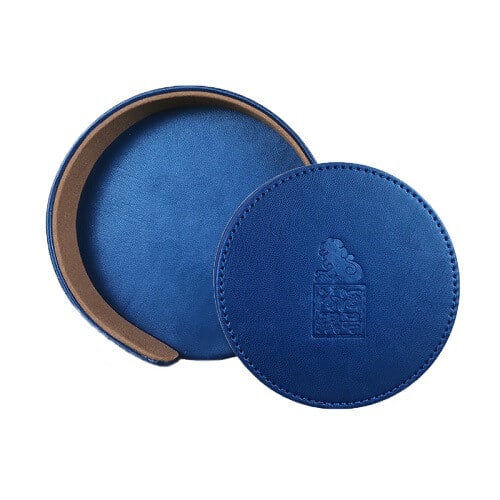
- A matching base with a recess — the coasters nest into a slightly larger coaster. Elegant, cheap in cork and wood, and keeps the stack on the table where people can see it.
- A vertical stand or caddy — the most visible on a desk and the most likely to keep the set intact, at the highest cost.
- A magnetic stack — a small magnet in each coaster. Novel, premium-feeling, adds meaningfully to unit cost, and rules out a few substrates.
Whichever you choose, the holder is the part recipients remember, and it is usually the first item value-engineered out of a quotation. Think carefully before agreeing to that.
Packaging that survives the courier
Coasters are small, flat and heavy for their size, which makes them one of the easier items to ship — with two exceptions that cause most of the damage claims.
Ceramic coasters shipped as a loose stack chip at the edges, because a stack of ceramic discs in a box behaves like a single rigid column and the impact goes straight into the rims. Interleaving with foam or card, or a moulded insert, prevents it and is worth the small cost. And cork or wood shipped in sealed polybags in a humid climate arrives damp: the bag traps moisture, and a fortnight in a container is enough to raise mould spots on the surface. Perforated bags or an unsealed inner wrap solve it.
For gift sets, the box matters more than the coaster on the day of handover. A rigid box with a die-cut insert holding each piece is what makes a modest coaster set feel considered — and it costs far less than upgrading the coaster material to achieve the same impression.
Because these decisions interact, it is worth reading this alongside why absorbency is not automatically better, checking the print methods by substrate for the shape you have chosen, and if you are buying for a venue rather than a gift, reading our guide to ordering in volume for venues. Set size and packaging move the total more than the coaster itself does, so what a coaster set costs to produce is worth a look before you fix the format.
Weight, freight and the hidden cost of ceramic
Coasters are dense, and on a large order the freight line is not trivial. A ceramic coaster with a cork base weighs roughly six to eight times what a cork coaster of the same diameter weighs, and that ratio carries straight through to shipping cost and to the price of moving stock between outlets afterwards.
Two consequences worth planning around. First, when you compare quotations, check whether freight is included and on what basis, because a ceramic quotation that looks competitive ex-works can land considerably higher. Second, if the coasters are going to multiple sites, the internal distribution cost is real — a set of ceramic coasters for twenty outlets is a pallet, not a parcel.
Cork, PU and silicone all ship cheaply and none of them break, which is part of why they dominate large multi-site orders even where a heavier material would present better.
Stacking height and storage footprint
One more number worth working out before you commit to a thickness: how tall the order is. A thousand 5mm coasters is five metres of stacked material, which is a meaningful amount of shelf once it is boxed. At 3mm the same order is three metres.
This matters in two places. Behind a bar, where storage is scarce and a bulky coaster gets pushed to a back room and then forgotten. And in a corporate store room, where a year’s supply of a thick coaster occupies space that has to come from somewhere. If storage is tight, a rigid thinner coaster in a dense material gives you the premium feel without the volume — 3mm acrylic or 2.5mm PU over board reads as substantial in the hand while taking up little more than half the shelf space of a 5mm cork equivalent.
Match the format to the occasion
One last framing that makes the format decision quick. A single coaster is a promotional item: it works at a trade show, in a welcome pack, or as part of a larger hamper, and it should be inexpensive, distinctive and easy to hand over. A set of four in a rigid box is a gift: it is what you give a client at year end, and the box and holder carry as much of the impression as the coaster does. A set of six with a caddy is a statement piece for a smaller list of senior recipients, and it justifies a premium material because the recipient count is low enough for the unit cost to matter less than the presentation. Decide which of those three you are actually buying before you choose a material, because each one points at a different answer.
Frequently asked questions
What is the standard coaster size?
90mm and 100mm are the two standards, round or square. 100mm is the safer choice for corporate gifting because it suits mugs, beer glasses and tumblers alike.
How thick should a custom coaster be?
3–5mm for cork, 4–6mm for wood, 2–3mm for PU, 6–8mm for ceramic including the base. Thicker feels more valuable but reduces stability under tall glasses.
Is a set of four or six better?
Four reads as a complete household set and is the most common corporate gift. Six suits a dining table and a more generous budget. Both work; two feels like a sample.
Can coasters be cut into a custom shape?
Yes, with a cutting die rather than a mould, so the cost is modest. Keep a flat stable area large enough for the glass base plus about 25mm, and avoid thin protrusions.
Do I need a holder for a coaster set?
Not strictly, but without one sets scatter quickly. A recessed base or a caddy is what keeps the set together and visible, and it is usually what recipients remember.
Send us the glass, not just the logo
If you tell us what people will be drinking from, we can size the coaster properly the first time. Send the measurement or a photo of the glassware with your brief and we will come back with a size, thickness and set format recommendation. Request a mockup on custom cork coasters or any other material, or talk to us about set and packaging options.