Snapback, Velcro or Buckle: Sizing a Cap Order for Heads You Will Never Measure
Here is the quiet problem at the centre of every corporate cap order: you are buying headwear for several hundred people whose heads you will never measure. There is no size survey, no fitting session, and no realistic way to reissue a cap that does not fit. So the entire sizing decision collapses into one line on the specification — the closure — and most briefs treat it as a styling detail.
It is not a styling detail. The closure decides how much of your recipient population the cap physically fits, how the cap looks from behind, whether it survives being pulled on and off forty times, and — in a climate like ours — how quickly it starts to look worn. Alongside it sits the sweatband, the only component of the cap that touches skin, and the one that most reliably determines whether a cap gets worn a second time.
This article covers both, with the actual head-circumference figures, so you can specify a one-size order that genuinely fits most of your people rather than most of the people in a catalogue photo. It applies across the customized cap styles we stock, from structured 6-panels to bucket hats.
What “one size fits most” actually covers
Headwear sizing is measured as head circumference, taken just above the ears and across the middle of the forehead. Published adult sizing runs approximately as follows:
| Size | Head circumference | Covered by a typical adjustable cap? |
|---|---|---|
| Youth | approx. 50–54 cm | No — needs a youth blank |
| Adult S | approx. 56–57 cm | Yes, at the tight end |
| Adult M | approx. 58–59 cm | Yes — the comfortable centre |
| Adult L | approx. 60–61 cm | Yes, at the loose end |
| Adult XL | approx. 62–63 cm | Usually not |
A typical adjustable “one size fits most” cap covers roughly 56–61 cm. That is a genuinely useful range — it takes in adult S through L — but note what it does not take in. Anyone at 62 cm or above is at the strap’s limit or beyond it, and anyone in the youth range is swimming in it.
The practical implication for a 300–1,000 piece corporate order is straightforward and rarely acted on: plan for the tails, not just the middle. If your order includes a family day, a school programme or a community event, a proportion of the recipients will be children, and adult adjustable caps will not fit them. Ordering a small youth allocation alongside the main run is a much better outcome than handing a child a cap that sits on their ears.
The four closures, and what each one costs you
Every closure trades adjustment range against durability, appearance and cost. There is no universally correct answer; there is a correct answer for your specific recipients.
| Closure | Adjustment | Reads as | Known failure mode | Best for |
|---|---|---|---|---|
| Hook-and-loop (velcro) | Continuous, widest range | Utility, budget, mass giveaway | Hook side collects lint and hair and loses grip; snags on hijab fabric and long hair | High-volume crowd giveaways where fit range beats longevity |
| Plastic snap (snapback) | Stepped, typically 7–8 positions | Street, youth, merchandise | Steps can fall between two comfortable settings; plastic can crack if forced | Campus, sports merchandise, younger audiences |
| Metal buckle / tuck strap | Continuous, precise | Premium, considered, corporate | Loose tail needs tucking; metal heats up in direct sun; can catch on bag straps | Executive gifts, dad caps, anything photographed |
| Elastic / stretch-fit | Two or three banded sizes | Athletic, clean-backed | Requires a size split at order stage; elastic relaxes with heat and washing | Sports teams where sizes can actually be collected |
Failure modes compiled from our own production and post-event feedback; exact strap hardware varies by blank and is confirmed on your mockup.
Two observations that are worth more than the table itself.
Velcro is the default because it is cheap, not because it is best. It genuinely has the widest adjustment range, which is why it dominates giveaway caps. But hook-and-loop is also the closure most likely to make a cap feel disposable, and it is the one that interacts worst with long hair and with headscarf fabric. If your cap is meant to be kept and worn, a metal buckle or a snap changes the perceived value of the whole item far more than an upgrade in twill weight would.
Stretch-fit is not a one-size solution. It is sold in banded sizes such as S/M and L/XL, which means you have to make a size decision at order stage. That is fine for a football club with a squad list. It is a trap for an event where you have a headcount and nothing else.
The closure is also a branding surface nobody uses
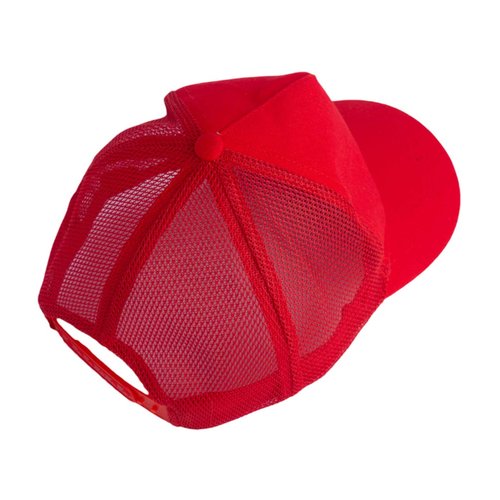
The back of a cap is seen constantly — in a queue, on a shuttle bus, from the row behind at an event — and it is almost always blank. The strap and the area around the closure will take a small embroidery, and a metal buckle can carry a stamped or engraved mark.
This is also the correct home for the element that most often fails on the front panel: a strapline or a URL that measures below the legible minimum when squeezed under a front logo can be set larger, on its own, across the back. The reasons that minimum exists are in minimum letter heights for cap embroidery — but the practical takeaway is that moving text to the back rescues more logos than shrinking it ever does.
The sweatband: the part everyone touches and nobody specifies
The sweatband is the strip of fabric lining the inside bottom edge of the crown. It is the only part of a cap in permanent contact with skin, it is what the embroidery frame clamps onto during decoration, and it is what determines whether the cap is comfortable on a 33 °C afternoon in the Klang Valley.
In our climate, three sweatband properties matter far more than they would in a temperate market:
- Moisture movement. A plain cotton sweatband absorbs and holds perspiration against the forehead. A polyester or blended performance sweatband moves it outward to evaporate. In sustained humidity, absorbency is not a virtue — it is a wet band that stays wet.
- Staining and tide marks. Perspiration carries salts and skin oils. On a pale sweatband, repeated wear-and-dry cycles leave a visible ring, and it shows first at the front where the band meets the crown. This is why a cream or white cap with a matching pale sweatband can look tired after a handful of outdoor days, while the same cap with a dark sweatband still looks new.
- Seam finish. Where the sweatband is joined to the crown there is a seam that sits directly on the forehead. A taped or bound seam disappears; an unfinished one is felt within twenty minutes, which is exactly how long a recipient needs to decide whether they will wear the cap again.
The one-line spec that saves a Malaysian cap order
Add this to your brief: “Moisture-wicking sweatband, in a dark colour regardless of crown colour, with a bound or taped join seam.” It costs almost nothing at the blank-selection stage, it is invisible in the product photo, and it is the difference between a cap that is worn for a season and one that is worn twice. Pale crown, dark sweatband is not a compromise — it is the correct build for a hot, humid market.
The recipients a one-size cap quietly excludes
A Malaysian workforce or event crowd is not the crowd in the catalogue photograph, and a single adjustable cap SKU does not serve all of it equally. Three groups are worth planning for explicitly, because doing so costs nothing at brief stage and is impossible to fix afterwards.
Staff who wear a tudung or headscarf
A cap worn over a headscarf sits higher, needs more strap length, and does not grip the same way. Hook-and-loop is the worst closure here — it catches on the fabric. If a meaningful share of your recipients wear a tudung, two things help: choose a snap or buckle closure with the longest available strap, and offer a second headwear option in the same branding. A branded visor or a bucket hat in the same colourway lets people choose without singling anyone out, and it keeps the whole team visually consistent in photographs.
Crews who also wear a safety helmet
On a site, in a plant or on a logistics yard, a structured cap does not go under a hard hat — it interferes with the helmet’s suspension harness, which is a genuine safety issue and not merely a comfort one. Branded caps for these teams are for off-site and end-of-shift wear, and a low-profile unstructured cap is the sensible build. If the intention is branding that is visible during work, that belongs on the helmet sticker programme, not on a cap.
Children at family days and school programmes
Adult adjustable caps do not shrink to roughly 50–54 cm. If your event has a family component, split a modest allocation into a youth blank. Bucket hats are the more forgiving option here — the fit tolerance is wider and they give real sun coverage, which matters for the reasons set out in the Merdeka and sports-day distribution calendar.
The One-Size Order Checklist
- Confirm the strap range in centimetres, not the phrase “one size”. Ask what the chosen blank actually adjusts between.
- Decide the closure on recipient behaviour, not on look. Kept-and-worn gift → buckle or snap. Handed out at a gate → velcro is defensible.
- Specify a dark, wicking sweatband with a bound seam, whatever the crown colour.
- Allocate for the tails. A youth quantity for family events; a longer-strap or alternative style for tudung-wearing staff.
- Use the back. Put the strapline, URL or year on the strap area rather than crushing it under the front logo.
- Check the closure against the crown. A snapback closure on a soft unstructured crown looks mismatched; a buckle on a flat-peak snapback fights the style. Pair the closure with the construction described in the centre seam that splits a six-panel front.
- Ask for one physical sample before the run and put it on three different heads in your own office. It is the only real sizing test available to you.
Frequently asked questions
Do custom caps really come in one size?
Adjustable caps typically cover about 56–61 cm head circumference, which spans adult small through large. They do not cover the youth range of roughly 50–54 cm, and they run out at the top end around 62 cm. Stretch-fit caps are banded sizes, not one size, and require a size split at order stage.
Which closure is best for a corporate cap order?
For caps intended to be kept and worn, a metal buckle or tuck strap gives precise adjustment and reads as the most considered. For very high-volume crowd giveaways where fit range matters more than longevity, hook-and-loop is the practical choice. Plastic snapbacks suit younger and merchandise-led audiences.
Why do light-coloured caps look dirty so quickly in Malaysia?
Because of the sweatband, not the crown. Perspiration salts and skin oils leave a visible tide mark on a pale band, and in sustained heat and humidity that happens after only a few wears. Specifying a dark, moisture-wicking sweatband keeps a light-coloured cap looking new for far longer.
What is the minimum order and lead time for custom caps in KL?
MOQ is from 200 pieces per design. Production takes 21–45 days after artwork approval depending on quantity, plus around 15 days shipping, with an express 7-working-day route on limited styles and quantities. We deliver across Kuala Lumpur and the rest of Malaysia, invoice with SST and can supply through ePerolehan for government buyers.
Tell us who is wearing them, not just how many
Give us the recipient mix — office staff, outdoor crew, students, families, a mixed roadshow crowd — and we will recommend the closure, the sweatband spec and any secondary style you should run alongside the main cap, then send a free digital mockup within one business day.
Request a free mockup for custom caps KL orders and we will include a sample recommendation you can put on real heads before committing to the run.
WhatsApp +60 10 717 5924 · Send your brief through our contact page
MOQ from 200 pcs · free digital mockup · quote-only pricing · SST invoice · ePerolehan-ready · delivery nationwide across Malaysia