Pencil Case, Toiletry or Document Pouch? The Sizing Brief Malaysian Buyers Get Wrong
Four buyers can send the same three words — “an A5 pouch” — and mean four different products. One wants a flat sleeve a booklet slides into. One wants a boxy toiletry bag roughly A5 in footprint. One wants a pencil case, because A5 is the notebook it will sit next to. One wants a document wallet that takes a folded A4 sheet without creasing. All four are being reasonable. Only one will be happy with what arrives.
Sizing is where pouch orders quietly go wrong, because a pouch is quoted by two flat dimensions and used in three. The gusset, the corner construction and the length of the zip opening decide what actually goes in — and none of those appear in the phrase “20 by 14 centimetres”. This is the sizing conversation we have with clients before we quote: what the four common names really mean in a factory, how gusset geometry converts flat measurements into usable volume, a fit test that takes two minutes, and a seven-line spec sheet you can paste into your next brief.
Short version. Specify three dimensions, not two. State the fattest item that has to go in, not the longest. Say whether the zip runs along one edge or wraps around the corners. Those three lines settle most sizing arguments before they start — and they are the fastest way to shortlist from the styles customised pouch KL buyers choose most often.
Four names, four products: how a brief gets mistranslated
The names below appear most often in Malaysian briefs. The dimensions are typical working references we start from — indicative, and always confirmed on your mockup — but the pattern of misunderstanding is consistent.
| Name in the brief | Typical build | Indicative size | The usual mistake |
|---|---|---|---|
| Pencil case / stationery pouch | Flat or lightly boxed, single zip along the long edge | About 21 x 9 cm, depth 0 to 5 cm | Ordered too short: a 30 cm ruler or a long marker will not lie flat |
| Cosmetic / makeup pouch | Flat with boxed corners, zip along the top edge | About 22 x 15 cm, depth 5 to 7 cm | No depth specified, so a compact and a brush set will not sit side by side |
| Toiletry pouch / travel kit | Fully boxed body, wide zip opening, often a hanging loop | About 24 x 13 x 10 cm | Zip runs along one edge only, so nothing tall goes in upright |
| Document / seminar pouch | Flat, minimal depth, zip wrapping two or three sides | About 34 x 25 cm for A4 | Sized at exactly A4, so paper corners bend every time |
| Tech organiser | Boxed, zip-around, elastic loops on an inner panel | About 26 x 19 x 5 cm | Depth cut to look slim, so a power bank and a plug will not close |
| Waist pouch / belt bag | Curved front panel, adjustable webbing belt | About 33 x 14 cm body, belt to roughly 120 cm | Belt length not stated, so it does not fit every attendee |
That last row matters more than it looks. When we produced 1,000 branded nylon waist pouches for beIN Sports Malaysia’s outdoor event in Petaling Jaya in April 2026, belt adjustment range was part of the specification from the start — an event giveaway that only fits half the crowd is not a giveaway.
Gusset geometry: five constructions and what each one does to capacity
“Gusset” simply means the panel or fold that gives a pouch depth. How that depth is made changes the shape of the space inside, and therefore what fits.
- Flat, no gusset. Two panels sewn together. Depth comes only from stuffing it, and the more you stuff, the more the opening pinches. Right for documents, cards and flat stationery; wrong for anything rigid.
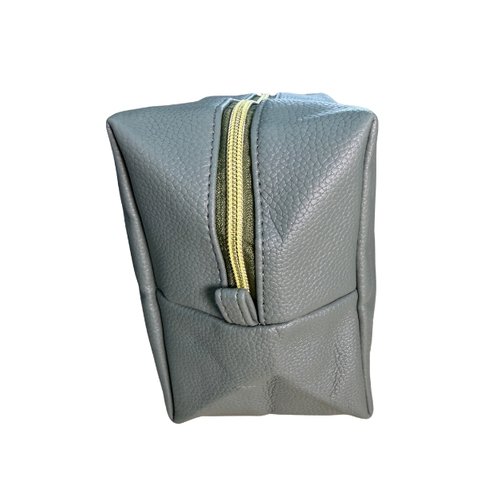
- Boxed corners. A square is cut from each bottom corner of a flat panel and the edges are sewn across. This is the most common cosmetic-pouch build: it stands up, holds shape and still folds flat when empty.
- Full base gusset. A separate strip runs along the base and up both sides. Gives a true rectangular interior and the most predictable capacity — the toiletry-kit build.
- Side gussets only. Concertina folds at each side, base sewn flat. Expands when full, packs slim when empty; good for pouches that must ship flat and be used full.
- Moulded or hard-shell. A formed shell with a zip around it. Fixed volume, maximum protection, no flexibility at all — the interior dimension is the interior dimension.
The boxed-corner rule worth memorising. On a boxed-corner pouch, the square cut out of each corner is half the finished depth. Cut a 3 cm square and you get a 6 cm base; cut 5 cm and you get 10 cm. It also costs you: the finished pouch loses roughly the cut dimension in height and twice it in width. So a 24 x 18 cm flat panel with 4 cm corners finishes at roughly 20 cm tall, 16 cm wide and 8 cm deep. If a supplier gives you a flat size and a depth that do not add up like this, ask which number is the finished one.
Capacity maths, and why a flat pouch is not half a boxed one
For any pouch with a real gusset, usable volume is close to width x height x depth. A 24 x 13 x 10 cm toiletry pouch is about 3,120 cubic centimetres — a little over three litres, which is roughly a shampoo bottle, a wash bag of dental items, a razor and a small towel. A 22 x 15 cm cosmetic pouch with 6 cm boxed corners is about 1,980 cubic centimetres, close to two litres.
A flat pouch does not follow that arithmetic. As it fills, the panels curve, the effective width shrinks and the zip line pulls into a bow. In practice a flat pouch of the same footprint holds noticeably less than the same footprint with a 4 cm gusset, and — more importantly — it holds it in a shape nobody wants: a wedge, thick in the middle, empty at the corners. This is why “just make it bigger” rarely fixes a fit problem. Adding depth fixes it; adding width usually does not.
The two-minute fit test: measure the fattest item, not the longest
Before you sign a size off, put the real contents on a desk and do this. It takes two minutes and it is the single most useful thing a buyer can do at briefing stage.
- Lay out everything the pouch must hold, arranged the way it would sit inside.
- Measure the group at its widest and tallest — then measure the single fattest item separately. That figure is your minimum depth, not an average.
- Add 1 cm to width and height for seam allowance and liner bulk, and 1 to 2 cm to depth if the contents are rigid.
- Identify the longest rigid item. If it is longer than the planned zip opening, you need a wrap-around zip, not a bigger pouch.
- Photograph the layout next to a ruler and send it with your brief. A photograph of the contents settles more sizing questions than a paragraph of description.
Zip opening: the spec that decides whether it opens wide enough
A zip running along one edge gives you a slot. A zip that turns down both sides gives you a mouth. A zip that wraps three sides lets the pouch open flat like a book. Nothing about the outside dimensions tells you which you are getting, and it is the difference between a tech organiser you can actually load and one that fights you every morning.
Our rule of thumb: a rigid item needs a zip opening at least 1 to 2 cm longer than its longest dimension to go in without forcing. Force is what wears closures out, and a pouch that has to be wrestled open every day will fail at the slider long before the fabric shows anything — the pattern set out in the zip is the part that breaks first. Where a wrap-around zip is not possible, the answer is usually a wider gusset rather than a longer body.
The seven-line pouch spec sheet
Paste these seven lines into your next enquiry and every quotation you receive will describe the same product.
| Line | Write something like |
|---|---|
| 1. Finished size | Width x height x depth, and state that these are finished, not flat-cut |
| 2. Construction | Flat, boxed corners, full base gusset, side gusset or hard shell |
| 3. Zip run | Single edge, two-sided, or wrap-around; gauge and slider count |
| 4. Contents | The actual list, plus the fattest single item and its measurement |
| 5. Lining | Unlined with bound seams, self-lined, or a named wipe-clean film |
| 6. Branding | Method, number of positions, and the approximate print size you want |
| 7. Packing | Loose in cartons, individually bagged, or pre-kitted into a gift box |
Line five is worth taking seriously if the pouch will hold anything that can spill; the case for adding a wipe-clean liner to a cosmetic pouch is largely a case about how the gift looks in month six. Line six is where sizing meets artwork, because a smaller pouch means a smaller usable panel once the print placement around seams and zips is taken into account.
When the pouch is the insert inside a bigger gift set
A large share of pouches we produce never leave the warehouse on their own. They go inside a Hari Raya hamper, a year-end appreciation box, a new-hire welcome kit or an event delegate bag. That changes three things in the specification.
- Measure the box interior, not the box. A rigid gift box with a foam insert loses a centimetre or more per side. Give us the internal cavity dimension and we will size the pouch to it.
- Decide flat or stuffed before packing is quoted. A boxed pouch shipped flat and folded takes a fraction of the cube of the same pouch packed open. Flat is cheaper to ship and slower to hand out; pre-stuffed presents better and costs more to store.
- Kitting is a separate operation. If the pouch has to arrive already filled with other items, that is assembly labour with its own timeline, and it needs to be agreed at quotation stage rather than discovered in the final week.
Timings are the same as the rest of our pouch work: minimum from 200 pieces per design, production 20 to 30 working days after artwork approval depending on quantity, plus roughly 15 days shipping, and express runs of 10 working days on limited styles and quantities. If the pouch is a component in a larger set, work backwards from the date the whole set has to be assembled, not the date the pouches have to arrive.
Frequently asked questions
What size pouch fits an A4 document?
Allow a margin around the paper rather than matching it exactly. A4 measures 21 by 29.7 cm, so a document pouch of roughly 34 by 25 cm lets sheets and a slim folder go in and out without bending the corners. If a notepad or tablet goes in too, add depth with a narrow side gusset rather than making the body larger.
What is the difference between a cosmetic pouch and a toiletry pouch?
Depth and opening. A cosmetic pouch is usually a flat body with boxed corners and a zip along the top edge, sized for compacts, brushes and small items. A toiletry pouch has a full gusset, a wider opening and often a hanging loop, because it has to take bottles standing upright. The same footprint in the two builds holds very different things.
How do I work out how much a pouch holds?
For a gusseted pouch, multiply width by height by depth in centimetres and divide by 1,000 for litres. A 24 by 13 by 10 cm toiletry pouch is roughly three litres. Flat pouches do not follow the formula, because the panels curve as they fill and the corners stay empty — assume noticeably less than the arithmetic suggests.
Can you make a pouch to a size we specify?
Yes. Custom sizes and gusset shapes are made to order from your pattern or from a sample you send us, with a digital mockup confirming the finished dimensions before production. Tell us the contents and the packing format and we will propose a size rather than asking you to guess one.
Send a photo of the contents, and we will size it for you
Photograph everything the pouch must hold next to a ruler, tell us the quantity and the handover date, and we will reply with a recommended size, construction and a free digital mockup, usually within one business day. Minimum from 200 pieces per design, nationwide delivery across Kuala Lumpur and the rest of Malaysia, SST invoicing and ePerolehan-ready documentation. Aquaholic is a Singapore-based corporate gifting specialist since 2003, now serving Malaysia.
Ready to start from a stock body? Customise pouch sizes and gussets with our team and we will confirm the finished dimensions on the mockup.
WhatsApp +60 10 717 5924
Send your brief
Aquaholic Gifts Malaysia · AS80, Jalan Hang Tuah 4, Taman Salak Selatan, 57100 Kuala Lumpur