A Wet Wipe Is Not a Tissue: Seals, Formats and Honest Labels for Malaysian Giveaways
Buyers choose a wet wipe pack the way they choose a tissue pack, because the two sit side by side on the same quotation. Then the wipes go into handbags, and three weeks later somebody opens one and the top wipe is dry. Nothing was wrong with the wipe. The pack stopped closing.
A wet wipe pack looks like a tissue pack wearing the same badge — a soft printed package, a similar size, a similar handout job — but it is a different product with a different failure mode. A tissue pack is paper in a wrapper, and the wrapper only has to stay shut. A wet wipe pack is a liquid-loaded cloth inside a package whose entire job is to stop that liquid leaving. When it fails, it fails silently, and the person holding it blames the brand printed on the front.
This is what our team looks at before recommending wipes over dry tissue for a Malaysian campaign: the seal and how to test it, what alcohol and non-alcohol formats each suit, what a label may and may not say, and how to choose between the two formats for a specific event.
Two products, one badge
| Dry tissue pack | Wet wipe pack | |
|---|---|---|
| What is inside | Folded tissue, usually 2-ply or 3-ply | A nonwoven cloth carrying a water-based solution |
| What the package must do | Keep the block clean and folded | Hold moisture in and keep contamination out, for the whole life of the pack |
| How it fails | Sheets tear or the block gets crushed | The pack dries out, leaks in a bag, or will not reseal after the first opening |
| Reclosure | Not required — a torn wrapper still works | Essential. The reseal is the product’s working part |
| Typical setting | Mass handouts, roadshows, counters, tables | Food-related events, clinics and reception areas, travel and welcome kits, family audiences |
| What a buyer should specify | Ply, sheet count, unfolded sheet size | Wipe count, wipe size, substrate weight, solution type, closure type |
The two formats compared on the points that actually decide satisfaction. Everything below follows from the second and third rows.
If your requirement is genuinely about paper — hands at a hawker stall, tables at a dinner, a giveaway by the thousand — the honest answer is often dry tissue, and the questions to settle are then the ply and sheet spec that decide how a dry pack feels rather than anything on this page.
The reseal is the product
Every wet wipe pack is opened, used and put back into a bag. What happens at that moment decides whether the pack survives a week. There are three common closures and they behave very differently:
- The adhesive sticker flap. A printed label peels back over an opening in the film and presses down again. Cheap, light and perfectly good — until the adhesive picks up lint from a handbag, or the flap is peeled back at an angle a few times too many. Adhesive fatigue is the normal end-of-life for these packs, and it usually arrives well before the wipes are used up.
- The hinged plastic lid. A moulded frame welded to the pack with a click-shut lid. Heavier, more expensive, and by far the most reliable reseal. It also gives the pack a rigid face, which changes how the artwork sits.
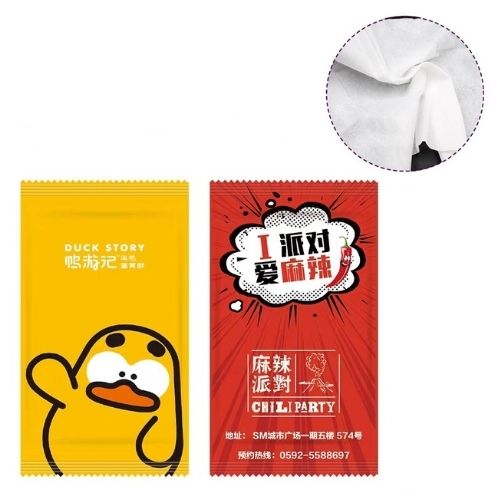
- The single-use sachet. One wipe, one sealed sachet, no reseal problem at all. Ideal for handing out at a counter, inserting into a kit or placing on a table setting, and the format where the printed surface is smallest and simplest.
The first opening matters too. Many packs use a die-cut opening under the label rather than a tear; if the film tears untidily on the first open, the flap has nothing flat to re-adhere to and the reseal is compromised from the start. That is a sample-stage observation, not something you can read off a datasheet.
Alcohol or non-alcohol
This is a suitability decision, not a quality ranking. Both formats are widely used in Malaysian corporate giveaways and each fits a different brief.
Alcohol-based wipes evaporate quickly and leave surfaces dry, which is why they suit hands before a meal, hard surfaces such as trays and handles, and situations where nobody wants a residue. The trade-offs are practical: they are drying on skin with repeated use, they are not the right choice for small children’s faces, they can affect coated or painted surfaces and some screens, and the volatile solution puts more demand on the pack’s barrier and seal. Non-alcohol wipes are gentler and more comfortable on skin and faces, which is why they dominate family, education and hospitality settings, and why they are the usual choice where a pack will be used repeatedly through a day.
One practical note: ask which format your audience will actually use in front of your logo — a wipe that stings a child’s face at a family day is a brand impression you did not budget for.
What the label may say, and what it may not
This is the part of a wet wipe brief that needs a conservative hand, and it is worth separating cleanly from the design conversation.
Branding is what you own; performance wording is what the product owns. Your logo, campaign line, colours and contact details are yours to place anywhere on the pack. A statement about what the wipe does to germs, bacteria or viruses is not decoration — it describes the product, and it changes what the product is taken to be. In Malaysia, anything presented as antibacterial, disinfectant, sanitising or protective against illness sits in a regulated space, and whether such wording may be used depends on the product and its registrations rather than on the printing.
None of this makes wipes a difficult product to buy. It makes the label a two-line question to settle at briefing rather than a discovery at proofing stage, which is when it usually surfaces.
Drying out is a packaging problem, not a mystery
A wet wipe pack loses moisture through two routes: the closure, and the film itself. A good pack uses a barrier film that resists moisture transmission and a seal that is continuous; a cheap pack economises on both, which is why the wipes at the top of the stack — the ones nearest the opening — are always the first to feel dry.
What you can control is straightforward. Keep cartons closed and out of direct sun and heat until handover — a car boot in the afternoon is the worst storage in Malaysia and the most commonly used. Do not open cartons early to count them and then leave them open. Store packs flat rather than on edge, so the wipe stack stays in contact with the solution.
Tissue or wipes for this event?
| Scenario | Usually the better fit | Why |
|---|---|---|
| Mass roadshow handout, thousands of pieces | Dry tissue pack | Lowest cost per pack, no reseal to fail, and the format people expect from a street handout. |
| Restaurant or café table service | Wet wipes, single sachet | One wipe per cover, no shared pack, and the sachet doubles as a place for your logo on every setting. |
| Clinic, dental or reception counter | Wet wipes, resealable | Hands and surfaces between visitors, and a pack that stays on the counter needs to close properly. |
| Corporate gift set or hamper insert | Either, at the higher spec | The pack is being judged in the hand, so 3-ply tissue or a lidded wipe pack earns its place. |
| Family day, school or community event | Wet wipes, non-alcohol | Faces and small hands, repeated use, and a gentler solution is the safer default. |
| Outdoor event in the heat | Both, deliberately | Dry tissue for sweat and spills, wipes for hands before food — and a stated storage plan for the wipes. |
A quick fit table for Malaysian events. Where two formats both work, the decision usually comes down to whether the pack is being handed out or kept.
Where both belong in the same campaign, run them as two separate items with two separate quantities rather than trying to split one run. Each design carries its own set-up, which is the argument set out in the 1000-pack minimum and where the set-up cost goes.
What to fix before anyone quotes
- Closure type — sticker flap, hinged lid or single sachet. This decides the pack’s real lifespan and a large part of its cost.
- Wipes per pack and wipe size, unfolded. As with dry tissue, the unfolded size is what the recipient judges.
- Substrate and solution. Nonwoven weight and whether the solution is alcohol-based or not, stated in writing.
- Fragrance or unscented. Unscented is the safer default for mixed corporate audiences.
- Label wording, with any product claim confirmed in writing by the supplier before artwork approval.
- Quantity and date. 1000 packs per design is the floor; production runs 21–45 days after artwork approval plus around 15 days shipping, with express at 10 working days on limited models.
Artwork sits on top of all of that. A wipe pack with a hinged lid has a rigid frame interrupting the printed face, and a sachet is a tiny canvas, so the rules for printing on a soft, semi-transparent pack apply here with even less room for detail. If you are still deciding between formats, the full range of branded wet wipes Malaysia buyers order alongside pocket tissue is the quickest way to see what each one looks like before you commit.
Questions buyers ask us about branded wet wipes
Can the pack carry a germ-kill percentage?
Not on our recommendation. A figure of that kind describes product performance rather than your brand, and wording of that type sits in a regulated space in Malaysia. Ask the supplier to confirm in writing which wording the specific product supports, before artwork approval, and print only what comes back. A pack carrying identity artwork alone is always publishable.
Are wet wipes suitable for children and family events?
A non-alcohol, unscented wipe is the usual choice for family, school and community audiences because it is gentler on skin and faces with repeated use. Ask for the product specification in writing and avoid printing any medical or protective wording on the pack.
How long will a pack stay moist?
That depends on the barrier film, the integrity of the seal and how the packs are stored — not on a number a printer can promise. Specify a good closure, keep cartons sealed and out of heat until handover, and test a sample with the ten-open check before committing to a full run.
What is the minimum order for branded wet wipes?
1000 packs per design, the same floor as printed tissue packs, because the same fixed set-up has to be paid for once whatever the run length. Tell us the closure type, wipe count and audience and we will recommend a specification.
Tell us the audience and the setting — we will recommend the format
A corporate gifting specialist based in Singapore since 2003, now serving clients across Malaysia from Kuala Lumpur. Send the event, the audience and the quantity and we will come back with a recommended format, closure and specification, a free artwork mockup, and a clear note of anything that must be confirmed in writing before printing. Minimum order 1000 packs per design, production 21–45 days after artwork approval plus around 15 days shipping, express 10 working days on limited models. Nationwide delivery, SST invoicing, ePerolehan-ready paperwork.
Start here: sanitiser wet wipes custom Malaysia and tissue formats, message us on WhatsApp at +60 10 717 5924, or use the contact form.
Aquaholic Gifts Malaysia · AS80, Jalan Hang Tuah 4, Taman Salak Selatan, 57100 Kuala Lumpur