Flat in Six Months: Custom Cushion Fill, Loft and the Recovery Test (Malaysia)
The cushion that photographs beautifully in week one and looks like a folded envelope by month six is almost never a printing failure. It is a fill failure — and the specification that would have prevented it is the one line nobody puts in the brief: fill weight, in grams.
Cushion briefs specify the same four things: size, cover fabric, print method and quantity. A brief says “40cm square, polyester, full-colour print, 300 pcs” and considers itself complete. Two suppliers can both quote that honestly and deliver cushions that feel like different products — because a cushion is not a printed cover. It is a printed cover wrapped around a quantity of fill, and that quantity is invisible on a quote.
This article is about the inside: what each fill does when a person sits on it daily for half a year, how to write a fill line so quotations become comparable, and a timed load-and-recover test to run on a sample before you approve 300 pieces.
The line missing from almost every cushion brief
Cover size gives you the outline. Fill weight gives you the object. A 40cm cover can be filled to a taut, upholstered block or to a limp pouch, and both are “40cm square”. The difference is measured in grams, and it is the most reliable predictor of whether a recipient still has the cushion a year later.
A second number rarely gets written down either: insert oversize. A well-made throw cushion uses an insert slightly larger than the finished cover, so the fill is under mild compression and pushes the cover taut into the corners. Skip it and you get the “dog-eared” look — a plump middle and four flat, empty corners. That geometry also moves your artwork, which is why how a design distorts once the cover is stuffed deserves its own conversation.
| Format | Typical finished size | What the fill line should state | What happens if it is left blank |
|---|---|---|---|
| Throw / sofa cushion | 35–45cm square | Fibre type + grams per piece + insert oversize | Under-filled corners, visible cover creasing at the seams |
| Seat / chair pad | 40 × 40cm, 4–8cm thick | Foam density in kg/m³ + thickness + firmness | Permanent dent under the sitter within months |
| Neck / travel pillow | U-shape, 28–32cm across | Moulded foam grade, or bead volume and fill ratio | Too soft to support the head, or too rigid to be used |
| Bolster / long cushion | 80–105cm long | Grams per piece and whether the fill is baffled | Fill migrates to the ends and leaves a hollow middle |
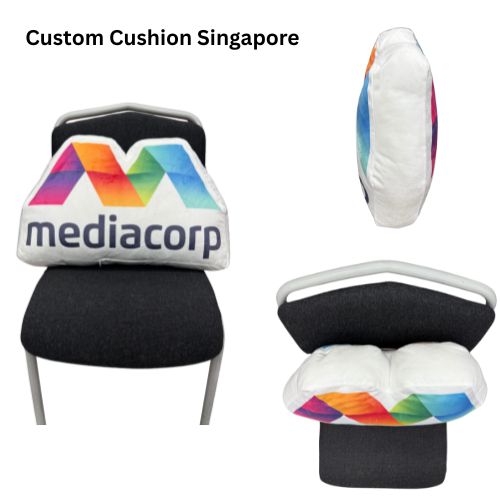
| Shaped / mascot cushion | Varies by artwork | Grams per piece plus fill by zone (limbs vs body) | Floppy extremities on an otherwise firm body |
Exact fill weights are confirmed on your approved pre-production sample, not assumed from a catalogue.
Long formats are the most exposed, because gravity works along the length. If you are looking at custom bolster Malaysia fill specifications, whether the fill is baffled into sections or free to travel matters more than anything printed on the outside.
Four fills, four completely different ways of going flat
“Foam or fibre?” is where most fill conversations start and stop. Each family fails in its own way, on its own timescale, and the failure mode should drive the choice — not the feel in the showroom.
Polyester fibre — the default, and the most variable
Loose polyester fibre is the standard fill for throw and printed cushions, and the one with the widest quality spread — the term covers everything from virgin hollow conjugate fibre with a silicone finish down to regenerated fibre recovered from waste. The good grade is springy and separates again after compression. The cheap grade is straight, matte staple fibre that tangles into felted lumps the first time it is compressed and damp.
Three words change what you receive. Hollow means a channel down the fibre’s centre, giving loft for less weight. Conjugate means spiral-crimped, so it springs back rather than lying flat. Siliconised means coated, so strands slide past each other instead of gripping and matting. Ask for hollow conjugate siliconised fibre by name — it is a grade a supplier either stocks or does not.
Shredded foam — heavier, moulds to the body, holds moisture
Shredded foam is offcut polyurethane chopped into chunks. It feels denser and more supportive than fibre and conforms to whatever leans on it, which is why it appears in lumbar and reading cushions. The trade-offs are weight, lumpiness where chunks are coarse, and a real drying problem in Malaysian conditions.
Moulded memory foam — no lumps, but a firmness that is fixed forever
Moulded viscoelastic foam is a single block, so it cannot clump, migrate or develop hollows. It suits seat pads and neck pillows, where a consistent shape is the whole point. Two numbers govern it: density in kilograms per cubic metre, which predicts how long it lasts, and indentation force, which is how firm it feels. They are independent — a dense foam can feel soft and a light foam firm — so one number without the other tells you nothing. It is also temperature-sensitive, softening in a warm room, which matters when the room is a KL office late in the afternoon.
Microbeads — novelty feel, and the shortest honest lifespan
Expanded polystyrene microbeads give the flowing, sand-like feel used in travel pillows and novelty cushions. They are very light and do not clump. What they do is crush: beads fracture under repeated loading and the pillow loses volume with no way to top it up. They also need a stretch knit outer and a tightly stitched inner bag — a seam failure on a bead cushion is not a repair, it is a floor covered in beads.
| Fill | Spec to quote it by | How it fails after six months of daily use | Best fit |
|---|---|---|---|
| Hollow conjugate siliconised fibre | Grams per piece | Gradual loft loss; recovers most of it if fluffed | Printed throw cushions, gift-with-purchase |
| Plain staple polyester fibre | Grams per piece | Felts into hard lumps; fluffing no longer works | Short-life display and photo props only |
| Shredded foam | Grams per piece + chunk size | Chunks compact toward the base; surface goes uneven | Lumbar and back-support cushions |
| Moulded memory foam | Density in kg/m³ + indentation force | Thins permanently under the load point if density is low | Seat pads, neck and travel pillows |
| EPS microbeads | Fill volume + fill ratio of the bag | Beads fracture; volume drops and cannot be restored | Novelty and travel formats, lightweight shipping |
What “going flat” actually is
Three mechanisms get lumped under one complaint, and they have different remedies.
Loft loss is the fibre crimp straightening under repeated compression. The cushion is thinner but still soft, and a vigorous shake restores part of it. Felting is fibres matting into dense pads — thinner and hard in patches, and no amount of fluffing helps. Heat and moisture accelerate it. Compression set is the foam equivalent: cell walls collapse permanently and the block never returns to its original thickness. Low-density foam sets fast under a body; higher-density foam takes far longer.
The load-and-recover test: 24 hours, no equipment
A squeeze in the hand tells you almost nothing, because a hand applies the wrong load in the wrong direction for the wrong length of time. A cushion is loaded by a whole body, over a broad area, for hours. Here is the test we ask buyers to run on the pre-production sample.
The 1-minute load, 24-hour recovery test
- Measure baseline height. Stand the cushion on a flat table and record the height at the centre in centimetres.
- Load it properly. Sit on it, centred, for a full 60 seconds.
- Read at 30 seconds. Stand up, wait, measure again. Good hollow conjugate fibre and decent memory foam are visibly close to baseline already.
- Read at 10 minutes. The honest number for a fibre cushion. Still obviously short of baseline means the fill weight is too low or the grade is poor.
- Read at 24 hours, untouched. Do not fluff it. Whatever height it has now is what it settles at in service — the gap from baseline is your six-month preview.
- Then feel for lumps. Run a flat palm across the face. Any ridge, void or hard patch on a new sample will be worse after 300 pieces have been through a courier network.
Run the same test on a compressed arrival and a loose one and you will see why what compressed shipping does to a fibre-filled cushion belongs in delivery planning. If the sample was washed before testing, read the result against whether the cover should come off for washing — a laundered insert and a fresh one are not the same object.
The four-line fill spec
Add these four lines and every quotation becomes comparable on the same basis. They remove the largest hidden variable in a cushion order.
| Line | Write it like this | Why it protects you |
|---|---|---|
| 1. Fill type by grade | “Hollow conjugate siliconised polyester fibre” | Rules out the felting-prone cheap grade by name |
| 2. Fill weight per piece | “Confirm grams per cushion on the approved sample” | Locks bulk production to the sample you signed off |
| 3. Insert oversize | “Insert larger than the cover on both dimensions” | Kills the empty-corner look before it happens |
| 4. Tolerance you will accept | “State the ± grams tolerance per piece” | Stops the last cartons feeling thinner than the first |
Match the fill to the life the gift will have
A mall-activation giveaway and a seat pad issued to a contact-centre floor are the same product category and completely different engineering briefs. For a retail giveaway that will be photographed and carried home, well-graded fibre at a generous fill weight gives the best perceived value per gram. For anything sat on daily — office chairs, prayer rooms, waiting areas, driver seats — only moulded foam at a sensible density survives. Travel formats change again: the fill must hold a shape against the head, not a load from above. And for festive door gifts at Hari Raya, Chinese New Year or Deepavali, the taut, well-filled face does most of the work in the first three seconds.
How fill decisions land on the production calendar
Fill is not a last-minute switch — fibre grade and foam density are bought in, so a change after artwork approval can push the schedule. Our cushion timeline: minimum 300 pcs, production 21–45 days after artwork approval depending on quantity and format, plus roughly 15 days shipping; express production of 10 working days on limited models and quantities. Build the sample test into the front of that timeline.
Questions buyers ask about cushion fill
How do I know if a cushion is under-filled without cutting it open?
Hold it by one corner and let it hang. A properly filled cushion keeps its shape; an under-filled one droops and collapses into folds. Then run the 24-hour recovery test — the gap from baseline is the clearest signal you will get without opening a seam.
Is memory foam always better than fibre?
No. It is better where a fixed shape and support matter — seat pads, neck pillows, lumbar supports. For a decorative throw cushion it is heavier, warmer against the body in a tropical room, and it removes the plump, squashable character people want from a sofa cushion. Choose it for function, not as a general upgrade.
Can we mix fills across one order?
Yes — one order can run a fibre-filled throw cushion for the mass giveaway and a foam seat pad for a smaller tier, provided each specification is sampled separately. The minimum order of 300 pcs applies per design, so plan the split at briefing.
Does a heavier fill always feel better?
Up to a point. Overfilling makes a cover rigid, strains the seams and stretches the print across the face. The target is a taut, wrinkle-free face with full corners while the centre still yields under a palm — a judgement made on a physical sample, which is why we send one before bulk.
Tell us how the cushion will be used, and we will spec the inside
A corporate gifting specialist based in Singapore since 2003, now serving clients across Malaysia from Kuala Lumpur. Send the format, the occasion and where the cushion will live, and we will return a fill specification you can hold a supplier to, plus a free digital mockup. Minimum 300 pcs, production 21–45 days after artwork approval plus around 15 days shipping, express 10 working days on selected models. Nationwide delivery, SST invoicing, ePerolehan-ready documentation.
Brief a logo cushion supplier for custom cushions Malaysia, message us on WhatsApp at +60 10 717 5924, or use the contact form.
Aquaholic Gifts Malaysia · AS80, Jalan Hang Tuah 4, Taman Salak Selatan, 57100 Kuala Lumpur