The Die Is the Product: How a Cutting Die Sets Your Piece Count, Your Minimum and Your Set-Up
Ask a puzzle supplier for a 750-piece puzzle and you will be offered 500 or 1,000. Not because nobody wants to help you, but because piece count is not a setting somebody types into a machine. It is a physical steel tool that already exists, or has to be built. Once you understand that the die is the real product — the printed image is almost the easy part — every other decision on a custom puzzle order falls into place: why the minimum exists, why a custom outline carries a set-up, why the finished size and the piece count are decided together, and why two identical-looking quotes can behave completely differently.
This article explains how a puzzle cutting die works, what it locks in, what it leaves free, and how to choose between a 300-piece and a 1,000-piece build for a corporate recipient who almost certainly has less table space than you think.
What a puzzle cutting die actually is
A puzzle die is a steel-rule die. Thin strips of hardened steel are bent into the interlocking pattern of the puzzle — every knob, every socket, every straight edge — and set blade-up into slots cut through a rigid base. Between the blades sits ejection rubber, compressed on the down-stroke, which pushes the cut board back out so it does not jam in the tool.
The board — your printed sheet laminated onto a greyboard core with a backing sheet behind it — is fed under a press, and the whole pattern goes through in a single stroke. Not a laser tracing a path, not a blade following a file. One tool, one hit, the entire puzzle at once. That single fact generates every constraint in this article.
Building the tool is skilled, slow work: the pattern is drawn, the base is slotted, hundreds of metres of rule are bent and seated, the rubber is fitted, and the die is trialled and adjusted until it cuts cleanly across its whole area. A factory therefore keeps a library of dies in the standard formats and piece counts and reuses them across thousands of jobs. Anything outside that library is new tooling, with its own cost and its own lead time.
One die means one set of piece shapes
Every puzzle cut on a given die has exactly the same piece shapes in exactly the same positions. Two puzzles from the same die are interchangeable piece for piece: the third piece down on the left of yours will drop straight into the same slot on your colleague’s. This is not a shortcut, it is how the whole industry works, and it has two consequences worth knowing before you place an order.
The first is that “unique piece shapes” is a marketing line rather than a manufacturing reality on any run at corporate volume. What makes your puzzle distinctive is the printed image, the finished size, the outer shape and the packaging — not the geometry of the knobs.
The second is a practical warning we give every buyer planning a family day or a build-it-together activity. If a room full of people open identical puzzles at the same time on shared tables, pieces migrate, and because they genuinely fit anywhere the mix is invisible until somebody gets to the end and finds a piece with the wrong bit of picture on it. If your puzzle is going to be built communally, give each table a physically separated tray or lid to work in, and hand the puzzles out in their bags rather than pre-tipping them.
What the die fixes, and what stays free
This is the table we would hand any buyer at briefing stage. The left column is decided the moment a die is chosen and cannot be revisited without new tooling. The right column can change up to the day artwork is approved, and in some cases per individual unit.
| Decision | Locked by the die? | What it means for your brief |
|---|---|---|
| Piece count | Locked | Choose from the standard counts, or pay for tooling |
| Finished size and proportions | Locked | Crop your artwork to the die’s aspect ratio, not the other way round |
| Piece shapes and grid | Locked | Identical across the whole run; plan communal builds accordingly |
| Outer shape (rectangle or custom outline) | Locked | A logo-shaped puzzle is a tooling decision, taken first |
| The printed image | Free | Change it late, and vary it across the run where the print method allows |
| Number of different designs in one order | Free | Split a run by department, branch or festive greeting at no tooling cost |
| Box, bag and gift packaging | Free | Decided separately, and it matters more than most buyers expect |
| Quantity above the minimum | Free | Scaling up spreads the set-up; scaling down does not remove it |
Why the die is the reason there is a minimum
Every puzzle order carries a block of work that happens exactly once regardless of how many you order. The artwork is imposed onto the sheet layout. The press is made ready — the die is mounted, packing is adjusted, and sheets are pulled and checked until the printed image sits inside the cut pattern within tolerance. Laminating is set up and the first boards are trialled for adhesion. Only then does the run proper begin.
That block is identical for a small order and a large one, which is why custom piece counts and die-cut outlines come with a minimum order — ours is from 300 pcs — rather than being available one at a time. It is also why the per-unit position improves noticeably as the quantity rises: you are dividing the same fixed set-up across more finished puzzles. Nothing about the minimum is arbitrary; it is the point at which the make-ready stops dominating the job.
The same logic explains the timeline. Production runs 21–45 days after artwork approval depending on quantity, plus around 15 days for shipping; an express route of 10 working days exists on limited styles and quantities, and it exists precisely because it uses a die and a format that are already set up.
Custom outlines: when new tooling earns its place
The outer boundary of the puzzle is part of the same die as the interior cuts, so a puzzle shaped like your product, your mascot or the outline of a state is a new tool. It is a genuinely striking gift and it is the one case where tooling is usually worth it — a shaped puzzle is instantly recognisable on a desk, and no competitor can produce the same object.
Three design constraints come with it. Steel rule can only be bent so tightly, so internal corners need a small radius rather than a sharp point. Any spike or tail narrower than a single piece will snap off in handling, so thin projections have to be thickened or absorbed into the silhouette. And the shape must still tile sensibly into interlocking pieces at the edges — a very complex outline produces fragile boundary pieces with almost no interlock left. Send the outline as vector artwork early, because it is the first thing that has to be resolved and the last thing you want to change after tooling starts.
300-piece or 1,000-piece? Choose the recipient’s table
Piece counts here refer to pieces inside the box, not to how many puzzles you order — a distinction worth stating plainly, because the two numbers get confused in almost every briefing conversation we have.
The instinct is that more pieces means a more generous gift. For a corporate recipient it often means the opposite. A larger puzzle needs a surface it can occupy uninterrupted for days, and in a Klang Valley condominium the only such surface is the dining table the household actually eats at. A 1,000-piece puzzle given to someone without a spare table is not a challenge, it is an imposition, and it stays in the box.
| Format | The build it asks for | Space it needs | Corporate fit |
|---|---|---|---|
| Mini / pocket | Minutes, in one sitting | A desk or a tray | Roadshows, mass giveaways, children’s programmes |
| 300-piece | One evening, start to finish | Half a dining table, cleared the same night | Family day, CSR, staff gifts, anyone with children |
| 500-piece | A weekend, in two or three sessions | A table it can stay on for two days | The safe default for an adult recipient |
| 1,000-piece | A week or more, as a project | A dedicated surface roughly a metre across | Known enthusiasts and landed-home recipients only |
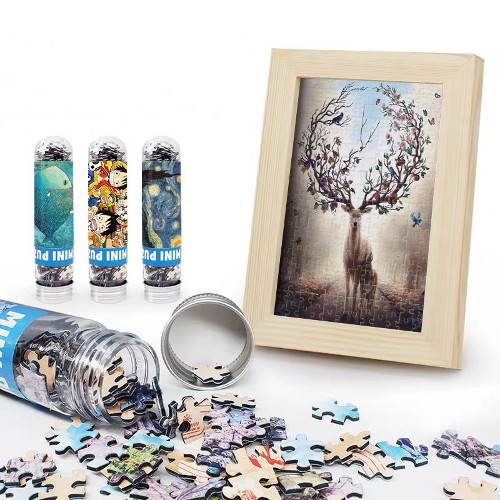
If you cannot answer the space question for your list — a mixed distribution of head-office staff, dealers and government stakeholders, say — the honest answer is that a proportion of them will never build it at all. That is not a reason to abandon the idea; it is a reason to consider the framed puzzle format for recipients who will never build it, which delivers the same image as something that gets hung rather than shelved.
Reading the die’s condition on your sample
Steel rule dulls with use, and a tired die is visible in the finished product if you know where to look. As a Singapore-based corporate gifting specialist working since 2003 and now serving Malaysia, this is the check our team runs on every first sample before it goes to a client. It takes a minute and it tells you more about a factory than a specification sheet does.
- Edge quality. Cut edges should be clean and slightly compressed, not furry. Fibre lifting along the cut means blunt rule.
- Release. Pieces should separate with light pressure and no tearing of the printed face. Pieces that cling together were not cut fully through.
- Knob strength. Flex a piece gently at the neck of a knob. It should not delaminate or crack — the neck is the weakest point on any puzzle.
- Fit. Joined pieces should hold when the assembled corner is lifted a centimetre off the table. Loose fit means the pieces will drift apart while the picture is being built.
- Registration. Check that the image sits square inside the outer boundary and that the margin is even on all four sides.
Registration is worth checking against your own file rather than by eye alone, which is one more reason to complete the artwork resolution check we run before cutting at mockup stage, while changes are still free.
Piece count questions we get asked
Can I order an exact piece count like 750?
Only if a die exists in that count or new tooling is commissioned. Piece count is set by the physical cutting tool, so in practice you choose from the standard formats — minis, a few hundred pieces, 500, 1,000 and above. Tell us the experience you want and we will match it to an available die.
Do all the puzzles in my order have identical piece shapes?
Yes. Every puzzle cut on the same die shares the same shapes and grid, so pieces are interchangeable between units. Plan communal builds with separate trays so pieces from different boxes do not mix.
Is a custom-shaped puzzle much slower to produce?
It adds a tooling stage before production starts, so confirm the outline as early as possible and expect the longer end of the 21–45 day band. Send vector artwork for the shape, keep internal corners rounded and avoid projections narrower than a single piece.
Tell us the experience, we will find the die
Describe who is receiving the puzzle and how long you want them to spend on it, and we will match it to an available format, confirm the finished size and send a free digital mockup, usually within one business day. Browse the full jigsaw puzzle range to see the styles first. Minimum order from 300 pcs, nationwide delivery, quote-only with an SST invoice and ePerolehan-ready documentation.
WhatsApp our team on +60 10 717 5924 · Send your brief through the contact page
AS80, Jalan Hang Tuah 4, Taman Salak Selatan, 57100 Kuala Lumpur