Three Tips, a Spring and a Magnet: An Honest Look at Clever Cable Formats
Three formats dominate the clever end of the cable catalogue: the 3-in-1 with a tip for every port, the retractable that winds itself away, and the magnetic one where the tip lives in the phone. All three demonstrate beautifully at a roadshow. All three are compromises, and each fails in a way that is specific to its own cleverness.
This is an honest assessment of the three, written from the supplier’s side of the table rather than the catalogue’s. The principle underneath it is simple: a plain cable has two joints, and every clever format adds more. Whatever is added sits in the load path, in the current path, or both. Knowing where the added part sits tells you exactly how the cable will die, and that is the useful basis for choosing between the 3-in-1 charging cable Malaysia event teams reach for and something plainer.
The 3-in-1 and multi-tip cable
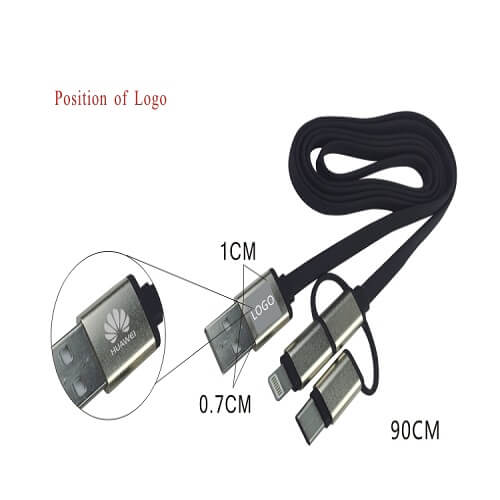
A multi-tip cable puts USB-C, Lightning and Micro-USB on one lead so that one giveaway suits everybody. For a public audience where you cannot know what people carry, that argument is genuinely strong, and it is why these are the most popular corporate cable in the market.
They come in two builds, and the difference matters more than the tip count.
- Moulded pigtails. Two or three short branches come off a junction near the device end, each ending in a fixed connector. Nothing can be lost. The unused tips dangle.
- Detachable adapters. One connector, usually USB-C, with small slip-on adapters that convert it. Tidier in the hand, and the adapters are the first thing to disappear into a drawer.
Why the tip is where it fails
Three reasons, all mechanical. First, every tip is a second connector in series with the main plug, so a three-tip cable has roughly twice the number of terminations that can go intermittent. Second, on a pigtail design the junction moulding is stiff and the branches are short, so all bending concentrates in a couple of centimetres of unsupported cable — the same concentration effect described in strain relief and the bend-cycle number suppliers quote, but repeated three times over. Third, and least expected: while the cable is plugged in, the two unused tips hang off the junction and swing, levering the connector that is doing the work every time the phone moves.
Which build to choose comes down to whether anyone will look after the product. For a mass door gift handed to three hundred strangers, moulded pigtails win: nothing can be separated from the cable, so nothing can be lost, and the slightly untidy look is a fair price. For a smaller, boxed gift to a client list, detachable adapters look and feel better in the hand, and the packaging can hold the spare tips in a moulded tray so they stay together for the first few months at least.
There is an electrical compromise as well. The host end of most multi-tip cables is a USB-A plug, which cannot negotiate USB Power Delivery, and the conductors branching to three tips are rarely generous. Many are charge-only. Most will charge only one device at a time regardless of how many tips are attached, which surprises the recipient who tries to charge a phone and earbuds together at a desk. The mechanics of that are in wire gauge, length and the fast-charge chain.
The retractable cable
Retractables solve a real problem — a cable in a bag becomes a knot — and they solve it well for about as long as the mechanism lasts.
What is actually inside
Four parts, and none of them exist in a plain cable:
- A spool carrying the conductor, which is usually a flat ribbon rather than a round cable, because only a flat conductor winds neatly into a shallow housing.
- A coil spring wound against the spool, storing energy as you pull the cable out.
- A locking mechanism, typically a pin riding in a heart-shaped cam groove — the same principle as a retractable pen. Pull, and it catches. Pull again, and it releases.
- A fixed short pigtail on the opposite side of the housing, or a set of sliding contacts, to get the current off a rotating spool.
The failure sequence
These do not fail all at once. They degrade in a recognisable order, and if you have a sample for a week you can see the beginning of it.
| Stage | What the user notices | What has happened |
|---|---|---|
| 1 | The cable no longer locks at every length, only at some | The cam groove has worn and the pin skips past catch points |
| 2 | It has to be pulled fully out and released to retract | The spring has taken a set and no longer returns the last section |
| 3 | It retracts crookedly, or jams | The flat ribbon has creased at the housing slot and no longer lies flat on the spool |
| 4 | Charging becomes intermittent | The moving contacts inside the housing have worn or collected grit |
Two more constraints follow from the format itself. Retractables are short, usually under a metre, because a longer ribbon needs a bigger spool. And a flat ribbon conductor is thin, which means higher resistance than a decent round cable of the same length. A retractable is therefore rarely the fastest cable in the room, and it is usually charge-only.
The one test worth doing on a retractable sample: extend and retract it a hundred times in one sitting, then check that it still locks at three different lengths and still retracts fully from half extension. A mechanism that has already lost a catch point after a hundred cycles will not survive a year in a bag.
The magnetic cable
A magnetic cable splits in two: a small tip that stays in the phone’s port permanently, and a cable end that snaps onto it. Contact is made by spring-loaded pogo pins or concentric metal rings. For a driver who plugs in one-handed at every traffic light, or for someone whose phone port has worn loose, it is genuinely excellent.
What it will and will not carry
The magnet is only holding a mechanical connection; the electrical path is a handful of small contacts, and that limits what can pass through it.
- Power: yes, and commonly to a stated current limit. Treat any high-wattage laptop-charging claim with suspicion unless it is specified in writing.
- Data: often not at all, and where it exists it is usually at the slower end. If the recipient needs to move files or use the phone with a car system, this is the wrong format.
- Video or accessory modes: assume not.
The four practical objections
- The port is occupied. With the tip in place, no ordinary cable fits without removing it — and the tip needs a fingernail or a pin to get out.
- The tip is lost at the next phone. It stays in the old handset when the recipient upgrades, and the cable becomes useless without it.
- Debris. An exposed magnetic tip in a pocket or a handbag collects paperclips, staples and metal dust, which sit across the contacts and have to be picked off.
- Case clearance. A thick case with a deep port cut-out can stop the cable end sitting flat against the tip, weakening the hold.
None of these is a reason to rule the format out. They are reasons to send it to the right audience — and to plan for the tip. Two spare tips packed with each cable costs very little at order stage and removes the single most common way this format becomes rubbish in a drawer. If the recipients are a fleet or a sales team on company phones, ask whether the handsets share one port type, because in that case one tip specification covers the whole order and spares can be held centrally rather than issued individually.
Format against audience: the matrix we use
| Format | Genuinely good at | First thing that fails | Charging behaviour | Best audience | Avoid when |
|---|---|---|---|---|---|
| Plain single-tip | Doing one job for years | The neck behind a plug | Best of the group, if the copper is specified | Staff, students, a defined internal audience | You cannot know which port people carry |
| 3-in-1 / multi-tip | Covering every phone in an unknown crowd | A tip or the junction moulding | Modest; often charge-only, usually one device at a time | Public roadshows, mixed delegate bags, mass door gifts | The audience is uniform and known |
| Retractable | Living in a bag without tangling | The lock, then the spring | Slower — short, thin ribbon conductor | Travel kits, car and desk users, tidy-minded recipients | It is the recipient’s only cable |
| Magnetic | One-handed plugging, worn phone ports | The tip is lost or the contacts foul | Adequate for phones; data usually limited | Drivers, sales teams, fleet and logistics staff | Recipients transfer files or upgrade phones often |
Three questions that settle the format
- Do you know what port your recipients carry? If yes, a single-tip cable in that port is the better gift. If no, the coverage of a multi-tip cable is worth its compromises.
- Will this be their only cable, or an extra one? An extra cable can be a clever format. A recipient’s only cable should be a plain, well-built one.
- Where will it live? A bag argues for retractable. A car argues for magnetic. A desk argues for a plain cable with a tidy strap and a decent length.
The unfashionable conclusion
For a mass giveaway where you will never meet the recipient again, a plain, well-specified single-tip cable usually outperforms a clever one. It has fewer parts to fail, better conductors for the same budget, no mechanism to wear out and no small component to lose. It is also the least exciting thing to put in a proposal, which is precisely why the clever formats keep winning approval meetings.
If the clever format is the right answer for your audience — and often it genuinely is — buy it with your eyes open: specify the tip construction, ask for a sample, and put the branding somewhere that survives the way the product is handled, which is the argument made in the cable tidy strap as the real print area.
Questions buyers ask us about cable formats
Are 3-in-1 cables worth it for a corporate giveaway?
For a mixed public audience, yes — one cable that charges any phone removes the guesswork, and that convenience is the point of the format. For a known internal audience on one port type, a single-tip cable is better built for the same outlay.
Can a 3-in-1 cable charge three devices at once?
Usually not. Most are wired so that one tip draws at a time, and where simultaneous charging is possible the current is shared. Assume one device unless the supplier confirms otherwise in writing.
How long does a retractable mechanism last?
It varies enormously by build, and the honest answer is that the mechanism, not the copper, sets the life of the product. Run a hundred extend-and-retract cycles on a sample and check it still locks at several lengths — that single test separates the good ones quickly.
Do magnetic cables transfer data?
Many do not, and those that do are usually slow. If file transfer or a car media connection matters to your recipients, choose a conventional cable.
What is the minimum order for these formats?
From 300 pcs per design, across all formats. Production is 21–45 days after artwork approval depending on quantity and branding, plus about 15 days shipping, with express production in 10 working days on limited models and quantities.
Tell us where the cable will live, and we will tell you which format survives there
Aquaholic Gifts is a Singapore-based corporate gifting specialist working since 2003, now serving Malaysia from Kuala Lumpur. Describe the audience, the event and the budget shape, and we will recommend a format honestly — including when the plain option is the better gift — send samples so you can compare a retractable USB cable corporate gift against a magnetic charging cable gift in your own hands, and prepare a free digital mockup. MOQ from 300 pcs, nationwide delivery, SST invoicing and ePerolehan supported.
WhatsApp +60 10 717 5924 · Contact the KL team
AS80, Jalan Hang Tuah 4, Taman Salak Selatan, 57100 Kuala Lumpur