Which Notebook Binding Survives a Year — and Why 90 Pages Becomes 96
A corporate notebook is not judged on the day it is handed out. It is judged in month seven, when someone flips it open on a meeting table and either it lies flat and holds together — or the spine has cracked, three pages have worked loose, and the wire has snagged every zip in the bag. Binding is the specification that decides which of those two things happens, and it is almost always the line a buyer skims past on the way to the cover colour.
The second half of this article covers something even less discussed: why notebook page counts jump in steps rather than sliding smoothly, and why asking for 90 pages will get you 96 whether you meant it or not. Together, binding and extent are the two decisions that quietly set how a customised notebook KL shortlist is built — before anyone has chosen a colour.
How each binding is actually made — and how each one fails
Every binding method is a different answer to one problem: hold a stack of folded or single sheets together while still letting it open. Each answer has a characteristic failure mode, and knowing the failure mode is more useful than knowing the name.
Saddle stitch
Folded sheets nested inside each other and stapled through the fold, practical to roughly 8–64 pages. It lies flat beautifully and is the correct answer for a slim event notepad. Its failure mode is the staple tearing through the fold once the book is rolled or over-stuffed; its structural limit is creep, where inner pages push out at the fore-edge as extent grows.
Perfect binding (EVA and PUR)
The spine edge is milled off and hot glue is applied directly to the exposed page edges, then the cover is wrapped on. It covers a very wide extent range — roughly 20 to 800 pages — and gives you a flat printable spine. It is also the binding most people mean when they complain that a notebook “won’t stay open”: you cannot leave a perfect-bound book open on a flat surface without breaking the spine, and it is often awkward to hold open one-handed. There are two glue families and the difference is real — PUR (polyurethane reactive) is generally accepted to be at least 50% stronger than conventional EVA hot-melt perfect binding, and it tolerates heat far better. In a warm car boot or an un-air-conditioned store room, EVA is the one that softens.
Section-sewn (Smyth sewn)
Folded sections are sewn together with thread and then glued into the cover. Bookbinders call it the Rolls-Royce of binding, and the reason is specific: the spine can be forced flat, right up to the gutter, without any detriment to the book’s strength, and the pages cannot be separated from the book without being ripped out. Its failure mode is essentially “the cover wears out first”. It is the binding under most quality hardcover journals, it suits roughly 40 to 800+ pages, and it is the one to specify when the notebook is a gift someone is meant to keep.
Wire-O and spiral
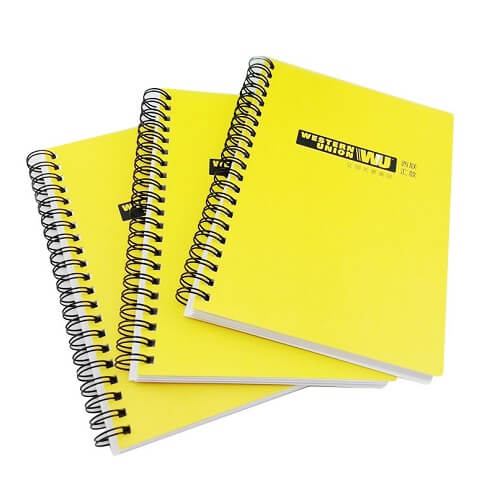
Punched pages held by a twin-loop wire (wire-O) or a continuous coil (spiral). Both fold back 360 degrees, which is why they dominate training manuals, workshop pads and anything used standing up on a site visit. Wire-O is comfortable to roughly 200 pages; spiral copes with more. The failure modes are mechanical rather than adhesive: the wire deforms if the book is dropped on its spine or crushed in a bag, a bent loop then catches every page that passes it, and punched holes tear out at the perforation. Plastic coil resists deformation better; metal looks more corporate. That is the real trade-off.
Case binding (hardcover)
A sewn or glued block cased into rigid boards with endpapers. It is the most protective construction available and handles the widest extent range. Its weak point is the hinge — the joint where the cover flexes — which is also where bonded-leather covers are most prone to cracking and peeling. If you are pairing a hardcover build with a synthetic cover, hinge quality is what you are really paying for, which is a point worth reading alongside cover material and decoration compatibility.
The one-year survival table
Read this as “what happens after twelve months in a laptop bag”, which is the only durability test that matters for a corporate gift.
| Binding | Lay-flat | Practical extent | How it fails | Specify it for |
|---|---|---|---|---|
| Saddle stitch | Excellent | ~8–64 pages | Staples tear through the fold | Slim event pads, seminar handouts, mass giveaways |
| Perfect bound (EVA) | Poor | ~20–800 pages | Spine cracks; pages release in heat | Thick books where a printed flat spine matters more than opening |
| Perfect bound (PUR) | Fair to good | ~20–800 pages | Same mode, far later — around 50% stronger than EVA | Reports, manuals and softcover journals kept long-term |
| Section-sewn | Excellent | ~40–800+ pages | Effectively doesn’t — the cover fails first | Executive journals, client gifts, keepsake notebooks |
| Wire-O | Excellent (360°) | ~10–200 pages | Wire deforms; punched holes tear | Training packs, planners, desk-based use |
| Spiral coil | Excellent (360°) | up to ~400 pages | Coil springs open at the ends; snags fabric | Workshops, site work, anything carried loose |
| Case bound (hardcover) | Depends on the block inside | ~50–1,000+ pages | Hinge cracks; corners knock | Premium gifts, awards, board and VIP sets |
The one question that settles most briefs: will this notebook be written in while lying open on a table? If yes, you need section-sewn, wire-O or spiral, and EVA perfect binding is off the list regardless of how good the cover looks. If it is mainly a desk ornament with occasional use, perfect binding is fine and buys you a printable spine.
Wire-O details that decide whether it survives a bag
Wire-O is the most commonly under-specified binding in corporate notebooks, because “wire-O” is treated as a complete instruction when it is really three separate ones.
- Wire diameter. Sized to the block thickness. Too small and the pages jam and will not turn; too large and the book gapes, catches on everything and loses its shape. A wire chosen with a little slack is the usual cause of “the notebook feels cheap”.
- Pitch (holes per inch). A 3:1 pitch gives more, smaller loops and suits thin books; 2:1 gives fewer, larger loops for thicker blocks. Mixing the wrong pitch with the wrong thickness is what produces the sad, oval loops you see on returned samples.
- Closure and finish. A properly closed wire is a full circle. Ask whether the wire is nylon-coated or bare — coated wire is quieter, kinder to bag linings and less prone to corrosion in humid storage.
One more wire-O consideration specific to gifting: a wire-bound book cannot carry an elastic closure in the usual way, and a wrap-around cover is needed if you want the book to stay shut in a bag. If the closure matters to the gift’s feel, the binding decision has already narrowed your cover options.
Why page counts jump in steps
Notebook inner blocks are not printed page by page. A large press sheet is printed with many pages imposed on it, then folded down into a section — a signature. Every sheet has two sides, so page counts are always multiples of four; fold that sheet again and you are working in multiples of eight; fold it once more and you are in sixteens. Press sheets typically carry 8, 16 or 32 pages depending on the trim size, and for a book at around A4 you can neatly fit 16 pages on a standard large press sheet, which is why 16-page signatures are the workhorse of book and notebook production.
The consequence for a buyer is simple and rarely explained: you do not get to choose any page count you like. You choose a number of signatures. Ask for 90 pages and the block will be built as 96 — six sixteens — with the difference showing up as blank pages, or as an inner-page asset if you were smart enough to have one ready. Printers say this plainly: a page count that does not make up full signatures gets rounded, and they will recommend adding pages rather than leaving a partial section.
Signature maths, in one box
| You ask for | In 16-page signatures | What you actually get |
|---|---|---|
| 80 pages | 5.0 | 80 — a clean fit |
| 88 pages | 5.5 | 96, or 80 plus a half-section the printer would rather avoid |
| 90 pages | 5.625 | 96 — with 6 blank pages you did not brief |
| 96 pages | 6.0 | 96 — a clean fit |
| 100 pages | 6.25 | 112, or 96 plus a short section |
Three things follow from that table. First, specify on a signature boundary — 80, 96, 112, 128, 160, 192 — and you keep control of the whole book. Second, if you are being rounded up anyway, claim the spare pages: a year calendar, a reference spread, a set of tinted dividers or a meeting-notes template will fill them and turn dead paper into something used weekly. Third, remember that a fractional signature is not free — it is a separate fold-and-gather operation, so the step you should worry about is the number of sections, not the number of pages.
Extent also interacts with the rest of the specification. Adding a signature adds spine thickness, which changes the wire diameter, the box depth and the carton count. Adding weight per sheet does the same thing — which is exactly why GSM, ghosting and the pens your team actually uses should be settled before the binding is locked, not after.
Matching binding to the Malaysian corporate use case
Conference and MICE delegate packs. High volume, moderate expectations, one to three days of intensive use followed by months of casual use. Saddle stitch for slim pads, wire-O or PUR perfect binding for anything with real extent. Avoid a heavy hardcover you will be paying to freight in the hundreds.
Client and VIP gifts. Section-sewn inside a hardcover or PU case. This is the one category where the binding is genuinely visible as quality: a book that opens flat and stays flat communicates care in a way no cover finish does.
Training, safety and site use. Wire-O or coil, coated wire, sturdy cover board, and a page count you can afford to lose pages from. Field use is hard on paper and the 360-degree fold-back is worth more than any premium finish.
School, university and orientation kits. Volume dominates. Saddle stitch or lightweight perfect binding, kraft or printed board covers, and the extent chosen strictly on a signature boundary to avoid paying for paper nobody asked for.
Dated diaries and planners. Section-sewn or wire-O, because a diary is opened and flattened daily for a year — and the schedule matters as much as the build, since a dated book delivered late is unsellable rather than merely late. That is a whole planning problem of its own, covered in working backwards from 1 January.
Common questions
Which binding lies flattest?
Wire-O and spiral, because they fold back a full 360 degrees. Section-sewn is the flattest of the “proper book” constructions and can be pressed open to the gutter without weakening the spine. EVA perfect binding is the one that will not stay open without cracking.
Is PUR worth asking for by name?
Yes, if the notebook is perfect bound and will live in a Malaysian climate — warm store rooms, car boots and outdoor events all punish hot-melt adhesive. PUR is widely accepted to be at least 50% stronger than standard perfect binding and is far more tolerant of heat. Put the word in the brief; it is not always the default.
What page count should I choose if I have no strong preference?
96 pages (48 sheets) for A5 corporate notebooks is the reliable middle: six clean signatures, enough extent to feel substantial, thin enough to carry, and comfortable for every binding method above. Move up to 128 or 160 for planners and diaries, and down to 40 or 64 for event pads.
Does binding change the lead time?
It can. Sewing and casing-in are additional operations after folding and gathering, so a section-sewn hardcover sits at the longer end of our 21–45 day production window after artwork approval, plus around 15 days shipping. Saddle stitch and wire-O sit at the shorter end and are the more realistic candidates for the 7-working-day express route, which covers limited models and quantities.
Can I mix bindings across one order?
Yes — a common structure is a sewn hardcover for the top tier of recipients and a wire-O or perfect-bound version for the wider rollout, sharing the same cover artwork and inner pages. Each build counts as its own design against the MOQ of 200 pcs, so plan the split before you commit quantities.
Tell us how the notebook will be used, not just how it should look
Give us the audience, the extent and where the book will live for a year, and we will recommend the binding that survives it. Explore custom printed notebooks wholesale options and we will come back with a free digital mockup, usually within one business day.
MOQ from 200 pcs per design · quote-only pricing with an SST invoice · ePerolehan-ready for government buyers · delivered across Kuala Lumpur and nationwide.
Aquaholic Gifts is a Singapore-based corporate gifting specialist established in 2003, now serving Malaysia nationwide from our KL office at AS80, Jalan Hang Tuah 4, Taman Salak Selatan, 57100 Kuala Lumpur.