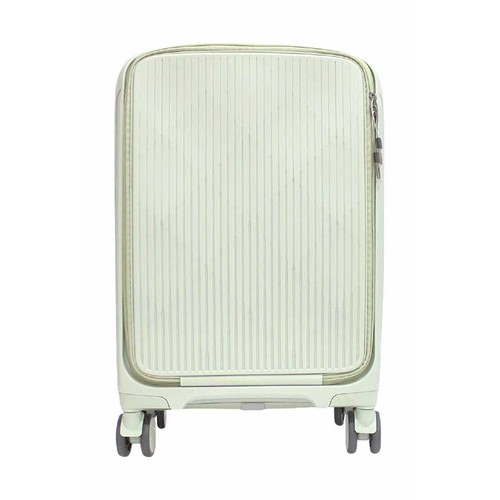
Wheels or a Trolley Sleeve? The Call That Decides What Your Travel Bag Gift Weighs
The most expensive component on a wheeled travel bag is the part that fails first. Wheels, their housings, the axle plate they are riveted to and the telescopic handle that runs up the back of the bag account for a substantial share of the cost of goods and almost all of the empty weight — and they are the only parts that get dragged over kerbs, dropped down stairs and thrown onto a belt. Meanwhile the humblest feature in the whole catalogue, a strip of fabric sewn across the back panel, costs close to nothing and does the same job on the days it matters.
That strip is the trolley sleeve: an open-ended band that slides over the extended handle of a wheeled case so a second bag rides on top instead of on a shoulder. Deciding between a bag with its own wheels and a bag with a sleeve is the single biggest specification decision on a travel gift, because it sets the weight, the cost, the shipping carton and — whether anyone intends it or not — how expensive the gift looks when it is handed over. This is the decision we work through with buyers before quoting any of the custom trolley bags with your logo in our range.
What wheels actually buy, and what they cost
Wheels buy one thing: they take the weight off the body over long, flat, smooth distances. Airport terminals, hotel corridors, convention centre floors. On those surfaces a wheeled bag is transformative, and above a certain load there is no substitute — nobody wants to carry a week’s packing across a terminal on one shoulder.
What they cost is less obvious. A wheel set and telescopic handle add empty weight to a bag before anything goes in it, and on a cabin allowance that is weight the recipient cannot use for clothes. They add a rigid spine, which means the bag can no longer be compressed, folded or stored flat. They add depth at the base, which is the axis most likely to fail a sizer. They add carton volume, so a shipment of wheeled bags takes more space and costs more to move than the same number of soft holdalls. And they add failure modes — a torn wheel housing or a jammed handle turns a premium gift into a broken object, whereas a soft bag with a worn corner is simply a soft bag with a worn corner.
The stairs test: ask where the bag stops rolling. In Malaysia that answer is usually a kerb, a shophouse step, a five-foot way, a wet car park or a flight of stairs at a station without a lift. A wheeled bag that has to be lifted regularly is being carried by its side handle, which is the handle nobody specifies properly — and it is carrying wheels as dead weight while it happens.
The trolley sleeve: the cheapest useful feature on a travel bag
A trolley sleeve assumes something reasonable about your audience: that the people receiving a business or incentive travel bag already own a wheeled case. If that is true — and for a top-performer, long-service or management audience it almost always is — then the second bag does not need its own wheels. It needs to ride on the first one.
Done properly, a sleeve turns a holdall into the better half of a two-bag system. The holdall goes in the cabin, the case goes in the hold, and the traveller pushes both with one hand. Done badly, it is a decorative band that the handle will not go through, or that lets the bag slide off at the first turn. The difference is four specification details, and they are almost never in a factory’s default drawing.
The four things a trolley sleeve has to get right
- Open at both ends. A pocket sewn shut at the bottom is not a sleeve. The handle must pass straight through so the bag can sit at any height on the pull bar.
- Wide enough for a twin-bar handle. Most modern cases use two parallel bars rather than one. A sleeve cut for a single bar will not go on, and this is the failure we see most often on first samples.
- Bar-tacked at both openings. The entire load of the bag passes through those two hems every time it is lifted onto the handle. Plain stitching there is the first seam to open.
- Positioned to balance, not to look tidy. A sleeve centred low on the back panel makes the bag sit upright on the case. A sleeve placed high makes it tip backwards the moment the case is tilted.
There is a fifth detail that is purely a branding question. The sleeve occupies the middle of the back panel, which on many bags is the largest uninterrupted flat area available — the exact area a decorator would like for a logo. You cannot have both, and choosing between them is part of the wider placement problem covered in branding placement on a bag with a trolley sleeve down its back.
Reading a wheel set before you approve it
If wheels are the right answer, they are worth inspecting properly, because two bags that photograph identically can have completely different running gear. These are the checks our production team runs on a wheeled sample before it goes to a client.
| What to look at | The good answer | What goes wrong otherwise |
|---|---|---|
| Wheel type | Two in-line wheels recessed into the shell for rough ground; four spinners only where floors are smooth | Spinners protrude on all four corners, snag on kerbs and are the first thing to shear off on a belt |
| How the wheel is fixed | Riveted to a metal plate that spans two panels, or bolted through a reinforced base | Screwed into fabric with a small washer — the mounting tears out and takes a hole in the bag with it |
| Bearing and tyre | A sealed bearing with a softer outer tyre — quieter, and it does not skate on polished tile | A hard plastic disc on a plain pin: loud in a quiet hotel corridor and gritty after one wet trip |
| Telescopic handle | Twin aluminium bars, two locking positions, minimal side-to-side play when extended | A single bar with a loose collar wobbles, then jams — the most common warranty complaint of all |
| Base protection | Moulded feet or studs so the bag stands on hardware, not on fabric | Bare fabric base abrades on wet, gritty ground and stains permanently |
Two of those rows are really weight decisions in disguise: a metal axle plate and an aluminium handle are heavier than the alternatives and are exactly the grams worth paying for, which is the argument set out in the grams a wheel set adds to an empty bag.
What wheels do to perceived value — in both directions
Wheels read as expensive. A wheeled case on a stage at an annual dinner looks like a serious prize in a way a folded holdall does not, and for a top-performer award that perception is doing real work. This is not irrational: a wheeled bag genuinely is a more complex, more costly object.
But perceived value has a second act, and it happens six months later. A cheap wheeled bag ages badly and publicly. A wobbling handle, a wheel that no longer spins, a housing pulling away from the shell — these are visible faults on an object your logo is printed on, and they are much worse for the brand than a plain bag that simply keeps working. A well-made soft holdall in a good fabric with solid hardware ages into something that looks used rather than broken.
So the honest rule is this: if the budget will not support a genuinely good wheel set, do not buy wheels. A very good holdall with a trolley sleeve outperforms a mediocre wheeled case on every measure that matters after the handover — weight, durability, storability and how the brand looks in year two. Wheels are worth having when they are worth having properly.
The decision, by programme
Here is how the choice resolves across the programmes we quote most often.
| Programme | Wheels or sleeve | Reasoning |
|---|---|---|
| Top-performer award, presented on stage | Wheels, specified properly | The object has to carry the moment. Put the budget into the wheel set and handle rather than into extra pockets |
| Incentive trip bag issued before departure | Sleeve on a large holdall | Recipients already have a case for the trip. The gift becomes their second bag, then their weekend bag |
| Long-service or retirement gift | Either — decide on the recipient’s travel | A frequent flyer wants a case; someone travelling twice a year wants a smart bag they can store flat |
| Conference or delegate distribution | Neither — foldable duffel | Wheels are dead weight in a distribution carton and a burden for delegates who flew in with their own luggage |
| Agent or dealer reward across several states | Sleeve, with a strong base | Onward distribution to branches is cheaper and easier when the bags are soft, and the sleeve keeps the utility |
| Executive or client gift, suits involved | Sleeve on a garment bag | A garment bag rides on a case and hangs in a wardrobe. Wheels would defeat both of its jobs |
Whichever way it goes, check the result against the frame at the gate before signing off, because wheels change the numbers that matter — the detail behind the cabin dimensions that actually get measured at the gate.
The ten-minute sample test
Before a wheeled or sleeved sample is approved, load it to a realistic packed weight and do these four things. They take longer to describe than to perform, and they catch almost everything.
- Pull the loaded bag over a kerb and a doorway threshold. Wheels that lift over an edge cleanly are fine; wheels that stop the bag dead will do that every day of its life.
- Extend the handle fully, lean the bag at the angle a person actually walks at, and push it in a straight line. Listen. Wobble and noise both come from the same place.
- For a sleeve, slide the loaded bag onto an ordinary twin-bar case handle, then push the pair around a tight turn. It should not slew off or rotate.
- Lift the loaded bag by the side handle and hold it for a slow count of ten. That is the handle that carries it up stairs, and it is the one factories under-build.
Questions buyers ask about wheels and sleeves
Can a bag have both wheels and a trolley sleeve?
Physically yes, but it rarely makes sense. The telescopic handle already occupies the back panel, so the sleeve has nowhere natural to sit, and a wheeled bag is not something people stack on another wheeled bag. Choose one role for the bag and build it properly.
Two wheels or four?
Four spinners are effortless on smooth floors and vulnerable everywhere else, because they protrude from the corners. Two recessed in-line wheels handle kerbs, gravel and wet car parks far better and are much harder to break in the hold. For Malaysian conditions we lean towards two.
Will a trolley sleeve fit every suitcase?
Not automatically. Handle bars vary in spacing, so the sleeve has to be cut generously and left open at both ends. We specify it against a twin-bar handle, which is the common modern format, and confirm the opening width on the mockup.
Do wheeled bags cost more to ship in bulk?
Yes, and it is worth planning for. A rigid wheeled bag cannot be compressed, so the carton volume is fixed and the shipment is bulkier than the same order in soft holdalls or foldable duffels. If bags are being redistributed to branches afterwards, that difference compounds.
How many travel bags is the minimum, and how long does production take?
MOQ is from 100 pcs per design. Production runs 21–45 days after artwork approval, depending on quantity and construction — wheeled and garment styles sit at the longer end — plus around 15 days shipping, delivered nationwide. Express is 10 working days on limited styles and quantities. Pricing is quote-only, invoiced with SST and ePerolehan-ready for government buyers.
Not sure whether your programme needs wheels?
Tell us who receives the bags, how they travel and whether the bags will be redistributed after delivery, and we will recommend a format, send a free digital mockup and quote it with no obligation, usually within one business day. Aquaholic Gifts is a Singapore-based corporate gifting specialist established in 2003, now producing for clients across Malaysia from Kuala Lumpur. Have a look through the wheeled and sleeve-equipped travel bag line-up first.
WhatsApp +60 10 717 5924 · Send your brief through our contact page
Aquaholic Gifts Malaysia · AS80, Jalan Hang Tuah 4, Taman Salak Selatan, 57100 Kuala Lumpur