Coaster Materials and Absorbency: What Works in Malaysian Humidity
Most coaster briefs specify a material before anyone has established what the coaster actually has to survive. In Malaysia that ordering is backwards, because the thing a coaster has to survive here is not spillage — it is condensation, and a lot of it, for hours at a time, in air that never dries out. A cold glass in a 30°C room at 80% relative humidity sheds water continuously. The coaster underneath it is not catching an accident. It is managing a steady flow.
This guide is built around a single test you can run in your own office in twenty minutes, before you commit to a thousand pieces. It is the fastest way to separate a customised coaster that will look good in year two from one that will be quietly thrown away in month three.
The twenty-minute condensation test
Take one sample of each material you are considering. Put them on a wooden or laminate surface you do not mind risking, ideally the same finish as the desks or tables they will end up on. Fill a glass with ice and water, set it on the first coaster, and start a timer. Do not use a chilled drink from the fridge — you want maximum condensation, so ice is the honest test.
At twenty minutes, lift the glass and check four things in this order:
- Is there a ring on the table underneath? This is the only question that matters to the person who receives the coaster. Water that has run off the edge, or soaked through, has defeated the entire purpose.
- Does the coaster stick to the glass? Lift slowly. A coaster that comes up with the glass and then drops is an irritation that people notice every single time, and it is the most common reason a coaster ends up in a drawer.
- Has the surface changed? Look for swelling at the edges, a raised grain, a cloudy patch, or a softened print.
- How long does it take to dry? Leave it and check again after an hour. This is the question that separates materials in Malaysia and it is almost never asked.
Run the same test on every candidate material and the decision usually makes itself. What follows is what you should expect to see.
What each material actually does with water
Cork
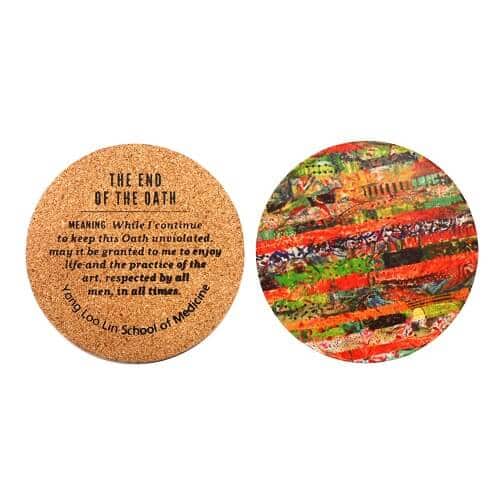
Cork absorbs, and it absorbs well. It will take the condensation off a glass without letting a ring through, and it grips the table rather than sliding. It is also light, warm to the touch and genuinely renewable, which is why it dominates the eco-gift end of the market. Its weakness is the drying question. Cork holds the water it takes in, and in a room that sits at 80% humidity it does not give that water back quickly. A cork coaster used every day in a Malaysian office is damp more often than it is dry, and damp cork eventually develops surface spotting and a musty smell. It is an excellent material with a maintenance requirement, not a maintenance-free one.
Wood and MDF
Wood behaves according to its coating, not according to the wood. A sealed wooden coaster with a proper lacquer will shed water and dry fast. An unsealed or lightly sealed one will drink at the end grain, swell, and lift its edges within weeks. MDF is the version of this problem with no upside — once water reaches the core it expands and never returns to shape. If you are quoting wooden coasters, the single most important line in the specification is the seal, and it is the line most quotations leave out.
Ceramic with a cork base
This is the combination that wins the twenty-minute test most often, and it is worth understanding why. The ceramic face is non-absorbent, so the print sits on a stable surface and nothing swells. The unglazed ceramic body wicks a small amount of moisture, which stops the ring forming. The cork base isolates the table and stops sliding. It also solves the sticking problem, because a glazed face releases the glass cleanly. The trade-off is weight, breakability in transit, and a higher unit cost.
PU leather
PU wipes clean, dries almost instantly and never swells, which makes it the low-maintenance option. It does not absorb at all, so water pools on the surface and can run off the edge if the coaster is flat and the drink is very cold. A stitched or slightly dished edge fixes this. PU also photographs well and suits a premium set, which is why it appears so often in executive gift boxes.
Acrylic and silicone
Both are fully non-absorbent and both rely on a raised lip or a textured surface to hold water rather than let it escape. Acrylic gives a hard, glossy, full-colour result and suits beverage-brand promotions where the artwork is the point. Silicone is unbreakable, grips hard and is the right answer for anywhere a coaster will be dropped or handled roughly. Neither will ever warp, and neither will ever look like a natural material.
The humidity problem nobody quotes for
Here is the part that catches buyers out. A coaster that performs beautifully in the twenty-minute test can still fail over a year, because the failure mode in Malaysia is cumulative rather than immediate.
Absorbent materials — cork especially, and unsealed wood — reach a steady state where they are never fully dry. In an air-conditioned office that is usually fine, because the air conditioning is also a dehumidifier. In a warehouse, a non-air-conditioned meeting room, a hotel corridor or a home in a high-rise with the windows open, it is not. Under those conditions absorbent coasters develop dark spotting on the underside first, where air does not circulate, and that spotting is mould rather than dirt. It cannot be wiped off.
The practical implication is that the right material depends on where the coaster lives, not on what it is made of. The same cork coaster is an excellent choice for a Kuala Lumpur office desk and a poor one for a beachfront resort restaurant. If you cannot control the destination — and with corporate gifting you usually cannot — the safe specification is a non-absorbent face with a cork or rubber base, which gives you the grip and table protection without the water-retention problem.
Absorbent is not automatically better
The instinct that a coaster should soak up water is inherited from paper beer mats, where the coaster is disposable and absorbency costs nothing. A reusable coaster is a different object with a different job: it has to keep water off the table and then get rid of that water. Absorbency solves the first half and complicates the second.
A useful way to frame the choice is to ask what happens to the water:
- Absorb and hold — cork, unsealed wood. Best appearance, warmest feel, needs a dry environment and periodic air-drying.
- Wick and release — unglazed ceramic body, absorbent stone. Takes the water in and evaporates it fast. The best all-round performer, at a price.
- Repel and contain — PU, acrylic, silicone, glazed ceramic with a lip. Zero maintenance, needs an edge or a texture so the water does not simply run off.
None of these is wrong. The mistake is picking one without deciding which behaviour you actually want, and then being surprised by the behaviour you got. If you are still weighing options across materials, our breakdown of which printing method suits each material is worth reading in parallel, because the material decision and the decoration decision constrain each other more than most buyers expect.
What to write into the specification
Once you have chosen, five lines in the purchase order prevent almost every disappointment:
- Material and thickness in millimetres. Cork at 3mm and cork at 5mm are different products — the thin one curls.
- The base treatment. State explicitly whether there is a cork, rubber, felt or EVA backing, and whether it is glued or moulded. This is where cheap coasters cut cost and where they fail first.
- The seal or coating on any wood. Name it. “Sealed” is not a specification.
- Edge finish. Rounded, chamfered, stitched or raw — this affects both how it feels and whether water escapes the edge.
- A sample from production, not from the showroom. Run the twenty-minute test on the production sample, not on the salesman’s demo piece.
For venues ordering in volume there are extra considerations around attrition and replacement — see our guide to buying coasters for a working bar. And if you have not yet settled the physical dimensions, getting the size and thickness right matters more than the material for whether people actually use them.
Budget-wise, material is the single biggest driver of unit cost, so it is worth reading our guide to what coasters cost by material in Malaysia alongside this one.
Backing, feet and what stops the coaster sliding
The face of the coaster gets all the attention in a brief and the underside decides whether people keep it. A coaster that slides when someone lifts their glass is not protecting anything, and on a glass or polished table it will travel a surprising distance.
There are four common backings and they are not interchangeable. Cork backing grips well, adds a little thickness and is the standard on ceramic. EVA or foam grips harder and is cheaper, but compresses over time and yellows. Felt looks premium and protects polished wood best, and is the worst performer once it gets wet. Moulded rubber feet or a moulded silicone underside grip hardest and survive washing, which is why they dominate venue specifications.
The failure point in nearly every case is the adhesive rather than the backing itself. A glued cork base on a ceramic coaster will separate if the coaster is regularly soaked, and once a corner lifts the rest follows within days. If the coaster will be washed rather than wiped, specify a moulded or mechanically bonded backing and put it in writing — it is the difference between a two-year item and a two-month one.
Frequently asked questions
Which coaster material lasts longest in Malaysian conditions?
Glazed ceramic with a cork base, and PU leather, both last longest because neither absorbs water into its structure. Silicone lasts indefinitely but reads as functional rather than premium. Cork and unsealed wood look best on day one and age fastest.
Do cork coasters go mouldy?
They can, in humid environments where they never fully dry — most often on the underside. Air-drying them occasionally prevents it. In an air-conditioned office it is rarely an issue.
Why does my coaster stick to the glass?
Surface tension between a wet flat coaster face and a wet glass base. Absorbent faces and textured or dished faces both reduce it. A perfectly flat, non-absorbent, glossy face is the worst combination for sticking.
Is a thicker coaster always better?
No. Thickness helps absorbent materials hold more water and helps every material feel more substantial, but past a point it makes the glass feel unstable and raises cost with no functional gain.
Can I mix materials across one order?
Yes, and it is common for sets — a ceramic face with a cork base, or a PU set in a wooden holder. Mixing whole coasters of different materials in one set rarely looks intentional.
Test before you commit
Twenty minutes and a glass of ice water will tell you more than any specification sheet. Send us the brief and we will send samples of the shortlisted materials so you can run the test yourself before anything goes into production. Browse the full custom coasters range to see what is available, or tell us where the coasters will live and we will narrow the shortlist for you.