Fifty-Six by Thirty-Six by Twenty-Three: Why a Soft Travel Bag Clears the Sizer and a Rigid Case Does Not
There is a metal frame at the boarding gate, and everything you need to know about cabin sizing is in the gap between what that frame measures and what your supplier quoted you. The frame measures the bag at its widest point, on its worst day: front pocket stuffed, wheels sticking out at the base, top handle standing proud, a jacket shoved down one side. The quotation measures a flat, empty bag laid on a cutting table. A bag can be honestly described as 56 cm tall and still not go into the frame, and the recipient of your gift is the one who finds out.
This matters more for a corporate gift than for a bag someone buys themselves. A buyer who chooses their own cabin bag can take it back. A recipient who is handed a branded bag at an incentive dinner will take it to the airport once, be told to check it in, and quietly stop using it. So before anything is quoted, it is worth knowing what the carriers Malaysians actually fly publish, why a soft-sided holdall behaves completely differently from a rigid case at the same nominal size, and how to write a specification that survives being packed. Everything below applies to the custom travel bags in Malaysia we quote most often — cabin cases, carry-on holdalls, weekenders and foldable duffels.
The number on the product page is not the number at the gate
Luggage is described in two incompatible languages. Soft bags are quoted by the dimensions of the main body, measured flat and empty. Wheeled cases are quoted in inches — 20-inch, 24-inch — and that figure refers to the height of the shell alone. The castors at the bottom and the moulded handle housing at the top sit outside it, so the real overall height is meaningfully greater than the headline number.
Airline sizers do not care which language the factory used. They measure overall external dimensions, including wheels, handles, feet and anything protruding from a pocket. That is the commonest reason a bag which looks compliant on paper is refused, and why we ask for two sets of figures on every wheeled sample: body dimensions, and overall dimensions with all hardware included. If a supplier offers only one, assume it is the flattering one.
Ask for it in this form: “overall external dimensions, loaded, including wheels, handle housing and side handles.” Those four words at the end change the answer. On a rigid cabin case they can move the height by several centimetres, which is the entire tolerance you have.
What the carriers Malaysians fly actually publish
There is no single cabin standard, but there is a strong convergence on one box. The figures below are as published by each carrier at the time of writing in August 2026; allowances change, so confirm against the carrier before you approve artwork.
| Carrier | Cabin pieces | Weight | Published size rule |
|---|---|---|---|
| AirAsia | One cabin bag plus one small personal item | 7 kg for both pieces combined | Cabin bag maximum 56 x 36 x 23 cm; personal item maximum 40 x 30 x 10 cm |
| Malaysia Airlines | One piece in Economy; two pieces in Business | 7 kg in Economy; 14 kg combined in Business with no single piece over 7 kg | Expressed by stowage location: overhead-bin items maximum 56 x 36 x 23 cm, under-seat items maximum 25 x 36 x 25 cm |
| Batik Air Malaysia | One cabin bag plus one personal item | 7 kg in Economy; 10 kg in Business | Same 56 x 36 x 23 cm envelope |
Two things in that table are worth more than the numbers themselves. The first is that the size rule is remarkably stable across full-service and low-cost carriers — 56 x 36 x 23 cm is close enough to a regional standard that you can design to it with confidence. The second is that Malaysia Airlines does not express its rule as a bag rule at all. It expresses it as a stowage rule: this is what fits in the bin, and this is what fits under the seat. That framing is the more honest one, because it tells you what the constraint actually is. A bin is a fixed aperture and the bag has to enter it.
The under-seat figure is the sleeper in that row. A shallow, wide item — a flat travel organiser, a document folio — is governed by a different box, generously wide but only about a hand deep. That is a useful design target for the second piece in a two-item gift set, and almost nobody specifies it deliberately.
Why a soft holdall passes where a rigid case does not
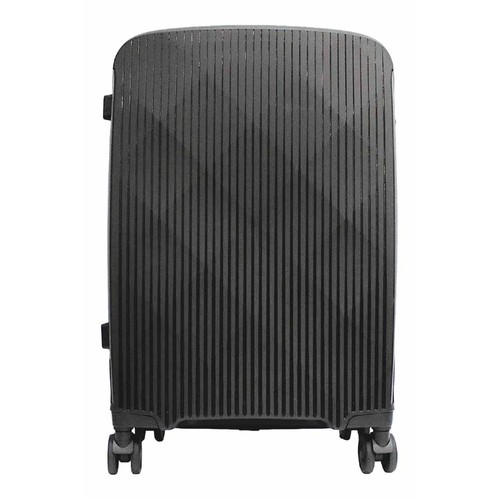
Put a soft duffel and a hard-shell cabin case side by side at the same nominal dimensions and they are not equivalent products. The case is a fixed solid. Its widest point is the same whether it holds three shirts or twenty, and if it is one centimetre over on the diagonal, it is over forever. The duffel is a compliant object. Its stated dimensions describe it at rest; under hand pressure it loses depth, the corners round in, and it goes into a frame that a rigid box of the same paper size will not enter.
This compliance is not free, and it works in both directions. A soft bag that is packed hard swells. Depth is the axis that moves — the 23 cm face is almost always the one that fails, because it is the smallest number and the one that grows first when someone rolls an extra pair of shoes into the middle. A bag can be safely under on height and width and still be stopped on depth alone.
Three construction details decide how well a soft bag holds its shape. A base board keeps the bottom flat and stops the bag from becoming a ball. Side panels cut with a proper gusset, rather than a single wrapped panel, hold the depth. And an end-to-end zip that opens the full length lets the bag be packed flat rather than stuffed through a small mouth, which is what actually causes bulging. Every one of those adds material, and material adds weight — which is the trade-off set out in what the bag weighs before anything goes in it.
The weight allowance is usually the binding limit
Everybody designs against the dimensions and almost nobody designs against the scale, which is backwards. On a 7 kg cabin allowance that covers both the bag and the personal item, the empty bag is a direct deduction from what the recipient can bring. A rigid cabin case with a telescopic handle and a four-wheel base can account for a substantial share of that allowance before a single shirt goes in. A soft holdall of the same volume can weigh a fraction of it.
This is why the honest answer to “which cabin bag should we give?” often depends on who is flying. Someone doing a two-night trip with a laptop bag as their personal item is fighting the scale, not the frame. Someone connecting through a larger aircraft on a full-service carrier in Business, with two pieces and a higher combined allowance, has room to enjoy a heavier, more substantial bag. Neither is wrong; they are different briefs, and the wheels question is where they diverge most sharply — covered in full in when wheels earn their place and when a trolley sleeve is enough.
Specifying a bag that is still cabin-legal when it is full
The practical approach is to design a tolerance in rather than to design to the limit. These are the clauses we put into a cabin-bag specification before a sample is cut.
The cabin-legal specification clauses
- Target the body dimensions a couple of centimetres inside the published envelope on every axis, so hardware and packing have somewhere to go.
- State that quoted dimensions are overall and include wheels, handle housing, feet and side handles.
- Cap the front pocket depth. An expanding bellows pocket on the face of a cabin bag is the most common single cause of a bag failing on depth.
- No expansion zip on a bag intended for the cabin. It exists to make the bag bigger than the frame, which is the opposite of the brief.
- Specify a recessed wheel housing rather than bolted-on castors if wheels are used at all.
- Give the empty weight a ceiling in the specification, in the same sentence as the dimensions, so it is treated as a requirement rather than an outcome.
The loaded measurement check we run on samples
A sample measured empty on a table tells you almost nothing. Our production team measures cabin samples the way a gate agent would, and the whole exercise takes about ten minutes.
- Pack it the way a real traveller would for two nights — clothes, shoes at the bottom, toiletries in the front pocket, not neat folded blocks.
- Stand it upright on the floor, unsupported, the way it will sit at the gate.
- Measure height from the floor to the top of the standing handle, not to the top of the fabric.
- Measure depth at the fattest point, which is almost never the middle — on most bags it is a third of the way up, at the level of the shoes.
- Measure width across the widest hardware, including side grab handles and any external strap fittings.
- Repeat with the bag packed for four nights. If it is still inside the envelope, you have a genuinely cabin-sized bag rather than a bag that photographs as one.
Matching the format to how the recipient actually flies
Cabin-legal is not automatically the right target. Plenty of programmes are better served by a bag that is frankly a checked bag, because that is the trip the audience is taking.
| How the audience travels | Format that fits | What to watch |
|---|---|---|
| Short regional hops, hand luggage only, low-cost carrier | Soft cabin holdall or carry-on duffel with a base board | Empty weight is the real constraint, because the allowance covers the personal item too |
| Two to three nights, business attire, full-service carrier | Rigid cabin case, or a holdall paired with a garment bag | Overall dimensions with wheels and handle, not the inch figure on the shell |
| Incentive trip, four nights or more, bags go in the hold | Large holdall or a check-in case | Hold limits are generous on size but firm on weight per piece — the bag’s own weight eats into it |
| Conference or delegate distribution, recipients already have luggage | Foldable duffel that packs into its own pouch | It travels flat on the way out and becomes the second bag on the way home |
| Mixed audience, unknown itineraries | Cabin-sized soft holdall | The compliant format is the safe default — it works in the bin and in the hold |
One more consideration sits outside the airport entirely. A bag carried through a terminal is on public display for hours, which changes how loud the branding on it should be — a point we make at length in how visible the logo should be on a bag people carry in public.
Questions buyers ask about cabin sizing
Is there one cabin bag size that works on every airline?
There is no universal rule, but 56 x 36 x 23 cm is the envelope the carriers most Malaysians fly converge on, and designing a body a little inside it on every axis gives you a bag that behaves on all of them. Confirm against the specific carrier if the gift is tied to a booked itinerary.
Does a 20-inch case count as cabin size?
Usually yes, but the inch figure describes the shell height only. Ask for the overall height including wheels and handle housing and check that against the envelope, because that is what the sizer at the gate measures.
Should we give a cabin bag or a larger holdall?
Follow the trip. If the audience does short regional trips without checking bags, cabin-sized wins and gets used constantly. If the gift marks an incentive trip of several nights, a larger holdall is the more generous and more appropriate object.
What is the travel bag minimum order, and how long does it take?
MOQ is from 100 pcs per design. Production runs 21–45 days after artwork approval depending on quantity and construction, plus around 15 days shipping, delivered nationwide across Malaysia. Express is 10 working days on limited styles and quantities. Pricing is quote-only, invoiced with SST and ePerolehan-ready for government buyers.
Tell us the trip and we will size the bag to it
Send us the carrier, the length of the trip and who is receiving the bags, and we will come back within one business day with a format recommendation, a free digital mockup and a no-obligation quote. Aquaholic Gifts is a Singapore-based corporate gifting specialist established in 2003, now producing for clients across Malaysia from Kuala Lumpur. Start with our cabin-sized travel bag range and we will work back from your dates.
WhatsApp +60 10 717 5924 · Send your brief through our contact page
Aquaholic Gifts Malaysia · AS80, Jalan Hang Tuah 4, Taman Salak Selatan, 57100 Kuala Lumpur