
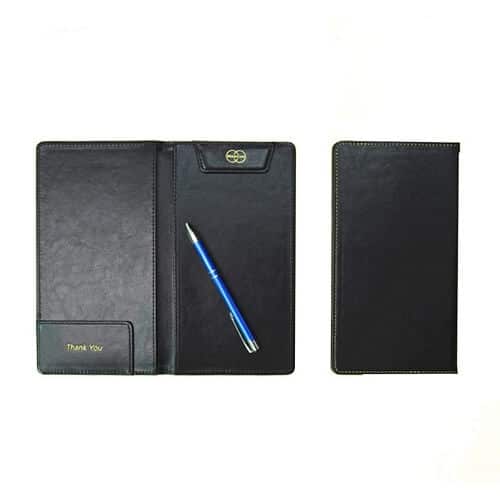
Where the Cash Actually Goes: Pocket Layout for a Table That Pays Three Ways
A bill folder goes out to the table holding one thing and comes back holding four. Nobody specifies it that way. The brief says leather or PU, says the logo goes on the front, says the colour has to match the dining room — and then the folder arrives with a single slit down the inside face, which is a home for exactly one item, and the floor improvises for the rest of its life.
Picture a table of four settling up in a mall restaurant in Kuala Lumpur. One guest hands over notes and wants change. One taps a card at the terminal. One scans a DuitNow QR and never touches the folder at all — but still asks for the printed receipt for a claim. The server now has to carry back, inside one closed object: a fistful of change, a card, a terminal slip and the itemised bill. Four items, three owners, one container.
This article is the inside of the folder — the part our production team works through before quoting custom bill folders for Malaysian restaurants and cafes. Measured geometry of the notes and cards that go in, the pocket depth that stops a note edge showing above the line, the base seam that quietly swallows coins, and a layout grid you can match against the way your own floor takes money.
The outbound folder and the inbound folder are two different objects
On the way out the folder is trivial. One docket, lying flat; the only test is that it does not fall out. Every sample you are shown passes that test, because the showroom demonstration is always the outbound trip.
On the way back it is a payment container, carried at speed, one-handed, at an angle, sometimes underneath two other folders. Its contents are loose, of four different shapes, and half of them belong to the guest while half belong to the house. Design the inside for the return leg and the outbound leg looks after itself. Everything below follows from that.
The geometry of a ringgit note
This is the number that decides whether a folder looks composed or looks like a wallet that has burst. Malaysia’s higher-denomination notes — the ones that make up almost every cash settlement in a restaurant — measure 145mm long by 69mm deep in the current series. Smaller denominations are shorter and marginally shallower; they are never the constraint.
Width. Usable pocket width — measured between the stitch lines, not across the whole panel — has to clear 145mm with a few millimetres to spare, or notes go in at an angle and buckle. A buckled note pushes the cover open a fraction, and a cover that will not sit flat is what a guest notices from across the table. Compact folders sized around a narrow docket fail this routinely: the docket fits beautifully, the money does not.
Depth. Visible pocket depth — base seam to pocket mouth — has to be at least 69mm if a large note is to disappear completely. Come in under that and the top strip of every note shows above the line. Two costs follow: change sitting in an open folder is legible from the next table, and a protruding note edge catches on the opposing panel as the folder closes, which is how notes end up creased, folded back on themselves, or slipping out of the mouth when the folder is picked up.
Local tip: ask for the pocket’s usable depth and width, not the folder’s external size. External dimensions are marketing; the stitch-to-stitch measurement inside the pocket decides whether a note disappears. If nobody can give you the figure, put a real note into the sample and look at it from the side. Thirty seconds, and it settles the argument.
Coins, and the base seam nobody checks
Coins are the one item a flat pocket genuinely cannot hold, and Malaysian floors deal with them constantly — a table that pays cash almost always gets coins back.
There is a construction detail here that separates a real pocket from a decorative one. On many economy folders, what looks like a pocket is the lining panel stitched down the two sides and left open along the bottom, because closing the base adds a stitching operation. It holds paper, because paper cannot travel sideways. It does not hold coins. Coins drop through the open base, migrate under the lining, and reappear a week later when somebody shakes the folder over a table — taking receipts with them on the way.
Run a finger along the inside base of every pocket on the sample. Seam present, it is a pocket. Fingertip slides into a gap, it is a flap. Then either specify a closed base seam or decide coins are not going into the folder at all — plenty of well-run dining rooms return change on a small dish. That is a legitimate policy, far better made deliberately than discovered in week two.
Where the folder must take coins, the honest options are a gusseted pocket with a closed base or a small dedicated compartment. Both add bulk, and a folder that no longer sits flat matters more than people expect once you look at what happens when folders are carried stacked through a busy service.
The card slot, and how cards actually get lost
A payment card is a standardised object: the ID-1 format in ISO/IEC 7810 measures 85.60mm by 53.98mm, and every bank card in the country is that size to a fraction of a millimetre. It is the only content of a bill folder you can design around with total confidence.
The card leaves with the rubbish. A card dropped into the same pocket as the paperwork ends up sandwiched between the guest’s copy and the terminal slip. At the pass, someone clears the folder, sees paper, bins the lot. This is the most common way a card is lost in a restaurant, and it is a layout fault rather than a staff fault. A card needs a home physically separate from anything made of paper.
The card slides out in transit. Folders are carried spine-down and tilted, and a card in a shallow straight slot creeps out under its own weight. The fix is geometry: a slot cut on a diagonal, or one deep enough to swallow more than half the card’s height, so gravity acts across the card rather than along it. A small thumb notch in the slot face lets the card be retrieved in one motion instead of being fished out with a fingernail.
Worth saying plainly: in Malaysia the card no longer travels to a back-office terminal. Portable terminals come to the table, so the card is inside the folder for seconds rather than minutes. That does not make the slot optional — it makes it a short, high-frequency exposure, the kind that gets normalised until the day it goes wrong.
The pocket census
This is the grid we work through with a venue before drawing an inner layout. List everything that can travel inside your folder, decide where it lives, and see what has no home. Whatever has no home is what your floor is currently improvising around.
| What travels inside | Where it should live | With no home for it |
|---|---|---|
| Notes tendered by the guest | Full-width pocket, 69mm usable depth or more | Note edges show above the line and crease on closing |
| Change returned in notes | Guest-facing pocket, a corner left proud | Guest closes the folder without seeing the change |
| Change returned in coins | Closed-base gusset, or a separate dish by policy | Coins escape under the lining, taking receipts with them |
| Payment card | Angled slot at 85.6 × 54mm, away from all paper | Binned with the paperwork, or slips out in transit |
| Terminal slip the guest keeps | Guest-side pocket, visible on opening | Left behind, then chased by phone the next day |
| Terminal slip the house keeps | Opposite face, or an outside rear pocket | Goes home with the guest and the shift will not balance |
Why a single slit fails when a table pays three ways
Follow the four-guest table through a one-pocket folder and the breakdown is mechanical rather than mysterious. The bill goes out in the slit. Notes come back in the same slit, on top of the bill. The card is laid loose on the panel because there is nowhere else, and the folder closes on it. At the terminal the server opens up and the card, the notes and the bill are one shuffled stack to be sorted standing up. Change is counted back into the same slit. Two slips print; both go into the same slit, because there is still only one.
The folder returns to the table holding five loose items in a single compartment, and the guest — by now standing — picks out what looks like theirs. What gets left behind is unpredictable, and unpredictability is the actual problem. Sometimes the house copy leaves. Sometimes a note stays folded inside the bill and surfaces at cash-up as an unexplained overage. Those are sorting failures, and sorting failures are solved by compartments, not by training.
The minimum viable fix is two opposing pockets, guest-side and house-side on facing panels, so ownership is decided by which half of the folder something sits in. That single change removes most of the ambiguity and it is the foundation of getting the merchant copy back after the guest has gone without anyone having to remember a rule.
Four inner layouts, and the floor each one suits
| Layout | Suits | Its limit |
|---|---|---|
| Single full-width slip | Cafes and counters settling almost entirely by QR or card | Collapses the moment cash and a card appear together |
| Twin opposing pockets | Casual dining, mixed payment, high table turnover | Still no dedicated home for a card or for coins |
| Pocket, angled card slot and closed-base gusset | Full-service restaurants with a genuine cash mix | Thicker, and will not stack flat in a waiter station |
| Flat presenter, retaining band and rear pocket | Bars, lounges and poolside, where folders are set down on wet surfaces | Contents are visible; poor for cash and change |
The six lines to put in your brief
- Usable pocket width, stitch to stitch, clearing 145mm with clearance
- Usable pocket depth of at least 69mm so a large note disappears completely
- Closed base seam on any pocket expected to hold coins or small slips
- Card slot on an angle, sized to 85.6 × 54mm, physically separated from paper
- Two pockets on opposing faces so guest and house paperwork cannot mix
- One line describing how your floor takes payment — cash share, card share, QR share
That last line does more work than the other five combined. A venue that is overwhelmingly QR needs a different inner layout from a concept taking cash all day — and both can share an identical outer shell, material and logo treatment.
Pocket questions we get asked
We are nearly cashless. Do we still need a deep pocket?
Yes, but for a different reason. A venue settling almost everything by QR still hands back paper, and paper in a shallow pocket sticks out and lifts under air conditioning. What you can drop is the coin gusset — which makes the folder slimmer and easier to stack, a real operational gain rather than a saving on materials.
Can a card slot be added to folders we already own?
Realistically, no. A card slot is stitched into the lining before assembly, so retro-fitting means unpicking and rebuilding — more work than making a new one, and the result never looks factory. Where a venue is stuck with single-pocket folders, the workable interim is a floor rule: cards never enter the folder, they travel in the server’s hand to the terminal and back.
Should the guest’s change go loose or in a pocket?
In a pocket, guest-facing, with a corner of the notes proud of the mouth so it reads as change rather than as paperwork. A guest who does not see their change closes the folder and walks away, and that recovery conversation is worse than a slightly less minimal look. It is the one place where letting an edge show is correct.
What is the minimum order, and can outlets in one group run different inner layouts?
Minimum order is from 300 pcs per design, and yes — a group often runs one outer specification with two inner layouts, because a hotel coffee house and a fine-dining room take payment differently under the same brand. Production runs 21–45 days after artwork approval, plus around 15 days for shipping nationwide; an express route of 10 working days exists for limited styles and quantities. Quotations carry an SST invoice, and we supply government and statutory buyers through ePerolehan.
Tell us how your floor takes money and we will draw the inside
Send us your cash, card and QR split, your docket size and how change is returned. We will come back with an inner layout and a free digital mockup, usually within one business day. Request a free bill folder mockup and we will confirm pocket depths before anything is cut.
Aquaholic Gifts Malaysia · AS80, Jalan Hang Tuah 4, Taman Salak Selatan, 57100 Kuala Lumpur


