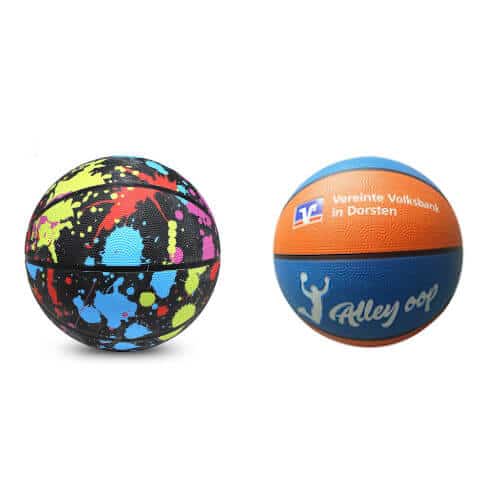
Three Basketballs That Look Identical in a Product Photo: Indoor Leather, Outdoor Rubber and Composite
A product photograph is a liar about basketballs, and it lies in a very specific way. A studio shot flattens the two things that actually separate one cover from another — how far the grain stands proud, and how the material behaves when it is wet. So three balls with completely different lifespans, completely different homes and completely different honest descriptions arrive in your inbox looking like the same orange sphere. We have sat in enough approval meetings where a client is choosing between images to know how the mistake happens, and it almost never gets caught before delivery. It gets caught when someone bounces the ball outside.
The short version. Full-grain leather is an indoor-only material that Malaysia’s climate is actively hostile to. Moulded rubber is the outdoor court material and is nearly indestructible but feels blunt. Composite — a polyurethane or microfibre surface over a fabric backing — is the one that works indoors, tolerates outdoors, needs no breaking in, and takes branding cleanly. On top of those three sits a fourth thing that is not a playing ball at all: the promotional display grade. Ordering it is fine. Describing it as a match ball is not.
Full-grain leather: a beautiful material in the wrong country
Leather is the traditional indoor cover, and there is a genuine reason players who use it are attached to it. It has a moisture-managing quality that synthetics approximate rather than match: it takes up a small amount of sweat rather than letting it sit on the surface, so grip in a long indoor session stays consistent in a way that is hard to reproduce. It also breaks in. A leather ball is stiff and slippery out of the box and improves for weeks as the surface conditions.
Everything that makes it good indoors makes it fragile here. Leather absorbs moisture, and absorbed moisture in an equatorial climate does not evaporate away tidily — it stays. A leather ball that gets rained on, or that lives in an unventilated store cupboard through a monsoon month, can stiffen, darken unevenly and eventually harden. Take it onto open concrete and the abrasion problem compounds the moisture one: the grain scuffs rather than polishes, and once the surface is broken it takes up water even faster.
Our position is straightforward. Leather is right for a sealed indoor floor, a club that stores equipment properly, and a recipient who will look after it. It is the wrong specification for a giveaway, a school donation, or anything warehoused before distribution — and because it needs breaking in, a leather ball handed out at an event feels worse in the first ten minutes than a cheaper composite would. That is a bad first impression to pay a premium for.
Moulded rubber: the honest workhorse
A rubber basketball is a different object in kind, not just in grade. The grain is not a surface layer applied to a backing — it is moulded into the rubber itself, so it goes down into the material rather than sitting on top of it. That is why rubber balls survive open concrete: when the pebble crowns abrade, there is more of the same material underneath, and the ball degrades gradually instead of failing at an interface.
The trade-offs are real and worth stating plainly. Rubber does not manage moisture; a wet rubber ball is genuinely slick until it is wiped. The hand feel is firmer and less forgiving. The bounce is typically livelier, which players notice. And the surface can feel slightly plasticky when new. None of that matters if the ball’s job is to survive a school court in Selangor for a year, and all of it matters if the ball’s job is to feel expensive in someone’s hands at a dinner.
One construction detail is worth checking on rubber samples specifically, because it is where corners get cut: the channels. A moulded rubber ball can be made with genuinely recessed channels or with shallow, largely cosmetic ones. It is the difference between a ball that plays and a ball that photographs, and it takes three seconds to check — the method is in our piece on what the pebble grain and channels do for grip.
Composite: the one most Malaysian orders should be looking at
Composite covers — polyurethane or microfibre surfaces bonded to a fabric backing — exist because most balls do not live in one place. They are grippy from the first bounce with no break-in period, they shrug off humidity in a way leather does not, they are far more comfortable in the hand than rubber, and they hold printed branding well because the surface is engineered and consistent rather than natural and variable.
The honest limitation is that a composite cover is a layer, and layers have an edge. Sustained abrasion on rough concrete wears through the surface layer and eventually exposes the backing, which shows as pale patches. On indoor floors and coated outdoor courts that is a multi-season concern. On raw, coarse concrete it is faster. Anyone specifying composite for a court that is genuinely rough should say so up front so the right grade of composite is quoted — the range within “composite” is wide, which is exactly why the word on its own tells you very little.
Local tip. If a supplier will only tell you “composite”, ask a follow-up that has a physical answer: is the cover laminated to a fabric backing, and does the pebbling continue into the channels or stop at the channel shoulder? Both are visible on a sample, and both tell you more about the grade than any adjective on a datasheet.
The fourth ball: promotional display grade
There is a category of basketball that is built to be seen rather than played with. The cover is thinner, the grain shallower and often glossier, and the whole surface is optimised for print to look vivid under lights. In the right context it is an excellent product: a signing ball, a display piece for a booth, a photo-wall prop, a mini ball in a gift box, a trophy that stands on a shelf.
It becomes a problem only through description. If a promotional-grade ball is handed to a school with a covering note calling it a match ball, the first person to take it outside finds out within one session, and the goodwill the donation was supposed to buy turns into a story about a company that sent cheap gear. Nobody in that chain did anything dishonest — someone just used a word from the wrong column.
The honest-description matrix
This is the table we use internally when a client asks how to word an announcement, a donation letter or a gift card. The right-hand column is the point: a description that is accurate protects the ball’s reception, and there is a good, warm way to describe every grade honestly.
| Cover | Where it belongs | What fails first | How to describe it honestly |
|---|---|---|---|
| Full-grain leather | Sealed indoor hall, club with proper storage | Surface hardening and darkening after damp storage or rain | “An indoor leather ball — keep it off the outdoor court and it will only get better” |
| Composite (PU / microfibre) | Indoor and coated outdoor courts; club and campus gifting | Surface layer wearing through to the backing on rough concrete | “An indoor/outdoor ball, ready to play straight away, best on a proper court” |
| Moulded rubber | Open concrete, schools, community courts, anything left outside | Gradual grain flattening; slick when wet until wiped | “An outdoor ball built for concrete — it will take a beating” |
| Promotional / display grade | Signing balls, booths, gift boxes, shelves, mini sizes | Grip and cover, quickly, if it is actually played with | “A commemorative ball — made to be displayed and signed” |
Notice that none of the honest descriptions are apologetic. “Made to be displayed and signed” is a better gift story than a vague “official size basketball”, because it tells the recipient what to do with it. The full range of grades, sizes and finishes is set out on our custom printed basketball options page if you want to see how they sit side by side.
Which one belongs in a corporate giveaway?
The answer depends on a question most briefs skip: will this ball be bounced, and if so, on what? Four common Malaysian scenarios, and where each one lands:
- CSR donation to a school or community court. Rubber, almost always. The balls will live outdoors, be stored badly, and be used by people who did not choose them. Durability beats hand feel and the honest description writes itself.
- Sponsoring a 3×3 or corporate league. Composite. Games are on coated or indoor surfaces, players will judge the ball on feel from the first possession, and there is no break-in window at a one-day tournament.
- Annual dinner, launch or year-end gift box. Composite in a smaller size, or promotional grade if it is genuinely a display piece. This is where print quality earns its place and where a mini ball often outperforms a full-size one, because it fits on a desk.
- Club or team gifting where recipients actually play. Composite as standard, leather only where you know the storage conditions. This is the one audience that will notice construction, so it is the one worth spending the sample stage on.
Storage: the failure nobody plans for
A detail that catches out corporate orders more often than material choice does. Balls delivered ahead of an event frequently sit in a store cupboard, a boot room or the back of a warehouse unit for weeks. Those spaces are warm and humid, and in the case of a metal-roofed unit in the afternoon, very warm. Leather suffers most. Composite is largely indifferent. Rubber is indifferent to humidity but can take on a set if balls are stacked under weight for a long time.
If your delivery lands well before the event, keep the cartons off a bare concrete floor, out of direct afternoon sun, and do not stack them higher than the supplier recommends. It costs nothing and removes the most common between-delivery-and-handover complaint we see.
Ordering practicalities. Minimum order is from 300 pcs. Pricing is quote-only against your grade, size, colourway and branding, with an SST invoice, and documentation can be prepared for ePerolehan where a government or statutory body is buying. Sizes run from size 3 mini through size 5 and size 6 to the standard size 7.
Timeline: digital mockup usually within one business day, production 21–45 days after artwork approval depending on quantity and grade, then around 15 days for shipping and nationwide delivery. Express production of 10 working days is available on limited styles and quantities. Once the grade is settled, the next decision is branding — and how printed branding survives on a pebbled cover behaves differently on each of these three covers.
Basketball material questions we get asked
Is a leather basketball always better than a composite one?
No — it is better at one job. On a sealed indoor floor, with a player who breaks it in and stores it dry, leather is excellent. For a gift that will be handed over and used immediately, in humid conditions, possibly outdoors, a good composite outperforms it on every measure that the recipient will actually experience.
Can I use one grade for the whole order to keep it simple?
Usually yes, and composite survives mixed use best. If your order genuinely splits — balls for an outdoor court and balls for a display cabinet — quote both rather than compromising, because the two are optimised for opposite things.
How do I tell composite from rubber on a sample?
Look at a channel edge and at the surface under raking light. Composite is a distinct layer over a backing, so the channel shows an edge; rubber is homogeneous through the section. Composite also feels warmer and slightly softer to the touch, where rubber feels cooler and more resilient.
Do mini basketballs use the same covers?
Size 3 mini balls are most often rubber or promotional grade, because they are usually novelty and display items rather than playing balls. Composite minis exist and are worth asking about if the ball is going to a child who will actually use it.
Can you match a basketball to our brand colours instead of orange?
Yes, across the playable grades and the promotional grade, with full-colour panel printing or custom base colours. Bear in mind that a dark cover shows dust and scuffing more readily than orange, so for an outdoor court a brand-coloured accent on an orange base ages better than a fully dark ball. Final colours are confirmed on your mockup.
Tell us what happens to the ball after you hand it over
Court, cabinet or gift box — that one answer decides the cover, and we would rather ask it now than have you find out later. Aquaholic Gifts is a Singapore-based corporate gifting specialist working since 2003, now serving clients across Malaysia from Kuala Lumpur. Send your logo and quantity and we will request a free basketball mockup for you, usually within one business day.
AS80, Jalan Hang Tuah 4, Taman Salak Selatan, 57100 Kuala Lumpur · MOQ from 300 pcs · quote-only, SST invoice, ePerolehan-ready