
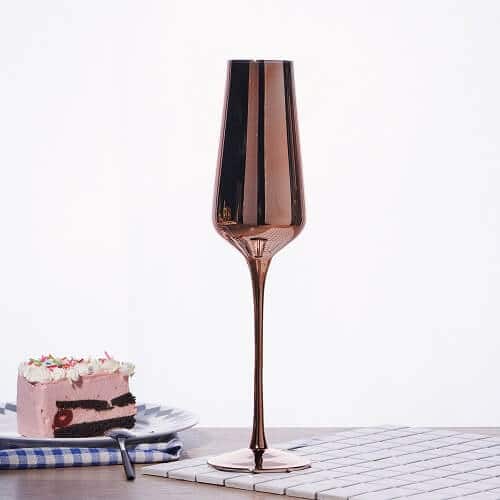
Where the Bubbles Start: Nucleation Points, Bowl Shape and Why a Coupe Goes Flat
Pour sparkling wine into a brand-new, spotlessly clean, perfectly polished glass and something strange happens: almost nothing. A brief hiss, a collar of foam that collapses, then a still, flat-looking drink. The champagne has not gone flat — it is fully charged with gas. It simply has nowhere to start.
This is one of the most useful things a buyer of branded glassware can know, and it almost never comes up in a brief. Bubbles in a sparkling wine do not appear out of the liquid on their own. They need a defect to grow on — a scratch, a speck, a trapped pocket of air. Good champagne glasses are manufactured with that defect deliberately etched into the base of the bowl. It is called a nucleation point, and whether your order has one is a decision you are making even if nobody asks you about it.
This article is about the bubble: what the bowl shape does to a sparkling pour, why the coupe that photographs beautifully is the shape that goes flat first, and how a logo etched too low on the bowl can throw its own stray bubble stream across your brand mark. If you are choosing custom champagne glasses in Malaysia for a launch, a gala or a wedding, this is the layer underneath the shape chart.
Champagne does not make its own bubbles
A sealed bottle holds roughly ten grams of dissolved carbon dioxide per litre at five to six atmospheres of pressure. When the cork comes out, that gas is desperate to leave — but forming a brand-new bubble from nothing inside a liquid takes far more energy than the drink has available. Physicists call the easy route heterogeneous nucleation: the gas needs an existing pocket of trapped air, above a critical radius of about two micrometres, to grow into.
In an ordinary glass, those pockets come from cellulose fibres — microscopic threads shed by the polishing cloth, the tea towel, the cardboard carton the glass travelled in, or the air of the room. Each fibre traps a tiny cylinder of air and can pump out something in the order of thirty bubbles a second until it exhausts itself. Every bubble train you have ever admired rising through a flute was almost certainly launched off a piece of lint. Which means the bubble show at your event is being decided by your caterer’s linen cupboard — a fragile way to run a toast in front of two hundred guests and a photographer.
The etched nucleation point most buyers have never heard of
Better glassware factories solve this on purpose. Inside the base of the bowl, at the lowest point of the liquid, they laser-etch a small deliberate roughness — typically a ring made up of no fewer than twenty individual impacts, each one a permanent, repeatable nucleation site. The result is what you actually want in a photograph: a single steady column of bubbles rising from the centre, identical in every glass on the tray, still going long after a random lint fibre would have burnt out.
The research on this is surprisingly specific: around twenty nucleation sites appears to be the sweet spot — enough for a confident, visible column, not so many that the drink froths itself empty in the first minute. More bubbles is not better. A glass that boils is a glass that will be flat before the speeches finish.
The distinction that matters on a branded order
A sandblasted or laser-engraved logo sits on the outside wall of the bowl. It is decoration; it does nothing for the bubbles, because the drink never touches it. A nucleation point is etched on the inside, at the base, in contact with the liquid. They are two different operations, on two different surfaces, and having one does not give you the other. If the bubble column matters to your event, it has to be specified as part of the glass, not as part of the branding.
The stray-bubble problem we now check for at mockup stage
Sandblast etching leaves a frosted, microscopically pitted surface — physically, exactly the kind of surface that likes to nucleate gas. On a flute the etched logo normally sits high enough to stay clear of the pour, and nothing happens. But when a client asks us to drop the mark low, close to where the bowl narrows, part of that frosted area ends up submerged. It can then quietly start its own bubble stream, with bubbles crawling out of the letterforms — which looks either charming or like a fault, depending entirely on whether you expected it.
Because of that, our production team’s standard advice on any etched champagne order is to pour something carbonated into the physical sample before you approve the artwork position — thirty seconds with a bottle of sparkling water tells you more than a week of PDF proofs. Clients who like the effect keep it; the rest move the mark up. Either way, nobody discovers it at the venue.
What the bowl shape does to a sparkling pour
Once the bubbles are rising, the bowl decides what they do to the drink. A rising bubble train is not decoration; it is a pump. It drags liquid up the centre of the glass and pushes it back down the walls, and that circulation carries aroma to the rim while it strips dissolved gas out of the wine.
In a tall, narrow flute that circulation reaches roughly two and a half centimetres out from the column — essentially the entire liquid surface, so the whole drink is being mixed and refreshed. In a wide, shallow coupe the same column only stirs about one centimetre outward, so around half the liquid never joins in, while the drink’s much larger exposed surface quietly bleeds carbon dioxide into the room. That is the coupe paradox: the best-looking glass in the photograph and the worst-performing glass in the hand. It is not a mistake to choose one. It is a mistake to choose one for a two-hour standing reception and then wonder why the second half of the evening tastes tired.
| Bowl shape | What the bubble column does | How long it stays lively | Where it earns its place |
|---|---|---|---|
| Flute | Stirs the full liquid surface; narrow rim holds gas in | Longest | Launches, galas, long standing receptions, tray service |
| Tulip | Full circulation, then the tapered rim traps aroma above the drink | Long | Seated dinners, tastings, anywhere the drink itself is the point |
| Coupe | Stirs only part of the bulk; wide surface loses gas fast | Shortest | Photographed toasts, glass towers, short glamour moments |
| Stemless flute | Flute-like column, but the hand warms the drink through the wall | Medium, and shortens in a warm room | Casual receptions, bar service, take-home keepsakes |
The Malaysian variable nobody puts in the shape chart: temperature
Every diagram of flutes and coupes you will find online was drawn for a temperate room. Ours is not one. Gas solubility falls as liquid warms, so a chilled sparkling wine poured into a room-temperature glass at a garden reception in Kuala Lumpur in the middle of the afternoon starts shedding its carbon dioxide the instant it lands. Three things follow, and they are all free:
- Chill the glasses, not only the bottle. A cold bowl slows the whole reaction and keeps the pour looking alive through the speeches.
- Pour on the tilt. Running the wine down the inside wall instead of dropping it into the base preserves noticeably more dissolved gas — the same trick a bartender uses with beer, for exactly the same reason.
- Pour late. Trays laid out fifteen minutes before the toast for the sake of a clean set-up photograph are trays of flat wine by the time the emcee reaches the microphone.
Capacity: why a 185ml flute behaves differently
A slim 185ml flute is a genuinely different serving object, and the difference is about the clock rather than the drink. A smaller pour is exposed to the room for a shorter time before it is finished, so guests are far more likely to drink it while it is still properly sparkling, and top-ups happen more often — which means more of the wine reaching guests has just left a cold bottle.
The trade-off is service load. More glasses in circulation means more collection, more washing between rounds and more traffic across the floor — which is why the glass you choose here has direct consequences for how two hundred glasses actually travel to a ballroom on the night. Shape, capacity and logistics are one decision wearing three hats.
Putting the logo where the bubbles are not
Once you know a nucleation ring throws a single vertical column of bubbles up the middle of the glass, the branding question changes shape. In a filled flute, that column is the busiest visual element in the object. A mark placed directly behind it competes with a moving stream of white dots; the same mark rotated a quarter-turn around the bowl reads cleanly, with the bubbles beside it rather than through it. That is not a reason to avoid nucleated glasses — it is a reason to review a filled sample rather than an empty one, from two metres away, which is the distance a guest at a launch actually sees it from.
A quick specification framework
When you send us a brief, these five lines answer almost every question we would otherwise have to come back to you with:
- Format of the moment — seated dinner, standing reception, photographed toast or take-home keepsake. This picks the shape before anything else does.
- Indoor or outdoor, and the time of day — the temperature question, and also the one that decides whether real glass is appropriate at all.
- How long a guest holds one glass — under twenty minutes tolerates a coupe; over an hour wants a flute or a tulip.
- Nucleation: yes or no — ask us to confirm on the specific model; it is not universal and not visible in a catalogue photograph.
- Branding method and position — etch, engrave or metallic print, and how high on the bowl.
If the answer to line two is “outdoors, on a pool deck, at four in the afternoon”, the conversation stops being about bowl shape and becomes a conversation about moulded plastic flutes and metallic finishes instead — a different set of trade-offs entirely, and one worth understanding before the venue tells you no glass on the deck.
Ordering, lead times and what we need from you
We are a Singapore-based corporate gifting specialist working since 2003 and now serving Malaysia from Kuala Lumpur. Our minimum order on champagne glassware is from 300 pcs. Digital mockups come back in about one business day; production runs 21–45 days after artwork approval depending on quantity and branding method, plus roughly 15 days shipping, with an express route of 10 working days on limited styles and quantities. Quote-only, invoiced with SST, and ePerolehan-ready documentation for government and statutory buyers.
Champagne bubble questions we get asked
Does every champagne flute have a nucleation point?
No. It is a deliberate manufacturing step, not a standard feature, and it is essentially invisible in a product photograph. Ask for it to be confirmed on the specific model you are quoting, because two glasses that look identical in a catalogue can behave completely differently once filled.
Will an etched logo make my champagne go flat faster?
Not in any way a guest would notice, provided the etch sits on the outside of the bowl where the drink never touches it. The case worth checking is a frosted mark placed very low, where part of it ends up submerged and can start its own small bubble stream — a visual question, not a taste one, and easy to resolve at mockup stage.
Coupes look best in our photographs. Is that a bad choice?
Not at all — just match it to a short moment. Coupes are excellent for a photographed toast, a glass tower or a welcome drink that guests finish quickly. For a two-hour reception where one glass has to last, a flute or a tulip will still be sparkling when the coupe has gone quiet.
Can you etch a nucleation point into glasses we already own?
It is far better handled as part of a new order. Working inside the base of an existing bowl gives inconsistent results across a batch, and consistency is the entire benefit. Tell us the effect you want and we will source models that already have it.
Get the bubble right before you approve the artwork
Send us your event date, guest numbers and logo and we will come back with a digital mockup, a shape recommendation and confirmation of whether the model you like carries a nucleation ring. Minimum order from 300 pcs, nationwide delivery across Malaysia, quote-only with SST invoicing.
Or start by browsing our champagne flute and coupe range.
Aquaholic Gifts Malaysia · AS80, Jalan Hang Tuah 4, Taman Salak Selatan, 57100 Kuala Lumpur


