Stitch, Edge, Lining, Hardware: The Four Places a Leather Gift Fails
Nobody has ever returned a corporate leather gift because of the colour. They return it, or quietly stop using it, because a thread has come loose and left a flap of lining hanging, because the painted edge has chipped along one side, because the keyring split and dropped a set of keys, or because the lining has bubbled away from the leather in a way that looks like the item is coming apart. Four places, every time.
All four are visible on a pre-production sample, and none of them requires a laboratory. This is the bench routine our production team runs when a sample arrives, written out so that you can run it yourself before you approve a run of 200 pcs. It takes about five minutes, and it is the difference between finding a construction problem on one item and finding it on all of them.
Failure one: the stitch
Stitching on a small leather item is doing two jobs: holding layers together and acting as a visible quality signal. It fails in predictable ways. Stitches placed too close to the cut edge tear out under load, because there is not enough material between the perforation and the edge to hold. Stitch length that is too long looks cheap and leaves long spans of exposed thread to snag; too short perforates the leather so densely that the line becomes a tear-off strip. And a lockstitch line that has not been secured at the ends will unravel from the first broken stitch onward, which is why a loose thread on a leather item is more serious than on a fabric one.
What to look for on the sample: a consistent, even stitch length along the whole line with no bunching at corners; thread that sits down in its channel rather than standing proud; a clear margin between the stitch line and the edge; and secured, tidy ends with no loose tails. Bonded polyester thread is the sensible default for corporate leather goods in this climate — it holds up to humidity and does not weaken the way natural fibre thread can. If a supplier cannot tell you what thread they are using, that is itself an answer.
Failure two: the edge
There are three ways to finish the cut edge of a leather item, and they fail differently. A raw edge is simply the cut, sometimes burnished; it is honest, it works well on thick full grain, and it looks wrong on thin coated material because the layers show. A painted edge is a lacquer applied in coats and sanded between them; it looks the most finished and is the most likely to crack and chip, especially where the coating is thick and the substrate flexes. A turned edge — the leather skived thin, folded over and glued down — is the most durable of the three on small goods, and the failure mode is the fold opening at a corner rather than the surface chipping.
In warm, humid air the substrate under a painted edge is constantly swelling and shrinking slightly while the lacquer film is not, and that mismatch is what eventually cracks the paint. It is also the reason an edge finish that looks flawless on the approval sample can look tired within a couple of years — which is one more argument for understanding darkening, patina and the lifted edge before you choose between a painted and a turned edge on a large order.
Failure three: the lining and the glue line
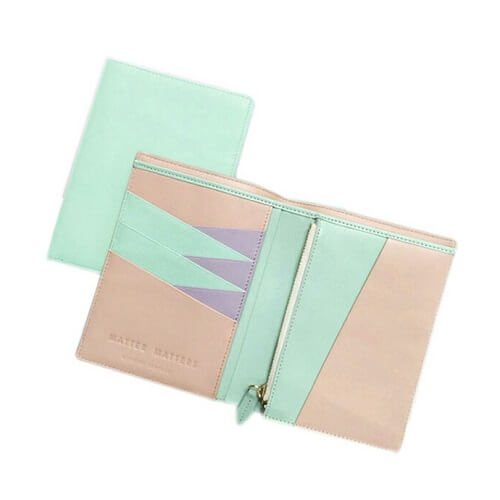
Almost every small leather good is a laminate: face material, adhesive, a stiffener or interlining, adhesive, lining. It is held together as much by glue as by stitching, and the glue line is where a well-made item and a cheap one really differ. Symptoms of a poor bond are easy to spot once you know them — a lining that lifts at a pocket mouth, a soft bubble under the face material when you press it, a card slot whose top edge has separated, or a faint outline of the stiffener visible through the face because the adhesive was applied unevenly.
Adhesive is also the component most affected by heat. An item left on a dashboard or in a car boot through a KL afternoon gets hot enough to soften many adhesives, and repeated cycles of that are what open pocket mouths on a wallet or a passport cover. The lining material matters too: a woven lining survives handling better than a thin non-woven, and a wipeable lining is worth specifying on anything that goes in a bag with a water bottle.
Failure four: the hardware
Hardware is the component buyers spend the least time on and recipients notice the most, because when it fails it fails abruptly. The usual suspects across a leather gift range are split rings and swivel clasps on keyrings and car key fobs, snap studs on wallets and passport covers, zips on coin and pouch sections, buckles and strap keepers on luggage tags, and magnetic closures on tablet covers.
- Split rings and clasps. A thin ring opens under the weight of a full key set. A swivel that is stiff on day one becomes a swivel that grinds. Test the ring by loading it and the swivel by rotating it repeatedly.
- Snap studs. The failure is not the stud breaking but the stud pulling out of the leather, taking a small disc of material with it. A stud set through a reinforced patch survives; one set through a single layer of thin material does not.
- Zips. The slider and the tape matter more than the teeth. Run the zip repeatedly and watch whether the slider tracks smoothly at the corners of a curved run — corners are where cheap sliders jam and eventually derail.
- Plating. In humid air, thin plating on a base metal develops surface spotting, and it does so faster on items carried against a body. Ask what the base metal and the finish are, and check hardware that has been handled rather than hardware straight out of a bag.
Hardware is also a branding opportunity that costs nothing extra in material: an engraved plate on a keyring or a luggage tag frame outlives the leather around it, which is worth weighing against why a fine logo disappears on pebbled hide when the item’s leather panel is small or heavily grained.
The bench test: six checks in five minutes
Run this on the sample before you approve the run
- The thread pull. Find the end of a stitch line and pull the thread gently sideways. Secured ends do not move. If a stitch lifts, the whole line will unravel in service. Then run a fingernail along the stitching and feel for thread standing proud of the surface.
- The edge rub. Ten firm passes of a thumbnail along one painted edge, then look at it under a light. Whitening, a hairline crack or any transfer of colour onto your nail means the finish is thin or under-cured.
- The fold and recover. Fold the item fully closed, hold it for a slow count, release it and watch the fold line. A crease that stays sharp and pale is a finish that will crack there. On real hide the fold should relax and the surrounding area should wrinkle finely rather than crease hard.
- The lining peel. Press a thumb across every lined panel, feeling for soft spots or bubbles, then pick gently at the mouth of each pocket. A good bond gives nothing at all; a poor one lifts a millimetre and tells you where the item will open first.
- The hardware cycle. Open and close every snap, run every zip end to end several times, load and twist the split ring, and rotate any swivel. You are listening as much as looking — grinding, clicking or a snap that needs two hands is a fault in a gift.
- The loaded fit. Put the item into service on the bench: cards in the slots, a passport in the passport cover, a key set on the ring. Half of all fit complaints appear the moment an item is filled, and none of them appear on an empty sample.
Any of these that fails is worth raising immediately, because at the sample stage it is a specification conversation and after production it is a claim. It is also worth remembering that a construction fault and a material fault look similar to a recipient — an item peeling at the edge because the adhesive gave way and an item peeling because it was bonded material are the same disappointment, which is why what the term genuine leather actually covers deserves the same scrutiny as the stitching.
What to write into the leather specification
| Component | What to state in the brief | Why it matters here |
|---|---|---|
| Stitching | Bonded polyester thread; even stitch length; secured ends; adequate edge margin | Humidity and daily handling punish weak thread and short edge margins first |
| Edge finish | Turned edge where the item flexes; painted edge only where the substrate is firm | Painted edges crack on flexing panels in warm damp conditions |
| Lining and adhesive | Woven lining; heat-stable adhesive; no bubbling or lifting at pocket mouths | Car interiors and unconditioned store rooms both soften weak glue lines |
| Hardware | Base metal and plating named; studs set through a reinforced patch; smooth zip run | Plating spots in humid air; studs pull out of thin, unreinforced material |
| Approval | Signed pre-production sample retained by both sides, photographed on all faces | Gives every later conversation a physical reference instead of a memory |
What “approved” should actually mean
Approval is not an email saying the sample looks nice. Sign and date the physical sample, photograph every face of it including the edges and the inside of the pockets, and keep it until the order is delivered and accepted. A retained sample turns a disagreement about a batch into a two-minute comparison.
How this fits the order timeline
Build the sample round into your schedule rather than bolting it on. A digital mockup comes back in about one business day, and the physical sample follows. Production then runs 20 to 30 working days after artwork approval depending on quantity, plus around 15 days shipping, with express production of 10 working days available on limited styles and quantities. Custom leather items start from 200 pcs, varying by item. Working with a leather gifts supplier Malaysia buyers can inspect means the sample stage is treated as a decision point, not a formality — and as a corporate gifting specialist that has been shipping these orders since 2003 from Singapore and now serves Malaysia, that is the stage where we would rather spend your patience. Delivery is nationwide with an SST invoice, and we are ePerolehan-ready for government buyers.
Ask for the sample, then take five minutes with it
Tell us the item and how it will be carried, and we will send a sample built the way the run will be built — thread, edge, lining and hardware all specified. Talk to our leather gifts Kuala Lumpur team about your next order.
WhatsApp +60 10 717 5924 · Contact our Kuala Lumpur team · AS80, Jalan Hang Tuah 4, Taman Salak Selatan, 57100 Kuala Lumpur
Leather construction questions we get asked
Which edge finish lasts longest on a leather gift?
On small goods that flex in daily use, a turned edge generally outlasts a painted one, because there is no lacquer film to crack. A painted edge looks the most finished and suits firm, less flexible panels. A raw burnished edge works well on thick full grain and looks wrong on thin coated material.
Can we get a physical sample before committing to the full order?
Yes, and you should. Ask for the sample to be built to the production specification rather than pulled from stock, then run the six bench checks above on it, sign it, photograph it and keep it. That single step prevents most of the disputes that arise after delivery.
Why does hardware develop spots on some items and not others?
Thin plating over a reactive base metal spots in humid air, and it happens faster on items carried against the body or stored in sealed packaging. Ask which base metal and which finish are being used, and prefer hardware you have handled over hardware you have only seen photographed.
What are the order minimums and lead times?
Custom leather items start from 200 pcs, varying by item. Allow about one business day for a digital mockup, then 20 to 30 working days of production after artwork approval depending on quantity, plus around 15 days shipping. Express production of 10 working days is available on limited styles and quantities.