The Bag Nobody Opens Until Tuesday: Wet Kit, Ventilation and the Honest Limit of “Waterproof”
The worst thing that ever happened to a gym bag sample in our office was nothing at all. A loaded duffle was zipped shut on a Friday afternoon with a damp towel inside, left in a warm room over the weekend, and opened on Monday. Nobody wanted to touch it. That accident became a fixed step in how we check sports bag samples, because it reproduces exactly what your recipients do: train, stuff the kit in, zip it, and forget the bag until the next session.
Almost every specification conversation about custom sports bags in Malaysia is about keeping water out. Rain, a wet car park, a downpour between the office and the car. That is the easy half. The harder half — the one that decides whether your logo’d duffle is still in use next year or has quietly been retired to a store room — is what the bag does with the water that goes in, deliberately, every single session. This article is about water moving in that direction, and about the point where the word “waterproof” stops helping you and starts working against you.
What actually happens inside a closed duffle between two sessions
A gym bag spends most of its life shut. The realistic cycle in Kuala Lumpur looks like this: session ends around eight in the evening, kit goes in, bag goes in a car boot or a hallway, and it is not opened again until the next evening — or, for a club that trains twice a week, until three days later. Ambient humidity here sits high enough year-round that a closed polyester barrel with a wet towel in it does not dry. It equilibrates. The air inside reaches saturation, the fabric stays wet, and the interior becomes a warm, still, damp box.
Three things follow, in a predictable order. First, odour — bacteria on skin and in sweat metabolise on synthetic fibres in exactly these conditions. Second, staining — a dye-transfer mark from a wet coloured jersey pressed against a pale lining for two days is often permanent. Third, mildew spotting on an uncoated lining, which shows as fine dark speckles along seam allowances and in the base corners where water pools.
None of that is a manufacturing defect. It is what happens when a brief treats the bag as a container rather than as a small sealed environment. It is also the commonest reason a branded bag stops being carried — and a bag that is not carried is a logo nobody sees.
The three things that go in wet, and what each one does
1. Sweat-loaded clothing
A soaked training shirt is the largest single water load in the bag and the most spread out — it touches every interior surface it can reach. It is also the load that carries the odour problem with it. Isolating it is worth more than any coating you can put on the outer shell.
2. Free water
Swimwear, a wrung-out towel, a bottle that was not fully closed. Free water runs downhill and collects in the base corners. If the base seam allowance is raw-edged and untaped, that water sits against exposed yarn ends for days. This is the failure that produces the tide-mark line you see along the bottom of an old bag.
3. Soil
Grass, court dust, sand, red earth from a padang after rain. Dry soil is a nuisance; wet soil is a stain that binds into the weave. Where the bag also carries footwear, soil and free water together do the damage — which is why how much room a shoe compartment really takes is a wet-kit question as much as a capacity one.
Where the air has to move on a barrel-shaped bag
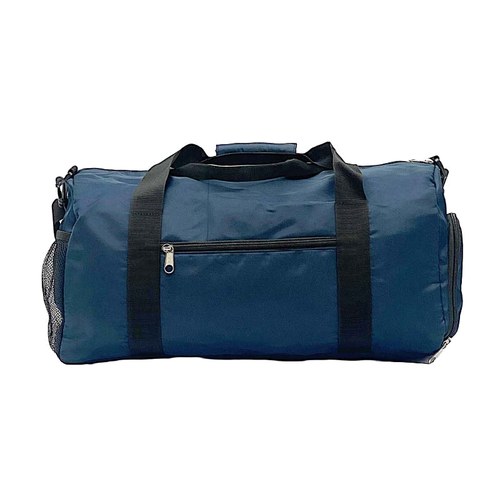
Ventilation on a duffle is a geometry problem. A duffle is a barrel: its interior volume is large relative to its openings, and the top zip runs along the highest line of the bag, where humid air already wants to sit. Punching a few eyelets into one end panel does little on its own, because air does not circulate through a single hole. Cross-flow needs two openings, on opposite ends or faces, with a path between them that a stuffed main compartment does not block. That gives four usable arrangements, and it is worth naming yours in the brief rather than asking vaguely for “ventilation”:
| Arrangement | How it is built | What it genuinely achieves | Cost to the brief |
|---|---|---|---|
| Metal eyelets, one end | Punched and set through the end panel, usually in a cluster of four to six | Lets pressure equalise and moisture escape slowly. Does not create airflow on its own | Cheapest option. Ask for a corrosion-resistant finish, not raw nickel |
| Mesh panel, one end or one side pocket face | A cut-out backed with open sports mesh, bound and stitched into the panel seam | Real vapour transfer from the pocket it serves. Best where the wet item is isolated behind it | Removes that panel as a print surface and adds a construction step |
| Mesh at both ends (cross-flow) | Opposing panels, so moving air has an entry and an exit | The only arrangement that dries a main compartment while the bag stays shut | Loses both end panels for branding and reduces dust exclusion |
| Vented wet pocket only | Sealed or coated pocket with grommets in its own outer face | Isolates the wet load and still lets it breathe outward, away from dry kit | The most useful compromise for a corporate or club bag |
The wet pocket: three ways it is built, and what each one really isolates
“Wet/dry compartment” covers three very different constructions, and a catalogue rarely says which you are getting. Ask directly.
A. The divided barrel. A fabric wall sewn across the main compartment, with its own zip on the outside. Cheap and roomy. It separates items but not moisture — vapour crosses the divider freely, and the divider seam itself is a wick.
B. The lined pocket. A separate pouch built from coated fabric, seamed into one end or one face. Water stays in the pouch for hours. This is the honest middle ground and what most club briefs should ask for.
C. The bonded liner. A welded or taped inner bladder with a sealed base, sometimes removable. Genuinely holds standing water. It is the only version that survives a swimming programme, and it is the only one worth also venting, because sealed plus damp plus warm is the worst combination in the bag.
Linings that survive being wetted over and over
The outer shell gets the attention. The lining is what lives with the wet kit, and only a few decisions matter.
Colour. A pale lining shows dye transfer and mildew speckle immediately; a mid-to-dark lining hides both and keeps the bag looking serviceable for years. This is the cheapest change on the entire specification and nobody asks for it.
Seam finish inside the base. Raw overlocked edges in the base corners hold water against yarn ends. A bound or taped base seam costs a little more and is the difference between a bag that dries and a bag that develops a permanent smell.
Wipeability. A main compartment you can reach into flat and wipe with a cloth gets cleaned; one full of internal pocket walls, elastic loops and sewn-in dividers does not.
Antimicrobial finishes. Be sceptical. If one is offered, ask what it is, whether it washes out, and what test standard the claim is made against. A vent and a dark lining will do more for the recipient than an unverifiable finish claim.
The honest limit of “waterproof” on a sports bag
Here is the contrarian part, and we would rather say it before you order than after. A standard duffle with a coiled top zip is water-resistant, not waterproof, and it cannot be made waterproof without becoming a different product. The top zip is a continuous opening along the highest seam. Strap anchors are stitched through the shell — every needle penetration is a hole. Base seams are sewn, not welded. A heavier coating and a storm flap over the zip will meaningfully improve rain performance, but they will not give you a sealed vessel.
More importantly, for a gym bag you should not want one. A genuinely sealed bag holds every gram of sweat and every millilitre off a wet towel inside a warm space for days. The best-performing bags in real use are the ones that resist rain from the outside and let vapour out from the inside, with the wet load isolated so it cannot reach the dry kit. Sealed is the right answer for a dry bag. Vented-plus-isolated is the right answer for sportswear.
The drying-window brief: four questions that set the whole specification
Start from the gap between sessions, not from a bag model. Answer these four and the construction picks itself.
- How long does the bag stay shut after a session? Under four hours, and a divided barrel is fine. Overnight or longer, and you need an isolated wet pocket. Multi-day gaps push you to a bonded liner plus a vent.
- How wet is the wettest item? Damp shirt, or dripping swimwear? Anything that can produce standing water changes the base construction, not just the pocket.
- Where does the bag live between sessions? A car boot in the afternoon sun is the harshest storage condition in the country. An air-conditioned office is the mildest. Same bag, very different outcomes.
- Does footwear share the space? If yes, the soil and moisture loads combine, and separation stops being optional.
The soak-and-shut check we run on a pre-production sample
Since that Monday morning this has been a standing step on sports bag samples. It tells you more than any datasheet.
- Soak a towel, wring it once so it is heavy but not dripping, and put it in the compartment the recipient would actually use.
- Put a folded sheet of pale dry cloth in the main compartment, against the divider or the pocket wall.
- Zip the bag fully and leave it somewhere warm and still for a full day and night.
- Open it and check three things in this order: is the dry cloth still dry, is there standing water in the base corners, and what does the interior smell like.
- Then leave the bag open and see how long it takes to smell neutral again. A bag that needs several days is a bag that will be abandoned.
Run it before you approve bulk, not after. It sits naturally alongside the four junctions that fail on a carried bag, so one sample session can clear both.
Getting ventilation into your order
Vents, coated pockets and taped base seams are construction changes, so they belong in the brief at quotation stage. Our minimum order is 100 pcs per design. Production runs 21–45 days after artwork approval depending on quantity, plus roughly 15 days shipping; an express route of 10 working days exists for limited styles and quantities. A digital mockup normally comes back within one business day, and invoicing is SST-compliant with ePerolehan-ready documentation for government and statutory buyers. If you are ordering for a whole squad, the timings interact with kitting a whole club in one order, so bring both conversations at once.
Wet kit questions we get asked
Can a custom gym bag be genuinely waterproof?
Not while it has a conventional top zip and stitched strap anchors. It can be strongly water-resistant with a coated shell, a storm flap and taped base seams — the better target anyway, because a sealed interior traps sweat.
Do ventilation eyelets let rain in?
Placed low on an end panel they can take in splash. Placed on the upper third of an end panel, or on the outer face of a wet pocket, they vent without becoming an obvious entry point. Specify the position, not just the feature.
Can the wet pocket be printed on?
Its outer face usually can, but coated surfaces behave differently under heat transfer and silkscreen. Say so at mockup stage and we will test on the actual coated fabric.
What is the minimum order for a custom gym duffle in Malaysia?
100 pcs per design. Ventilation and lining changes do not raise that figure, though they do need to be agreed before the mockup is approved.
Tell us what goes in wet, and we will spec the bag around it
Send us the session pattern, the wettest item and where the bag sleeps between sessions. We will come back with a mockup, a construction recommendation and a quote. A Singapore-based corporate gifting specialist since 2003, we now produce and deliver nationwide across Malaysia from our Kuala Lumpur base. You can also browse our custom gym duffle range first.
Aquaholic Gifts Malaysia · AS80, Jalan Hang Tuah 4, Taman Salak Selatan, 57100 Kuala Lumpur