Kitting a Club at 100 pcs: Names, One Common Design and the Member Who Joins in March
The hardest bag in a club order is the one you order in March. The main run went out before the season, everybody got a bag with their name on it, and then three new members joined. Now you need a handful of bags in the same colour, the same model, the same embroidery thread and the same name style — below anybody’s minimum, months after the original dye lot, and needed before the next fixture. Every club kitting programme eventually meets this problem, and almost none of them plan for it at the point where planning is free.
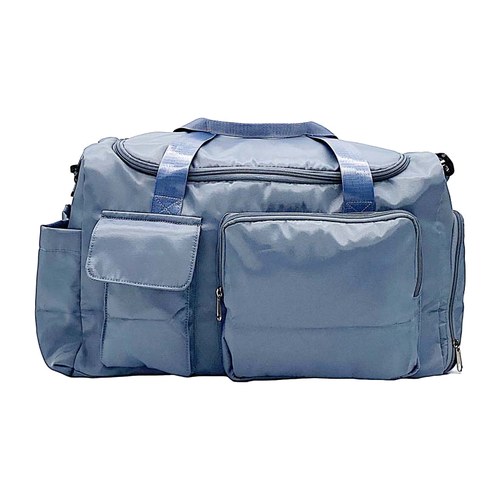
This article is about kitting a squad, a corporate sports team or a gym membership cohort with team sports bags with your logo at a real order quantity — how to decide between one common design and individual personalisation, how names and numbers are actually applied and what each method costs you in time, and how to build the reorder problem into the first order instead of discovering it later.
Decision one: how many designs are you really ordering?
Our minimum order is 100 pcs per design, and the phrase that matters there is per design. A design is a combination of bag model, colourway and common artwork. Individual names on an otherwise identical bag do not create new designs; a second colour for the junior squad does. Buyers often plan a two-colour split without realising they have just doubled the threshold they need to clear, and then have to redesign the programme late.
So before anything else, write down every variation you are imagining and mark each one as either a personalisation (same design, different name) or a genuine design split (different model, colour or common artwork). Most clubs find that what they wanted was one design with contrasting name blocks, not two designs — which is both cheaper and far easier to reorder.
Four ways to put a name on a bag — and what each does to your schedule
Personalisation is where a smooth order turns into a slow one, because it converts a single repeating process into a per-item process. The method decides how much slower.
| Method | How it looks | Schedule impact | Reorder friendliness |
|---|---|---|---|
| Heat transfer / DTF name strip | Crisp, full colour, any typeface, sits flat on the panel | Lowest — names are ganged onto one print sheet and pressed individually | Good. Easy to match later if the artwork file is kept |
| Computerised embroidery | Premium, stitched, best on a flat pocket face | Highest — each bag is hooped and run separately | Good, if the thread codes and digitised file are recorded |
| Woven or printed name tab | A small label stitched into a seam or a pocket edge | Moderate — labels are made in advance, then matched to bags at sewing | Moderate. Label runs have their own minimums |
| Removable hook-and-loop name patch | A patch on a sewn-in landing panel, swappable by the club | Lowest of all on the bag itself — the bags stay identical | Excellent. New patches can be made without new bags |
The contrarian recommendation: make the name removable
Most clubs instinctively want the name stitched on permanently, because permanent feels like quality. For a club with a stable membership and a long horizon, that is right. For almost everybody else it is the wrong call, and here is why.
A permanently named bag has exactly one owner for its entire life. When that member leaves, the bag leaves with them or becomes unusable stock. A bag with a sewn-in landing panel and a removable patch is a club asset: it can be reallocated, it can be reissued to a new intake, and a replacement patch is a small, fast, low-minimum item compared with a new bag. The club logo and the common artwork stay permanent, printed large where they belong; only the individual identity is swappable.
Two construction notes if you take this route. Put the landing panel on a flat pocket face, not on the curve of the barrel, or the patch corners will lift. And specify the panel colour to contrast with the shell, so an empty panel still looks deliberate on an unallocated bag rather than looking like something has fallen off.
Numbers, and the length problem nobody checks
Squad numbers are easy; names are not. The single most common cause of a late artwork round is a name list where the longest entry does not fit the block that was designed around a short one. Malaysian rosters routinely contain long multi-part names, names with bin and binti, names with apostrophes or hyphens, and names in more than one script.
Fix it in the brief with three rules. First, send the full list at mockup stage, not just a sample name — the block gets designed around the longest entry. Second, agree a policy up front for what happens when a name is too long: shorten to a preferred name, drop to a second line, or reduce the type size for that bag only. Third, decide the case convention (full capitals or title case) and stick to it, because mixing them across a squad is visible from across a room.
The name-list format that saves a round trip. One row per person, with these columns: row number, name exactly as it should appear, squad or department, and a preferred short form. Send it as a spreadsheet, not inside the body of a message — copied text loses accented characters and turns straight apostrophes into curly ones, and both cause artwork corrections.
And lock it. The list is the artwork. Once it is approved, changes to it are artwork changes, and the production clock restarts for the affected items.
Planning for the member who joins in March
This is the part worth reading twice, because it is decided at the first order and cannot be fixed afterwards. There are three viable strategies and one that is not.
Strategy one — blank buffer. Order a proportion of the run with the common club artwork but no individual name, allowing roughly one in ten spare on top of the confirmed roster. New members get a bag immediately; only the name element needs producing later, and with a removable patch that is a same-week job. This is the strategy we recommend most often.
Strategy two — scheduled intake batches. If your membership turns over on a known cycle — a school year, a corporate intake, a gym membership renewal — do not order continuously. Consolidate joiners into two windows a year and place a second order that clears the minimum properly. This suits schools and universities well.
Strategy three — a deliberately reproducible specification. If you know you will reorder, design for it: a stock bag model rather than a bespoke pattern, a standard shell colour rather than a custom-dyed one, and artwork that does not depend on an exact colour match across dye lots. A tonal or single-colour logo tolerates a slight shade shift between runs; a large photographic print against a bare shell colour does not.
The strategy that does not work is assuming a small top-up run can simply be placed later at will. Minimums exist for a reason, custom shell colours are dyed to order, and a dye lot from one season is not guaranteed to be matched exactly in the next. Plan the buffer at the start and the problem never arises.
The kitting calendar, counted backwards from handover
Work back from the date the bags must be in members’ hands — a season launch, a sports day, a Merdeka tournament, a year-end presentation night — not forward from today.
| Stage | What has to be finished | Timing |
|---|---|---|
| Handover day | Bags distributed, sorted by squad | Day zero |
| Delivery buffer | Goods received, counted, spot-checked against the name list | Allow a clear week before handover |
| Shipping | Nationwide delivery, longer to East Malaysia | Around 15 days |
| Production | Bags made, common artwork applied, names applied, packed | 21–45 days after artwork approval |
| Artwork approval | Logo layout and the locked name list both signed off | The clock starts here, not at enquiry |
| Mockup and roster close | Digital mockup returned; club stops accepting names for this run | Mockup usually within one business day of the brief |
The row that clubs consistently underestimate is roster close. Everything downstream is fixed and predictable; the only genuinely uncontrolled variable is how long the committee takes to stop adding names. Set that date first and defend it. An express route of 10 working days exists on limited styles and quantities, but it is a rescue, not a plan.
Packing and handover: the part that decides whether the day runs smoothly
Personalised goods arrive as a sorting problem. If they come in mixed cartons, somebody spends the morning of the event unpacking and hunting for names in a hall. Two requests at order stage remove that entirely: individual poly-bagging with the name visible through the bag, and carton labelling by squad or department with the name range printed on the outside. Ask for a packing list per carton as well. It costs nothing meaningful and it converts a chaotic handover into a table with labelled stacks.
One more practical point for a club: if the bags are being handed out at a training session, people will use them immediately. Make sure the model you chose actually suits how they train — that means checking shoe pockets and what actually fits inside one, and being honest about the overnight damp problem inside a gym bag, because a club bag lives a harder life than a corporate giveaway.
Placing the order
Send us the roster size, the handover date, whether you want individual names, and how you expect membership to change over the year. Minimum order is 100 pcs per design; production runs 21–45 days after artwork approval, plus about 15 days shipping nationwide. Invoicing is SST-compliant and we can prepare ePerolehan-ready documentation for schools, universities and statutory bodies. Because a club bag gets used hard, it is also worth running the approved sample through where a hard-used sports bag breaks first before you sign it off for the whole squad.
Team kitting questions we get asked
Does adding individual names change the minimum order?
No. The minimum is 100 pcs per design, and individual names do not create separate designs. A second bag colour or a different model does.
Can we add more bags later for new members?
A top-up run is a new order and has to clear the minimum in its own right, so the practical answer is to build a blank buffer into the first order or to batch joiners into scheduled intakes. Removable name patches make both approaches work far better.
Will a reorder match the original colour exactly?
On a stock shell colour it will be very close. On a custom-dyed colour, a later dye lot can shift slightly. If exact matching matters, order the full programme including the buffer in one run.
Should the club logo be printed or embroidered?
Print for large side-panel artwork and full colour; embroidery for smaller, premium marks on a flat pocket face. Many club bags use both — a printed crest on the side and a stitched name or squad tag on the pocket.
Can you deliver to more than one location?
Yes, nationwide across Malaysia, including split deliveries to different branches or campuses. Tell us the split at order stage so cartons are packed and labelled by destination rather than sorted on arrival.
Send the roster and the handover date — we will build the calendar backwards
Tell us the squad size, whether you want names, and how your membership changes through the year. We will propose a personalisation method, a buffer plan and a mockup. A Singapore-based corporate gifting specialist since 2003, now producing and delivering nationwide across Malaysia from Kuala Lumpur. You can get a quote on branded sports bags for your club today.
Aquaholic Gifts Malaysia · AS80, Jalan Hang Tuah 4, Taman Salak Selatan, 57100 Kuala Lumpur