The Armhole Is the Fit: Why Two Singlets Marked M Can Fit Nothing Alike
Two singlets came across the bench on the same morning, both labelled M, both measuring almost the same across the chest laid flat. On a person they behaved like different garments. One sat where a sleeved top sits. The other dropped so far down the side of the ribcage that the wearer’s undergarment strap was visible from three metres away, and she spent the rest of the fitting holding an elbow against her side.
Nothing about the chest measurement predicted that. The difference lived in a single number that neither quotation mentioned: how far the armhole was cut down the side seam. Once you remove a sleeve, that number stops being a construction detail and becomes the fit.
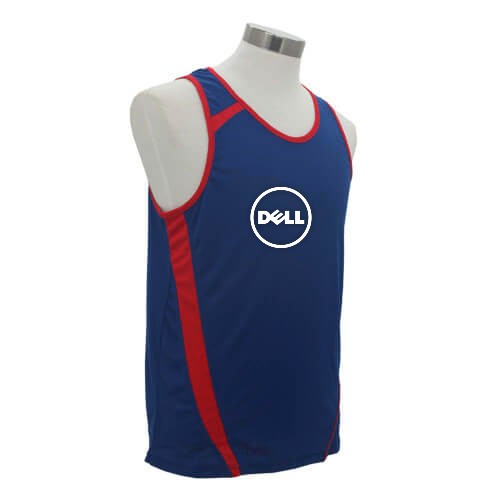
This is the article we wish buyers read before signing off a sleeveless sample: the four measurements that actually describe an armhole, the depths we cut for each kind of singlet, the three separate reasons an armhole gapes, and what a team photograph looks like when the armhole was specified by nobody. If you want to see the cuts side by side while you read, our custom singlets Malaysia range shows the running, stringer and racerback bodies next to each other.
Remove the sleeve and you remove the thing that was holding the fit together
On a sleeved garment, the sleeve is a structural member. It wraps the top of the arm, anchors the shoulder seam, and hides the armhole entirely. You can cut an armhole badly on a sleeved top and nobody will ever know, because the sleeve covers the evidence.
Take the sleeve away and three things happen at once. The armhole becomes a visible finished edge. The shoulder seam loses its anchor and slides inwards or outwards depending on strap width. And the opening becomes a window: whatever sits underneath is on show through it.
That is why chest measurement alone tells you almost nothing about a singlet. A generous chest with a shallow armhole gives you a boxy, modest tank. The same chest with a deep armhole gives you a gym stringer. The tape reads identically in both cases.
The four numbers that describe an armhole
When our production team writes a singlet spec, the armhole is never one figure. It is four, they interact, and every one is measured on the garment laid flat rather than on a body.
| Measurement | How it is taken (garment flat) | What it controls |
|---|---|---|
| Armhole drop | Highest point of the shoulder, straight down the side, to the bottom of the armhole curve | How much ribcage is exposed below the underarm |
| Armhole opening | Along the curve, shoulder point to underarm point | Whether the arm has room, and how much binding the edge needs |
| Strap width | Narrowest point of the shoulder, neckline edge to armhole edge | Whether the strap covers an undergarment strap, and whether a logo fits |
| Chest width below armhole | Across the body 2.5 cm under the armhole curve, seam to seam | Whether the opening lies flat on the ribs or stands away |
The last row is the one buyers miss. A deep armhole on a narrow body pulls flat against the ribs and looks intentional; the same drop on a wide, boxy body has nothing holding it closed and hangs open. Depth and width must be chosen together.
The depth bands we cut, by what the singlet is for
These are the working ranges our production team specs on a men’s size M body, measured as armhole drop from the high shoulder point. The M figure is the anchor you approve and the rest of the run is graded around it. Ladies bodies typically run one to two centimetres shallower at the same nominal size.
| Singlet type | Armhole drop on M (typical) | What that depth is doing | Where it goes wrong |
|---|---|---|---|
| Event or marathon singlet | 20–22 cm | Covers the ribcage, prints large, works over a base layer | Too shallow and the arm rubs the binding |
| Training singlet | 22–24 cm | Frees the shoulder while staying closed at the ribs | Little — the safest band for a mixed group |
| Running vest | 23–25 cm | Air moves through; the edge clears a swinging arm | Gapes if the body is boxy rather than tapered |
| Basketball singlet | 25–28 cm | Full overhead range, no edge catching the shoulder | Shows side torso; needs a fitted body |
| Gym stringer | 28–33 cm | Deliberately open — the cut is the style | Not a corporate garment; order only on request |
| Ladies racerback | 19–22 cm | Straps pulled inwards, opening sits higher and closer | Pulled too far in, they press on the neck |
Notice how narrow the useful corporate band is. Between roughly 20 and 24 centimetres almost anybody in a mixed group will wear the garment. Below 20 it binds. Past 26 you are into styling territory and people quietly decline. That is tied to how wide a shoulder strap has to be before a logo can live on it, because a deep armhole and a narrow strap arrive together.
Three reasons an armhole gapes, and they need three different fixes
“It gapes” is the most common complaint on a sleeveless order, and it is not one fault. Diagnosing it correctly stops you paying to fix the wrong thing on the next run.
One: the body is wider than the wearer
If the chest width below the armhole is generous, the fabric has to go somewhere, and the shortest route is outwards through the opening. This is what makes a boxy unisex singlet gape on a slimmer wearer while fitting the largest person in the group perfectly. The fix is a taper through the body, not a shallower armhole.
Two: the armhole curve is too straight
An armhole has two distinctly different halves. The front must scoop more than the back, because the shoulder rolls forward. When a pattern uses nearly the same shape front and back, the front edge stands off the chest and you get a permanent gap under the front of the arm. Fold a flat sample at the shoulder: the front and back armhole edges should not mirror each other.
Three: the binding was stretched during application
The edge is finished with a strip or a fold, applied slightly shorter than the raw edge so it draws the curve in. Applied at the same length it holds the opening at full size; applied stretched, which happens when an operator pulls the strip flat, the finished armhole ends up longer than the pattern and flutters. That is workmanship rather than design, and it is why the binding that finishes a cut armhole deserves its own inspection step on the pre-production sample.
The two-minute gape test on a sample
Put the sample on a person of the right size, arms relaxed and down. Slide two fingers flat between the front armhole edge and the chest.
Two fingers with light contact is correct. A whole hand with room to spare points at chest width. A gap only at the front points at the pattern curve. An edge that ripples along its length with the arm down points at stretched binding.
Side seam or tube: two ways to build the body
A singlet body reaches the sewing machine either as two panels joined at both sides or as a continuous tube with no side seams. Buyers are rarely asked which they want, and the two behave differently once an armhole is cut into them.
| Side-seam construction | Seamless tube | |
|---|---|---|
| How it is built | Front and back panels cut separately, joined down both sides | Cut or knitted as a continuous loop, no vertical joins |
| Armhole behaviour | The seam anchors the bottom of the armhole and resists stretching outwards | No anchor point; the opening relies entirely on the binding |
| Fit shaping | Tapered, waist-curved or dropped-hem all possible | Straight through — only the knit shapes it |
| Printed artwork | Laid out per panel, but planned across the join | No join to plan around, at the cost of shaping |
| Best suited to | Fitted sports bodies and any deep armhole | Plain, boxy cotton singlets and casual gym wear |
The practical rule: the deeper the armhole, the more you want a side seam. A basketball or stringer cut on a seamless tube has nothing holding the bottom of the opening, and it stretches out along the edge within a season. Side seams also give you somewhere to reinforce, and the top of the side seam where it meets the armhole is the highest-stress point on the whole garment.
What a team looks like when nobody specified the armhole
Here is the outcome that brings people back to us. A group orders sleeveless kit and asks for “singlets, size M to XXL, our logo on the chest”. The armhole is never mentioned by either side, so the factory uses whatever depth its house pattern carries — usually a fairly deep sports cut, because that is what most sleeveless orders are.
On delivery day the largest wearers are comfortable and the smallest are not, because the same absolute drop in centimetres is proportionally far deeper on a smaller frame. Part of the group puts a tee underneath, which defeats the point of a sleeveless garment in a Malaysian afternoon. In the event photographs the row looks uneven, because half the group is wearing a printed singlet and half is wearing a printed singlet over a grey tee.
None of that is a manufacturing defect. Every garment matches the sample. The order simply never contained the number that decides how a sleeveless garment sits, so the factory chose it — for the average of everybody else’s orders.
Put this line in the order and the problem disappears
“Armhole drop 22 cm on size M, graded ±1 cm per size, front curve scooped deeper than back, chest measured 2.5 cm below armhole to be confirmed on the pre-production sample.”
That sentence converts the armhole from an assumption into a checkable specification, and gives you grounds to reject a sample that does not match.
Three habits that prevent it
- Grade the armhole, do not fix it. If the drop is identical from S to XXL, the small sizes are effectively wearing a deeper cut. Ask for it to move by around a centimetre a step.
- Approve the deepest and the shallowest size, never the middle. The middle size always looks fine; the ends are where a grading error shows.
- Decide layering before you decide the cut. Worn over a tee, you can go roomier and slightly deeper. Worn alone, close the armhole and taper the body.
That last point reaches the artwork too. A design drawn to sit high on the chest vanishes behind a collar if half the group layers, which is one reason panels printed flat before the singlet is sewn need the wearing scenario settled before the artboard is opened.
Questions buyers ask about custom singlets
What is armhole drop, and how do I measure it?
Lay the singlet flat, find the highest point of the shoulder where the strap meets the neckline, and measure straight down the side to the lowest point of the armhole curve. That is the armhole drop — the most useful single number on a sleeveless garment, and not the same as the opening measured along the curve.
Why does the same size fit two of our staff so differently?
Because the armhole drop is usually fixed across sizes while people are not. A 25 cm drop on a tall frame reaches the top of the ribs; the same 25 cm on a short frame reaches the waist. Grade the drop with the size and most of the difference disappears.
Can you make a singlet that does not gape at the armhole?
Yes — a shallower drop, a taper through the waist, and a front armhole curve cut deeper than the back. We show all three on the pre-production sample before the run starts.
Is a stringer suitable for a company event?
Rarely. A stringer’s drop is deep enough that a significant part of most groups will not wear it. Order stringers when recipients have asked for them, such as a gym’s own members, and use a training or event cut for a mixed workforce.
What is the minimum order for custom singlets in Malaysia, and how long does production take?
Our singlet MOQ is from 200 pcs. Production runs 20 to 30 working days after artwork approval, plus around 15 days shipping nationwide. An express route of 10 working days exists on limited styles and quantities — give us the handover date and we work backwards from it.
Send us the group, and we will send back the armhole
Tell us who is wearing them, what they are doing in them and whether anything goes underneath, and we will recommend a drop, grade it across the size run and return a free digital mockup before anything is cut. Browse the stringer singlet Malaysia and racerback cuts to see how far the depth range really travels.
A Singapore-based corporate gifting specialist since 2003, now serving Malaysia from AS80, Jalan Hang Tuah 4, Taman Salak Selatan, 57100 Kuala Lumpur. WhatsApp us on +60 10 717 5924 or use the contact page. SST-compliant invoicing and ePerolehan-ready documentation on request.