500ml, 1.5L or a 3L Airpot? Sizing a Customised Thermal Flask by Cups Served
Nobody buys a flask in millilitres. They buy it in cups — the four cups a manager pours across a morning of interviews, the twelve cups a surau needs during buka puasa, the forty cups a hotel breakfast counter turns over before nine. Yet almost every brief we receive names a volume first and works out the serving job afterwards, which is how a company ends up gifting 500ml flasks to a team whose actual problem is a meeting room with no kettle.
This article turns the question around. Start from cups served and the capacity falls out of the arithmetic. Below you will find a cups-per-fill table you can hold against your own use case, a four-room framework for deciding which size belongs where, and the two practical limits — weight and drop survival — that quietly rule out the size the spreadsheet recommends. It is the sizing conversation we have before we quote any customised thermal flask capacities for a Malaysian corporate order.
Capacity is a serving number, not a volume number
Three things sit between the number on the label and the number of drinks a flask actually delivers.
The stated capacity is not the fill capacity. Makers generally advise filling to roughly one to two centimetres below the base of the neck, so the stopper has somewhere to displace liquid into and does not force an overflow when it is screwed down. On a slim body that headspace is small; on a wide body it is not. Treat the label as an upper bound and plan on a working fill a little under it.
A cup is not a cup. The little melamine or paper cups on a pantry tray hold roughly 120–150ml. A standard office cup is nearer 200ml. A generous cup of kopi is 250ml or more. Halve the cup size and you double the servings, so the cup you have in the cupboard changes the flask you should buy more than any spec on the body.
The last portion is not usable. Whatever is left below the riser tube of a pump pot, or below the angle at which a stopper will pour cleanly, is liquid you paid to heat and will pour down a sink. Build in a margin: plan the flask so the job finishes at roughly four-fifths of the fill, not at the last drop.
The cups-per-fill table
Servings are calculated on a working fill of about 90% of the stated capacity, rounded down — the honest number, not the marketing one.
| Stated capacity | 150ml pantry cups | 200ml office cups | 250ml large cups | Realistic job |
|---|---|---|---|---|
| 350ml | 2 | 1 | 1 | One person, one sitting |
| 500ml | 3 | 2 | 1 | One commuter, half a working day |
| 750ml | 4 | 3 | 2 | One person, a full day, or two people sharing |
| 1L | 6 | 4 | 3 | A small huddle; a family car journey |
| 1.5L | 9 | 6 | 5 | A meeting room of six to eight, one round |
| 2L | 12 | 9 | 7 | A training room, one round with a top-up |
| 2.5L pump pot | 15 | 11 | 9 | A pantry morning; a small surau |
| 3L pump pot | 18 | 13 | 10 | A department floor; a training day |
| 5L pump pot | 30 | 22 | 18 | Event counter, buka puasa serving, hotel breakfast |
The rule that saves most briefs: two 1.5L flasks beat one 3L pot whenever the drink is not the same for everyone. One pot of hot water plus one of coffee serves a mixed room; a single large pot commits the whole volume to one drink and someone always wants the other.
Four rooms, four flasks
When we size a corporate order we ask which of four rooms the flask lives in. The answer decides capacity, pour hardware and how the item should be packed, all at once.
The commute — 350ml to 500ml
One person, one drink, carried in a bag or held in traffic on the Federal Highway. The constraint here is not volume but girth and weight: it has to sit in a bag alongside a laptop without becoming the reason the bag will not close. This is where slim bodies and one-handed tops earn their keep, and where a fully sealed closure matters most because the flask spends its day lying down among other people’s documents.
The desk and the site — 750ml to 1L
Filled once in the morning and expected to last through the day without a refill trip. For site and outdoor teams this is the sweet spot: enough for several drinks, still liftable with one hand, and big enough that a cup-lid model becomes practical because there is something to share.
The meeting table — 1.5L to 2L
A table flask is a serving vessel, not a personal one, and that changes what “good” means. It must stand stable on a polished table, pour without a run-back onto the veneer, and be operable by a guest who has never seen it before. This is also the format that gets branded most visibly, because it sits in the middle of the table for the length of the meeting — which is a genuine argument for spending the decoration budget here rather than spreading it thinly.
The pantry and the counter — 2.5L to 5L
Above two litres, tipping stops being sensible and dispensing takes over. Pump pots belong to hotels, staff pantries, clinics, surau, event registration counters and any Ramadan buka puasa arrangement where a queue forms in fifteen minutes and then disappears. The decision here is not really about capacity at all — it is about the pump, the riser tube and whether either can be cleaned, which is where the stopper types that pour cleanly matter far more than the litre count on the label.
Weight: the limit the spreadsheet forgets
Water weighs a kilogram per litre. Add a double-walled stainless body and a 2L table flask arrives at the meeting room somewhere north of two and a half kilograms, held out at arm’s length, tipped, by whoever is nearest. That is the moment flasks get dropped, and it is the reason large formats need to be judged by their handle rather than their capacity.
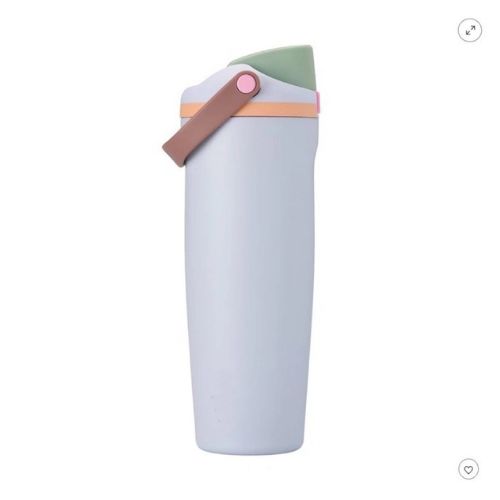
Three handle patterns show up in this category. A fixed side handle riveted or welded to the body gives the best control when pouring, because the wrist stays under the load; check that it is attached to the outer shell in at least two places and that it does not flex when you lift a full body. A folding bail handle over the top is compact for packing and good for carrying, but poor for pouring — the flask swings. A silicone loop or paracord strap on the crown is a carry aid only; it should never be the thing you pour with, and on a heavy flask it puts all the load through the stopper thread.
If a flask is going to be carried between floors, ask for a body with both: a fixed handle for the pour and an attachment point for a strap. And if the recipients include people who will carry it while also carrying something else — nurses, site supervisors, event crew — size down one step and give them two flasks rather than one heroic pot.
Drops, dents and the warm-wall check
A stainless vacuum flask does not shatter, which is exactly why people assume a drop is harmless. It usually is cosmetic. Occasionally it is not: if the impact deforms the outer shell far enough to breach the seal between the two walls, air enters the gap and the vacuum is gone. The flask still holds liquid, still looks fine, and quietly stops insulating.
There is a ten-second diagnostic for this and it is worth teaching your team. Fill the flask with very hot water, close it, wait two minutes, then put a hand around the outer wall. A working vacuum flask feels close to room temperature almost everywhere except the neck and the base. If the body feels warm, the vacuum has been compromised and no amount of pre-heating will bring the retention back. Run the same check on delivery, before distribution, on a sample from each carton — it catches transit damage that a visual inspection will miss.
Two ordering habits reduce the risk. Ask for individual boxes rather than bulk-packed bodies on a long domestic route, particularly to Sabah and Sarawak; and specify a base that sits on a silicone or moulded ring rather than bare steel, which absorbs the everyday knocks that accumulate on a pantry counter. The retention you eventually measure depends on it — the physics of that is covered in heat retention across a full working day.
Ordering a mixed-capacity fleet
Most real briefs are not one size. A company gifting staff for Hari Raya may want 500ml personal flasks for everyone, a handful of 1.5L table flasks for the meeting rooms and two pump pots for the pantry — one brand, three formats. That is entirely normal, and it is worth structuring the brief that way from the start rather than raising it as an afterthought.
Two things to know. Our minimum order is from 300 pcs per design, so the personal flask is normally the design that carries the quantity while the larger formats ride alongside it in smaller numbers. And artwork does not scale straight across sizes — a lock-up that sits correctly on a 500ml body is proportionally lost on a 3L pot, so each format needs its own mockup. Ask for all of them in the same round; production runs 21–45 days after artwork approval depending on quantity, plus around 15 days shipping, and that clock starts from the last artwork you approve, not the first.
Finally, size with the contents in mind. A wide-mouth body sized for soup or bubur behaves very differently from a narrow one sized for coffee, and its closure is a different problem entirely — see wide-mouth food flasks and their sealing problem before you commit a large order to that format.
Frequently asked questions
What flask size works best as a general staff gift in Malaysia?
500ml is the safest single choice: two office cups, slim enough for a bag, light enough that nobody leaves it at home. Move up to 750ml only if the recipients spend the day away from a kettle.
How many people will a 2L flask serve at an event?
Around nine standard office cups per fill, or roughly twelve small pantry cups. For a queue, plan on refilling rather than on capacity — two 2L flasks with a kettle behind them serve a crowd better than one 5L pot that cannot be topped up mid-service.
Can we order several different capacities under one order?
Yes. Send the full picture — headcount, rooms and drinks — and we will propose the split. The minimum of 300 pcs applies per design, and each format gets its own digital mockup so the branding sits correctly on every body size.
Tell us the cups, not the millilitres
Give us the headcount, the rooms and what people actually drink, and we will come back with a size split rather than a single catalogue number. Aquaholic Gifts is a Singapore-based corporate gifting specialist working since 2003 and now serving Malaysia from Kuala Lumpur. See the full range before you brief us, including customised thermal flask KL orders with nationwide delivery.
WhatsApp +60 10 717 5924 · Send your brief
Aquaholic Gifts Malaysia — AS80, Jalan Hang Tuah 4, Taman Salak Selatan, 57100 Kuala Lumpur. Free digital mockup, quote-only pricing, SST invoicing, ePerolehan-ready for government buyers.