Hot Soup, Bee Hoon and a Dropped Bag: How Bamboo, Steel and Wheat-Fibre Cutlery Behave
The material decision on a cutlery set is usually settled in a meeting room, from a specification sheet, by people looking at swatches. It is actually settled about four seconds into the recipient’s first hot meal, when a steel spoon full of curry mee soup touches their lower lip and they put it down again to let it cool. Nobody writes that into a brief, and it is one of the few differences between bamboo, stainless steel and wheat fibre that the recipient will notice every single day.
This article deliberately skips the specification-sheet comparison and looks instead at how the three common materials behave in a mouth, in a bag and under a laser. It is the perspective our production team has built from handling these pieces before they ship, and it is the one that predicts whether your stainless steel cutlery set Malaysia order or its bamboo alternative is still in use next Hari Raya.
Heat conduction: the first mouthful of hot soup
Metal conducts heat quickly. That is not a defect, but it changes the eating experience with anything served genuinely hot — and a great deal of what is eaten here is served genuinely hot. A steel spoon lifted from a bowl of soup arrives at the lip carrying the temperature of the soup on a thin, highly conductive edge. Most people manage it by sipping from the side of the bowl of the spoon rather than the tip, or by waiting. Bamboo and moulded wheat fibre both conduct heat poorly, which is why a bamboo spoon in hot soup feels neutral in the mouth from the first spoonful.
The flip side is that steel also sheds heat quickly, so it cools in seconds once it leaves the bowl, while a thick wheat-fibre spoon that has been sitting in hot soup holds warmth longer than you would expect. In practice: if your gift is aimed at people who eat soup noodles several times a week, a non-metal spoon is a genuine comfort improvement. If it is aimed at people eating rice and stir-fries, the difference barely registers.
The lip test, done properly. When a sample arrives, do not just hold it. Dip the spoon in freshly boiled water for ten seconds, lift it out, count to three and touch it to the back of your hand. That is roughly what the recipient’s lip will feel. Do the same with each candidate material side by side — the ranking is obvious within a minute and impossible to get from a catalogue.
Mouthfeel and taste carry-over
Stainless steel is the reference material for cutlery precisely because it is nearly inert, but a small proportion of people are sensitive to a faint metallic note with acidic foods — anything with tamarind, lime, tomato or vinegar. It is not a fault in the steel; it is a genuine sensory difference that some palates pick up and most do not.
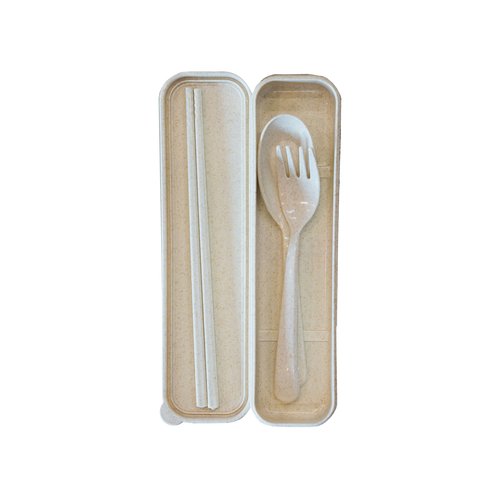
Bamboo is the opposite. It is taste-neutral and warm in the mouth, with a slightly soft, matte contact that many people find pleasant. Its risk is the reverse: an untreated or worn bamboo utensil can pick up flavours over time, particularly from oily curries, and hold them faintly. Wheat fibre sits between the two, with a slightly waxy contact that reads as plastic-adjacent — because a wheat-straw composite is a fibre-filled polymer, not a bare natural material.
If your recipients are food professionals, hotel staff or a culinary brand’s guests, steel is the safe signal. If the gift is positioned around natural materials and slow living, bamboo’s mouthfeel supports the story rather than fighting it.
Strength where it matters: tines, edges and the bee hoon test
A fork’s job is to spear and to twirl, and both depend on tines that are thin enough to penetrate and stiff enough not to splay. This is where the three materials separate most sharply.
Stainless steel gives thin, stiff tines with enough spring to twirl noodles without deforming. Bamboo cannot be made thin at the tine without becoming fragile, so bamboo forks carry blunt, chunky tines that push food around more than they spear it — perfectly fine for cake, salad and cut fruit, frustrating for a firm piece of chicken. Wheat fibre can be moulded thinner than bamboo but flexes under load; the classic failure is a tine that bends rather than penetrates, then springs back.
Run what we call the bee hoon test on any sample: twirl a forkful of thin fried noodles and lift. Steel holds the twist. Bamboo lets it slide off. Wheat fibre usually holds, but you can feel the flex. It sounds trivial and it is the single most common quiet complaint we hear about non-metal sets.
How each material fails, and when
Nothing lasts forever. What matters for a corporate gift is whether the failure is gradual and forgivable or sudden and embarrassing.
| Material | Typical failure | What triggers it | Care that delays it |
|---|---|---|---|
| Bamboo | Surface fuzzing, then splintering along the grain at the bowl edge | Prolonged soaking and repeated hot-wet cycles; the grain lifts and stays lifted | Wash by hand, dry standing up, and re-oil occasionally with a food-safe oil |
| Stainless steel | Cosmetic scratching and dulled finish; handle bending only on very light gauges | Abrasive scouring; loose pieces knocking together in an unlined case | Sleeved case slots; dry after washing to avoid water spotting on a mirror finish |
| Wheat fibre | Warping, stress-whitening at the neck where the handle meets the bowl, colour fade | Heat exposure and repeated flexing at the same point; strong sunlight for pale colours | Keep away from sustained heat; choose deeper colours where fade would show |
The pattern is worth stating plainly: steel fails cosmetically, bamboo fails texturally, wheat fibre fails structurally. Only one of those three makes the recipient stop using the set, which is why a wheat-fibre set is best positioned as an accessible mass-distribution gift rather than a long-service award.
Weight in a bag
Carried weight is the reason a lot of well-made sets stop travelling. From lightest to heaviest: wheat fibre first, bamboo close behind, stainless steel clearly heaviest — and a full steel set in a hard case is a noticeable object in a handbag rather than an invisible one.
That does not make steel wrong. It makes the case choice and the piece count part of the same decision as the material. A three-piece steel set in a slim roll travels comfortably; a five-piece steel set with a straw in a rigid box is something people carry for two weeks and then leave in a drawer. If you want the premium feel of steel and daily carry, cut the piece count rather than the material — the trade-offs are laid out in the fork-spoon-chopstick question.
How each material takes a mark
This is where material and branding stop being separate conversations. The same logo file produces three genuinely different results.
| Material | Best method | How the mark reads | Durability |
|---|---|---|---|
| Bamboo | Laser engraving | High contrast — a dark burnt brown on a pale surface. The most legible of the three at small sizes. | Permanent, but softens visually if the surface fuzzes with age |
| Stainless steel | Laser engraving | Lower contrast — a lighter matte grey against the polished surface, subtle and premium rather than bold | Permanent; unaffected by washing |
| Wheat fibre | Pad or silkscreen print | Solid colour, good for bold marks; engraving reads poorly on a fibre-filled surface | Good, but a printed mark on a handle is the first thing to wear |
Two practical consequences. First, if your brand identity depends on a dark, bold mark, bamboo will flatter it and polished steel will mute it — brief a matte or satin steel finish if you want the engraving to read strongly. Second, on every material the handle is a narrow canvas, so the case remains the place where a full logo lock-up actually fits, which is why we treat roll-up, clamshell or pouch as a branding decision and not just a packaging one.
Choosing by who receives it
Long-service, client and management gifts → stainless steel. It survives being treated badly, it signals value in the hand through weight alone, and the engraving is permanent. Pair it with a small piece count so it still travels.
Sustainability campaigns and eco-brand gifting → bamboo. The material carries the message without a word of copy, the engraving contrast is the best of the three, and the low weight suits daily carry. Include care guidance so it is hand-washed and dried standing.
Large event handouts and campus drives → wheat fibre. Light, colourful, moulded in one piece, and forgiving of a distribution where not every set will be treasured. Accept that it is a shorter-life product and position it accordingly.
Mixed audience, one order → steel utensils in a branded fabric case is the most broadly acceptable combination we quote. It offends nobody’s expectations and photographs well for internal comms.
Whichever way you go, the material choice should be checked against how long the set actually has to last to justify itself, which is a separate calculation covered in the use-count that decides the eco claim.
Frequently asked questions
Bamboo or stainless steel — which should we choose?
Bamboo is lighter, kinder in the mouth with hot food and takes the highest-contrast engraving. Stainless steel is stronger at the tines, tolerates careless washing and reads as premium. Choose bamboo for eco campaigns and steel for recognition and client gifting.
Is wheat fibre a plastic?
A wheat-straw composite is a polymer filled with agricultural fibre, so it is a plastic with a plant-fibre content rather than a plant-only material. That is worth saying accurately in your campaign copy — overstating it is the fastest way to attract criticism of an otherwise good gift.
Can bamboo utensils go in a dishwasher?
We advise against it. Sustained heat and prolonged wet cycles are exactly what lifts the grain and starts the fuzzing that eventually becomes splintering. Hand wash, rinse and dry standing up, and the set lasts far longer.
Can you mix materials within one set?
Yes — a steel spoon and fork with bamboo chopsticks is a common and sensible combination, taking the strength of steel where it matters and the warmth of bamboo where it does not. Tell us at briefing stage so the marking schedule is planned around two processes.
Compare the materials in your own hand
Aquaholic Gifts is a Singapore-based corporate gifting specialist since 2003, now serving Malaysia nationwide. Send us your brief and we will advise on the material that suits your recipients, with a free digital mockup within one business day — including our wheat straw cutlery set options alongside bamboo and steel.
WhatsApp +60 10 717 5924 · Request a mockup via our contact page
Aquaholic Gifts Malaysia · AS80, Jalan Hang Tuah 4, Taman Salak Selatan, 57100 Kuala Lumpur · Minimum order from 300 pcs · Production 21–45 days after artwork approval, plus about 15 days shipping · SST invoice · ePerolehan-ready.