
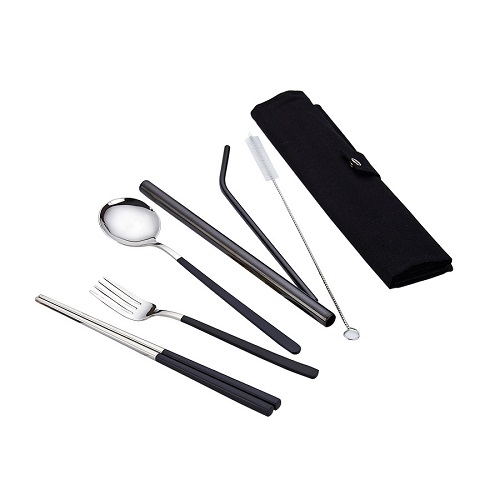
The Case Is the Product: Roll-Up, Clamshell or Pouch for Cutlery That Survives a Handbag
Across the branded utensil sets our production team has handled, a fork almost never comes back. What comes back — or rather, what gets quietly binned by the recipient — is the case. A zip that splits at the corner. A snap button that pops open inside a handbag and spills three pieces of steel into the lining. A canvas roll that was put away damp on a Tuesday and smelled sour by Friday. The utensils outlive the thing that carries them, and once the carrier fails, the whole gift stops being used.
That is the uncomfortable truth behind every reusable cutlery gift: the case is the product. It decides whether the set travels, whether it dries, whether it stays closed, and — because a fork handle offers barely more than a thumbnail of brandable surface — it is also where your logo actually lives. This article covers the four case formats we quote most often for custom cutlery sets Malaysia buyers order, the five-minute sample test that predicts failure before you commit to 300 pcs, and where the branding really lands.
Why the case, not the fork, decides whether the gift survives
A cutlery set is unusual among corporate gifts because it is a multi-part product that has to be reassembled after every single use. A mug is one object; you wash it and it is done. A cutlery set is three to six loose objects that have to be washed, dried, gathered and returned to a container — and the container has to make that easy enough that the recipient does it again tomorrow.
Every point of friction in that loop costs you use-days. If the roll has to be laid flat on a desk and rolled precisely to close, it will be rolled loosely. If the clamshell needs both hands and a click, it will get shoved in a bag half-latched. If the pouch has no way of separating a wet brush from a dry fork, the whole thing goes into a drawer to be dealt with later, and “later” is where reusable gifts go to die. When we talk about whether a reusable set earns its keep, the case is usually the deciding variable — not the material of the utensils.
The four case formats, and what each is actually good at
Almost every set we produce lands in one of four carrier types. They are not interchangeable, and the choice should be driven by where the set will be carried rather than by which one photographs best.
| Format | Closure | What it survives | Drying behaviour | Branding surface |
|---|---|---|---|---|
| Roll-up canvas / cotton | Tie string, elastic loop or snap tab | Being squashed. Nothing rattles, nothing cracks. Poor against tine pressure — sharp tips work through thin weave. | Best of the four if unrolled. Worst of the four if rolled up wet. | Large flat panel. Embroidery or silkscreen, full logo with tagline. |
| Hard clamshell / box case | Hinge with snap latch or magnet | A dropped bag. The utensils never take the impact. Weak point is the hinge, not the shell. | Poor unless vented — a sealed shell traps moisture against the pieces. | Rigid lid. UV print handles full colour and gradients cleanly. |
| Drawstring / flat pouch | Drawstring, velcro flap or zip | Daily handbag use, if the pieces are held in sleeves. Loose pieces in an open sack knock and scratch. | Good with an open-weave or mesh base; poor with a lined PU body. | Front face. Embroidery, silkscreen or a woven label. |
| Gift box only (no carrier) | Lid | The unboxing, and nothing after it. This is presentation, not transport. | Not applicable — the box rarely leaves the house. | Largest area of all. Offset or UV, full wrap. |
The mistake we see most often: a beautiful gift box specified with no carry case inside it. The recipient opens it, admires it, and leaves it on the shelf because there is nothing to put in a bag. If the budget allows only one, choose the carrier and let the packaging be simple — a gift box protects the first ten seconds, a case protects everything after that.
The five-minute sample test
Before any bulk order, we ask buyers to run a physical sample through five checks. It takes about five minutes and it catches nearly everything that shows up as a complaint six weeks after distribution. Do it on the actual sample with the actual set contents — a case that passes with a fork and spoon can fail the moment a straw and cleaning brush are added.
The Aquaholic five-point case test
1. The inversion test. Close the case, hold it upside down and shake it twice, firmly. Anything that slides out will slide out in a bag. Velcro flaps and magnetic lids fail this more often than people expect.
2. The tine test. Press the fork tips against the inside of the fabric and run a thumb over the outside. If you can feel the points through the weave, the case will develop four small holes within months. The fix is a sewn-in sleeve or a reversed fork orientation, not a heavier fabric.
3. The damp test. Wet the pieces, put them straight in, close it and leave it overnight in a warm room. Open it in the morning and smell it. This single test predicts the biggest cause of abandonment in a humid climate.
4. The full-load test. Add every piece the final set will carry — including the straw and its brush, which is the item that most often does not fit. If the closure now strains, the case is undersized and the closure will be the first thing to fail.
5. The one-hand test. Open and close it with one hand while holding something in the other. That is how it will be used at a hawker table. A closure that needs two hands and a flat surface loses use-days quietly.
Drainage, and the musty pouch problem
This is the failure mode that is unique to Malaysia and to every other warm, humid market, and it is barely mentioned on supplier pages. A cutlery set is washed at a pantry sink, shaken twice, and put back in its case still carrying a film of water. In an air-conditioned office, that film does not evaporate — it sits between a damp cotton lining and a steel handle for eighteen hours. Repeat that for two weeks and the case develops a sour smell that no amount of washing the utensils will fix, because the smell is in the carrier.
Three design choices measurably reduce it. First, avoid a fully lined interior: an unlined natural-fibre roll or a single-layer canvas pouch breathes; a PU-lined pouch does not. Second, specify a vent — on a hard clamshell that means small perforations at the hinge end, which cost nothing at moulding stage and are impossible to add later. Third, give the cleaning brush its own external loop or side sleeve rather than burying it with the utensils, because a wet bristle head is the single wettest item in the set.
If your recipients are field staff, students or anyone who will not have a drying rack, we would push you towards a vented hard case over an unlined roll, even though the roll dries better in principle — the roll only dries better if someone unrolls it, and nobody does.
Where the branding really lands
Here is the part that surprises marketing teams. Laser engraving on a utensil handle is genuinely permanent and it looks excellent — but the handle of a fork or spoon gives you a narrow strip, usually enough for a wordmark or a compact icon and nothing else. Taglines, registered marks and multi-colour logos do not survive that reduction. Meanwhile the case offers a flat panel many times larger, on a surface that faces outward every time the set is opened at a table.
| Surface | Best method | What the logo can be | Watch-outs |
|---|---|---|---|
| Utensil handle | Laser engraving | Wordmark or simple icon, one tone | Fine serifs and thin strokes close up at small sizes; curved handles reduce usable width further |
| Canvas roll or pouch face | Embroidery or silkscreen | Full logo, lock-up with tagline, campaign line | Embroidery thickens fine detail; gradients need print, not stitch |
| Hard clamshell lid | UV print | Full colour, photographic, gradients | Curved lids need the artwork kept inside the flat zone or it distorts |
| Straw | Laser engraving | Accent mark or short wordmark only | Tight radius means anything wide wraps out of sight |
| Gift box | UV or offset | Anything, including full wrap artwork | Seen once; do not spend your whole branding budget here |
Our standing recommendation is a two-tier approach: engrave a compact wordmark on the utensil handles so the branding is permanent and survives the case being replaced, and put the full logo lock-up on the case where it can be read. The exact areas are confirmed on your digital mockup before anything is cut, and the choice of material changes how a mark reads — worth understanding how bamboo and steel handles behave in the hand before you lock the engraving down.
Closures, ranked by how they fail
Every closure fails eventually; what matters is whether it fails safely or catastrophically. Ranked from most to least forgiving in daily use:
- Tie string or elastic loop — fails slowly. The elastic slackens over months, the set still stays rolled, the user notices and adapts. Cheapest to replace mentally, hardest to break.
- Snap latch on a hard case — fails audibly. When the latch tab wears, it stops clicking and the user knows immediately. Safe failure.
- Zip — fails at the corner where the slider turns. Once a zip splits it is finished; there is no partial function. Specify a zip only where the case body is stiff enough to keep the tape straight.
- Velcro — fails invisibly. It picks up lint, loses grip gradually, and the user only finds out when the set is loose in the bag. It also snags knitwear, which is a real complaint from recipients who carry it in a handbag.
- Magnet — fails immediately under shear. Magnets hold well when pulled straight apart and badly when slid sideways, which is exactly what happens in a bag. Use magnets for presentation boxes, not for transport cases.
Briefing a case that matches your set
When you send a brief, four lines of detail change the quote and the outcome more than anything else: the exact set contents (because which pieces a set actually needs determines the internal layout), where the set will be carried, whether the recipient will have anywhere to dry it, and whether the logo must be readable at arm’s length or can be a discreet mark.
On timing: allow about one business day for the digital mockup, then 21–45 days of production after artwork approval depending on quantity and branding method, plus around 15 days for shipping. Express production in 10 working days is possible on limited styles and quantities. Minimum order is from 300 pcs. A case with a custom internal layout, a bespoke fabric colour or a moulded shell sits at the longer end of the production window, because the case tooling — not the utensils — is the long pole.
Frequently asked questions
Which case format lasts longest in daily use?
A vented hard clamshell with a snap latch, for most recipients. It protects the pieces in a bag, it fails safely and audibly, and it does not absorb moisture. A canvas roll can outlast it if the recipient genuinely unrolls it to dry, but that behaviour cannot be assumed.
Can we brand the case and the utensils on the same order?
Yes, and we usually recommend it — engraving on the handles plus a printed or embroidered logo on the case. Each additional branding position adds setup and a little production time, so tell us both at briefing stage rather than adding one later.
Does the case have to match the utensil material?
No. Natural-fibre rolls pair well with bamboo for an eco campaign look, but a canvas pouch around a steel set is equally common and often more practical. Match the case to the carrying scenario first and the aesthetic second.
We already have a set design. Can you supply just a branded case?
Tell us the exact dimensions of your existing pieces and we will advise on case options that fit them. Send us the pieces themselves if you can — internal layout is the part that is hardest to specify from a drawing.
Get the case right before you order 300
Send us your set contents, your carrying scenario and your logo, and we will come back within one business day with a free digital mockup and a no-obligation quote. Browse the full range of travel cutlery set printing options, or message us and we will recommend a format for your recipients.
WhatsApp +60 10 717 5924 · Send your brief through our contact page
Aquaholic Gifts Malaysia · AS80, Jalan Hang Tuah 4, Taman Salak Selatan, 57100 Kuala Lumpur · Minimum order from 300 pcs · SST invoice · ePerolehan-ready.


