The Cuff Test: Why Ribbing Decides How Long a Hoodie Looks New
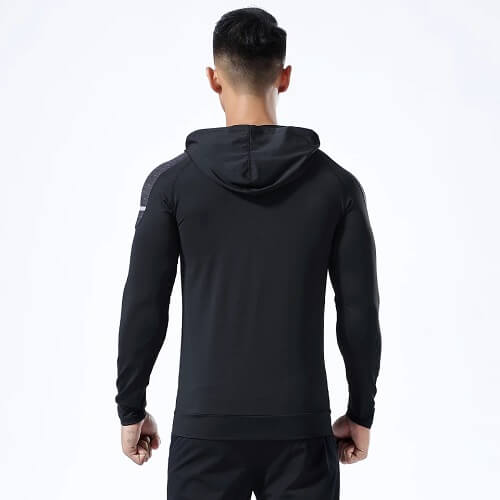
Take any hoodie off a rail, push two fingers into the cuff, stretch it as far as it will comfortably go, hold for ten seconds and let go. Watch what happens next. If the cuff snaps back to where it started, the garment will still look new in a year. If it sags open and stays there, you are holding a hoodie that will read as tired by Hari Raya whatever you paid for the fabric.
Ribbing is the least specified component on a hoodie and the one most responsible for how the finished garment ages. It appears on a purchase order, if at all, as the word “ribbed” — no composition, no depth, no recovery requirement. Meanwhile the cuffs and hem are the parts of the garment being pulled, pushed up the forearm, sat on and dragged over hands every single day.
This article covers what rib actually is, why elastane content decides whether a cuff still grips after six months, how deep the rib should be, the pull-and-release test you can run on a sample in two minutes, and the five lines to put on the order so you get rib that lasts.
Rib is a separate fabric that happens to be attached to your hoodie
The body of a hoodie is a terry or fleece knit. The cuffs and hem are not that fabric at all — they are a rib knit, made on different machines, in which columns of stitches alternate between the front and the back of the cloth. Those alternating columns fold like a concertina, which is why rib pulls in hard across its width and springs back. It is a mechanical spring made of yarn.
Two structures dominate. A 1×1 rib alternates one column front, one column back, giving a fine, tight trim that recovers well. A 2×2 rib alternates in pairs, giving a chunkier, more visible ridge and a slightly softer pull, which is the streetwear look. Both are fine. What is not fine is the third option, which turns up more often than anyone admits: a piece of the body fabric folded over and hemmed, with no rib structure at all. It looks acceptable in a photograph and has no stretch memory whatsoever.
The important point for a buyer is that the rib is bought separately from the body cloth and specified separately. It has its own fibre composition, its own gauge and its own quality level, and none of that is implied by the fabric you approved for the body. A beautiful cotton-rich fleece can arrive with rib that has nothing structural in it.
Elastane is the entire argument
A rib with no elastane in it stretches because of its geometry — the concertina opens out. It returns because the yarn has some crimp and the loops want to sit back down. That return is finite. Every stretch beyond a certain point permanently rearranges some of the loops, and after a few hundred cycles the trim no longer closes. This is why an all-cotton cuff goes soft and flared and never comes back.
Elastane changes the mechanism. A small percentage — commonly around three to five per cent in the rib, not in the body — puts an elastic filament inside the yarn that pulls the loops back into place actively rather than passively. That single line on a specification is the difference between a cuff that still grips in month twelve and one that gave up in month three. It costs very little per garment, and it is the first thing removed when a supplier is asked to sharpen a quotation.
Elastane also has enemies worth naming on the care card. Heat is the main one: a hot tumble dryer degrades elastic filament faster than anything else a garment normally meets, and a cuff that has been through a commercial dryer a dozen times will have lost grip while the fleece still looks new. Body oils and repeated hot washing do the same more slowly. Cool wash and line dry is not a fussy instruction on a hoodie — it is specifically protecting the trims.
The pull-and-release test
You do not need a laboratory to grade recovery. This is the check our team runs on every hoodie sample before it goes to a client, and it takes about two minutes per garment.
- Measure the relaxed cuff flat. Lay it on a table, do not smooth it out, and write the width down.
- Stretch it to about half as wide again and hold for a full ten seconds. Count it out; three seconds is not the same test.
- Release and wait ten seconds, then measure flat again without touching or reshaping it.
- Compare. Back to the original width is excellent. A few millimetres wider is acceptable. Visibly wider, and you are looking at a cuff that will flare.
- Now do it thirty times quickly and measure once more. This is the one that separates real rib from rib that passed a single pull. A cuff that fails only after thirty cycles is a cuff that fails in month four.
- Repeat on the hem. The hem takes less abuse but it is far more visible when it goes, because it hangs at the widest part of the silhouette.
Photograph the cuff flat before and after. Two phone photographs settle any later conversation with a supplier far faster than an adjective does, and it is the same principle as inspecting two-panel and three-panel hood construction on the same sample — record what you saw while the garment is in your hands.
Depth, width and the ratios that matter
| Trim | Indicative depth | What the depth is doing | What goes wrong if it is short |
|---|---|---|---|
| Sleeve cuff | 7–9 cm | Spreads the grip over a length of forearm instead of one line | Rides up the arm all day, and abrades the fleece above it |
| Body hem | 5–8 cm | Holds the body shape and stops the hem flipping up when seated | Rolls outward and the silhouette reads shapeless |
| Hem versus body width | Hem narrower than the chest | Creates the slight blouson shape a hoodie is meant to have | Straight tube; the garment hangs like a bag |
| Rib gauge | Matched to body weight | Keeps the trim in proportion to the cloth it holds | Fine rib on heavy fleece is overpowered and distorts |
There is a Malaysian wrinkle on cuff depth that no size chart carries. Hoodies here spend a lot of their life with the sleeves pushed up the forearm, because the wearer walks between an air-conditioned office and a car park at 33 °C. A cuff that is too tight will not push up and gets fought with; a cuff that is too loose slides straight back down. Around eight centimetres with real recovery is the specification that survives that daily habit.
Good rib, badly attached, is still bad
Rib is always sewn on stretched. The trim is cut shorter than the sleeve opening, and the operator eases the two together while stretching the rib to match. That ratio is a real production setting, and if the operator over-stretches it — because the trim was cut a little short, or because the line is running fast — a portion of the rib’s recovery is spent before the garment is folded into a polybag. The customer then receives a cuff that was correct on paper and slack in the hand.
Two things to look at on the sample. First, the ribs across a size run: if the small and the extra-large cuffs feel equally tight, the rib was probably not graded, and one of them is being stretched harder than it should be. Second, the join. Rib is knitted as a tube or a strip and closed with a seam, and that seam should sit at the underarm on a cuff and at a side seam on a hem. A join sitting on the outside of the wrist is a garment assembled without care, and it is the sort of detail that shows up in a close photograph of somebody holding a microphone. It is the same category of problem as the placement map for a hoodie front: nobody notices it until the camera does.
Why a flared cuff makes the whole garment read cheap
The visual logic is simple and unforgiving. A gripping cuff ends the sleeve at a defined point, so the arm reads as the right length. A flared cuff has no end point: the sleeve appears to continue past the wrist and over the hand, so the whole garment looks too big for the person in it. The same thing happens at the hem — once it stops pulling in, the body of the hoodie hangs straight down and the silhouette collapses.
This is why trims deserve a line in the quotation rather than an assumption, and why every specification we issue from our event hoodie and team hoodie printing range in Malaysia names the rib composition explicitly. It is also worth pairing with the fabric decision, since the trim and the body wear against each other — loopback versus brushed fleece and what pills first is the other half of how the garment looks at twelve months.
Five lines to put on the purchase order
- Rib structure — 1×1 or 2×2, stated for cuff and hem separately.
- Rib composition including elastane percentage — the single most important line on this list.
- Finished depths for cuff and hem, measured on the approved sample, with a tolerance.
- Recovery requirement — describe the thirty-cycle test and state that the cuff must return to within a stated few millimetres.
- Join position — underarm for cuffs, side seam for hems, and no visible join on the outer wrist.
One line, copied straight onto your order: “Cuff and hem rib to contain elastane; supplier to confirm percentage in writing; cuff to pass a thirty-cycle stretch-and-release check at pre-production sample stage.” It is unusual enough that it changes the conversation with a supplier immediately.
Questions buyers ask about hoodie cuffs and hems
Why did the cuffs on our hoodies go loose so quickly?
Almost always because the rib contained no elastane, so recovery depended entirely on knit geometry and ran out. Tumble drying accelerates it further. Specify elastane in the rib and cool wash on the care card and the same garment behaves very differently.
Can loose cuffs be repaired?
Not usefully. Recovery loss is permanent, and replacing the trims on a finished garment costs more than the garment is worth on a bulk order. This is a specification problem, which is why the test belongs at sample stage rather than after delivery.
Should the cuffs and hem match the body colour exactly?
They should either match closely or contrast deliberately. A near-match that is slightly off is the one outcome to avoid, because the eye reads it as a mistake. If your brand palette allows it, a contrast rib in a second brand colour is a strong, low-cost design decision.
What is the minimum order for custom hoodies, and how long does production take?
From 200 pcs. Production is 20 to 30 working days after artwork approval depending on quantity, plus roughly 15 days shipping, with an express route of 10 working days on limited styles and quantities. Send your logo in vector format for a free digital mockup. Invoicing is SST-compliant and we can meet ePerolehan documentation requirements.
Ask us for the rib composition before you ask us for a price.
Send your logo and quantity and we will come back with a mockup, the rib specification in writing and a sample you can run the thirty-cycle test on yourself — including embroidered hoodie work from our KL office, from 200 pcs and delivered nationwide. Aquaholic Gifts is a Singapore-based corporate gifting specialist since 2003, now serving Malaysia.
WhatsApp +60 10 717 5924 · Send your brief through our contact page · AS80, Jalan Hang Tuah 4, Taman Salak Selatan, 57100 Kuala Lumpur.