White Cloth, Dyed Through: The Parts of a Sublimated Jersey That Never Take Colour
A navy team kit came back from first sample looking perfect on the hanger. Then somebody pulled the shoulder seam apart with two hands, and a faint line of white pinpricks appeared along the stitching. The buyer thought the sample was defective. It was not. It was the most honest thing a sublimated garment can show you about how it was made.
Sublimation is not printing. It is dyeing. That single distinction explains why your jersey has no hand feel, why nothing on it can peel, why you cannot order it in black cloth, and why several parts of the finished garment will never take your colour at all unless somebody asks for them to. This article is the list of those parts — written by the production side, not the sales side.
The dye goes into the fibre, not onto it
In a sublimation run, your artwork is first printed in reverse onto transfer paper using disperse dyes. The paper and the polyester cloth pass together through a heat press. At temperature, the dye skips the liquid stage entirely and turns to vapour, the polyester fibre opens, the vapour enters, and as the cloth cools the fibre closes around it. The colour is now inside the polymer. There is no ink film sitting on the surface of the cloth, because no ink film was ever deposited.
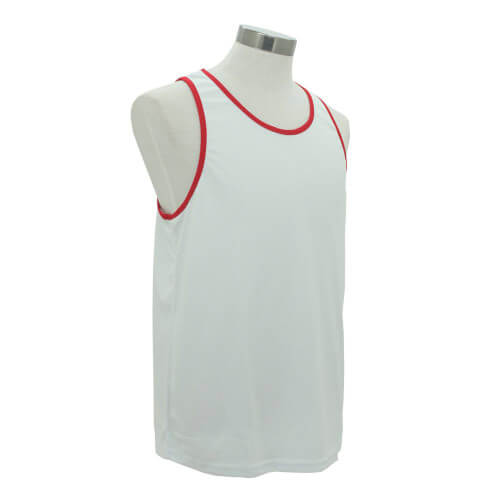
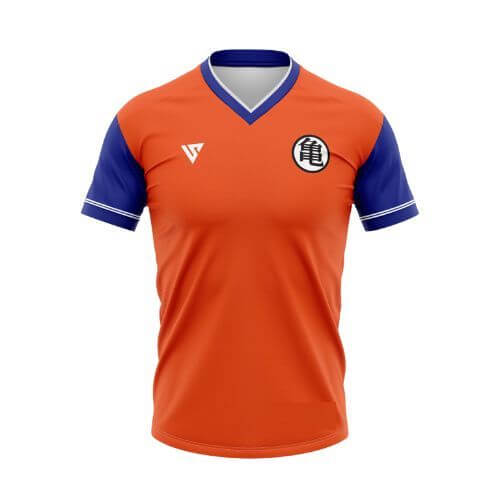
Everything buyers like about a sublimated kit follows from that one fact. The garment weighs the same printed as unprinted. You cannot feel the design with your fingertips, even across a full-bleed sponsor block. There is nothing to crack, because cracking requires a layer that is stiffer than the cloth underneath it. And there is no per-colour charge, because gradients, photographs and a dozen sponsor colours all leave the printer in the same pass. This is the standard on every one of our custom jerseys in Malaysia — V-neck, round-neck and sleeveless are all built this way.
The honest counterpart is that a sublimated jersey does not fail the way a printed one does. It never peels, so it never looks damaged. Instead it ages the way dyed cloth ages — the whole garment shifts slightly and evenly over a long season of sun and washing, and the design goes with it. Usually the better failure mode. Still a failure mode.
Consequence one: white is not a colour you can print
Disperse dye is transparent. It can only make cloth darker or more saturated than it already is. It cannot make cloth lighter, and it cannot lay down white. So on a sublimated jersey, every white element in your design — the white in a club crest, a white outline around a number, a white sponsor wordmark on a red chest — is not printed. It is a reserved area of bare cloth that the dye was told to skip.
Three practical results follow, and no competitor product page in Malaysia mentions any of them:
- Your white is the mill’s white. Base sublimation cloth carries an optical brightener, so it reads as a clean cool white. It will not match a warm off-white or a cream in a brand manual, and there is no way to correct it, because correcting it would mean adding dye.
- Very fine white lines close up. A hairline white keyline inside a dark field is asking the press to leave an extremely narrow strip untouched while dye vapour is moving in from both sides. Below roughly one and a half millimetres of stroke width, that line tends to fill in and go muddy. Thicken it at artwork stage, or drop it.
- Pale tints look chalkier than the screen. A ten per cent tint of your brand colour is mostly bare cloth showing through a thin dye load. On a matt micro-mesh it reads paler and flatter than the same tint on a glossy interlock. If a pastel is central to the design, ask to see it on the actual fabric you have chosen, not on paper.
Consequence two: there is no dark blank to start from
Buyers often assume we hold black, navy and maroon jersey cloth and print onto whichever one suits the design. We do not, and nobody does. Sublimation only works on white polyester, so a black sublimated jersey is white cloth that has been dyed black across every square centimetre of every panel, including the parts nobody looks at.
That makes solid dark kit the single most demanding thing a sublimation line is asked to produce, for a reason that has nothing to do with skill. A knit is built from yarns, and a yarn has an interior. Dye enters generously from the printed face and less so towards the yarn core. On a mid-tone or patterned garment you will never notice. On a dense solid black, any place where the cloth is opened up — a needle perforation along a seam, a hem stitched twice, the crown of the shoulder under hard stretch — can reveal a fraction of undyed yarn as a white speckle. That is the line of pinpricks in the opening paragraph.
The undyed component audit
A jersey is not one piece of cloth. It is printed panels plus a set of components that were manufactured somewhere else, in their own colours, long before your artwork existed. Those components do not go through the heat press with your panels. Unless the brief names them, they arrive in stock colours. This is the table we walk through with buyers before artwork is locked, and it settles more arguments at sample stage than anything else we do.
| Part of the jersey | Takes your colour? | What to say in the brief |
|---|---|---|
| Front, back and sleeve panels | Yes — full bleed, edge to edge | Nothing needed |
| Sewing thread at every seam | No — stock thread | “Thread tone to match the adjacent panel colour” |
| Round-neck rib or binding | Only if cut from printed cloth | “Self-fabric binding cut from the printed panel” |
| V-neck mitre strip at the point | Only if cut from printed cloth | Name the contrast colour, or ask for self-fabric |
| Armhole binding on a sleeveless jersey | Only if cut from printed cloth | Specify contrast or self-fabric on both armholes |
| Waistband elastic on matching shorts | No — stock black or white | Confirm which stock colour before approval |
| Drawcord, eyelets, zip on a jacket in the set | No — stock hardware colours | Ask for the available range early |
| Woven size and care label | No — made separately | Choose woven, or a printed neck label inside the panel |
| Number applied as heat transfer instead | No — it is a film on the surface | Only choose this knowingly — it can crack, the sublimated panel cannot |
The last row matters more than teams expect. A sublimated body with heat-transfer numbers is a hybrid garment: one part of it will outlive the club and one part of it can lift at a corner after a season of hot washes. If the roster is settled early enough, the numbers belong inside the print file — which is exactly how names and numbers are set out on a jersey when the schedule allows it.
Why the inside looks faded, and what that means for reversible kit
Turn a sublimated jersey inside out and you will see a pale ghost of the design rather than a blank white surface. Dye entered from the printed face and travelled part of the way through the cloth. How far it travels depends on knit density: an open micro-mesh shows more on the reverse than a smoother interlock does.
This is normal and it is not a quality issue. It becomes a real issue in one situation only: reversible kit. Basketball and futsal sides regularly ask for a jersey that flips between two colourways, and the ghost image is not a second design — it is a washed-out copy of the first. A genuine reversible has to be built as a double-layer garment or printed as two separate faces, which changes the cut, the weight and the schedule. Ask for it at brief stage, never at sample stage.
Polyester only — and what that quietly rules out
Disperse dye bonds with polyester and has almost no affinity for cotton. A cotton-blend jersey comes out of the press with the polyester fraction coloured and the cotton fraction still pale — a washed, vintage effect nobody ordered. So a fully sublimated jersey is a polyester jersey, no matter how much a committee likes the feel of cotton.
What fabric choice changes is surface, not colour chemistry: a micro-mesh gives a matt, slightly grainy print because the knit has visible holes; an interlock gives a smoother, deeper-looking print. If a photographic sponsor image or a fine gradient is central to the design, choose the smoother knit and see it on the actual cloth — the same reason it pays to know reading a jersey mockup before approval is a skill worth ten minutes of anyone’s time.
The seven-point sample check we run before a sublimated jersey ships
- Stretch the dark areas. Two hands across the shoulder crown and across the back of the armhole. Look for yarn-core speckle, not for the print.
- Check the thread against the panel. Every seam, front and back. White thread on a maroon body is the most common surprise on a first sample.
- Check the binding colour. Neckline, and armholes if the jersey is sleeveless. Stock white binding on a coloured neckline changes the whole look of the garment.
- Turn it inside out. Confirm the ghost is acceptable to whoever signs off, and that nobody was expecting a reversible.
- Look at the reserved whites. Any white keyline, crest element or wordmark: is it still crisp, or has the dye closed in on it?
- Compare colour in daylight, not office light. Fluorescent office lighting shifts teals and purples noticeably. Take the sample to a window with the approved swatch.
- Run a thumbnail along the hem edge. You are feeling for any raised edge. On a correctly sublimated garment there is nothing to feel, anywhere.
Aquaholic has been a Singapore-based corporate gifting specialist since 2003 and now serves clubs, companies and schools across Malaysia from Kuala Lumpur, so this checklist comes from sample tables rather than from a supplier brochure. The neckline you choose changes which of these checks matters most, which is why it is worth settling choosing between a V-neck and a round-neck jersey before artwork rather than after.
Questions buyers ask about sublimated jerseys
Can you sublimate our design onto a black jersey?
Not onto black cloth, no — but you can absolutely have a black jersey. We dye white cloth black across the whole panel as part of your print. The garment ends up black; it simply was not black before your artwork existed. Ask to see a stretched sample if the design is a flat solid black across the shoulders.
Will the print crack, peel or fade after washing?
There is no layer on the surface, so there is nothing to crack or peel. Colour lives inside the fibre and washes as the fabric washes. Cold wash, inside out, no bleach and no tumble dryer keeps a sublimated kit looking right for far longer than any transfer-based decoration would.
Can we have a pure white logo on a coloured jersey?
Yes — it is created by reserving bare cloth rather than printing white. Keep white strokes reasonably thick and expect the mill’s cool white rather than a warm brand white. Send vector artwork so the reserved shapes are cut cleanly.
Why does the inside of the jersey look faded?
Because dye entered from the printed face and only travelled part way through the knit. Every sublimated garment does this. It only matters if you were expecting a reversible jersey, which has to be built differently.
What is the minimum order and how long does a sublimated jersey take?
Minimum order is 100 pcs per design. Production runs 21–45 days after artwork approval, plus around 15 days for shipping and delivery. An express route of 10 working days is available on limited styles and quantities. Pricing is quote-only and invoiced with SST; government buyers are served through ePerolehan.
Send us the design and we will tell you what the cloth will do with it
Share your colourway, crest and sport, and we will come back with a free digital mockup, the component list for thread and binding, and an honest note on anything the dye will not do. Browse the fully sublimated custom jerseys we make, then talk to us.
Aquaholic Gifts Malaysia · AS80, Jalan Hang Tuah 4, Taman Salak Selatan, 57100 Kuala Lumpur · nationwide delivery