The Ring Fails Before the Logo Does: Split Rings, Swivels and Plating in Malaysian Humidity
Nobody has ever come back to us saying the logo fell off. The message is always about the metalwork: the ring sprang open on a car park floor, the clasp stopped clicking shut, or the bright chrome finish went cloudy and grey somewhere around month four.
This is the strange asymmetry of keychain buying. Nearly all of the attention at briefing stage goes to the branded face — the material, the colours, the shape — and nearly all of the disappointment afterwards comes from the two or three grams of hardware nobody discussed. A keychain is the only corporate gift that is handled several times a day, carried against a leg in a hot pocket, dropped onto concrete, and expected to survive a climate that sits above 70% relative humidity most of the year. The fob is the part you design. The ring is the part that decides whether the gift is still in use next Deepavali.
Here is what actually fails, why the tropical climate accelerates it, and the three checks you can run on an incoming sample before you sign off a run. It is the specification layer behind the custom keyring Malaysia hardware and ring gauges we fit as standard.
Four ways to attach a keychain, and what each is genuinely for
Hardware is usually treated as a default rather than a decision. It should not be — the attachment determines how the gift is used, and a mismatch is the reason a nice keychain ends up in a drawer.
| Attachment | Typical size | Best for | How it fails |
|---|---|---|---|
| Flat split ring | About 25–30 mm across, flat wire | The default for house and office keys | Thin, soft wire loses its spring and gaps open |
| Swivel lobster clasp | About 25–35 mm long | Clipping onto a bag loop or belt; frequent detaching | The internal spring tires; the swivel stiffens with grit |
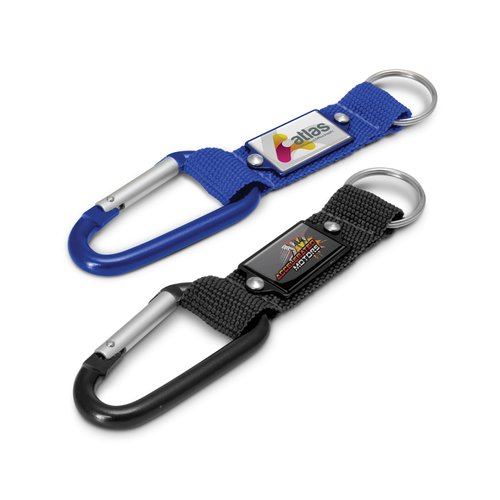
| Aluminium carabiner | About 50–60 mm long | Backpacks, site work, outdoor and sports events | Gate spring weakens; anodised colour scuffs at the gate |
| Ball chain | About 60–100 mm loop | Bag charms, plush and soft-PVC hangers, retail display | The connector pops apart under a sharp pull |
The most frequent mismatch we see is a heavy die-cast fob issued with a lightweight ball chain because the design was styled as a bag charm. Mass wins that argument every time. If the fob has real weight to it, it needs a split ring or a clasp, not a chain.
Ring diameter deserves a moment of thought too, and it is almost always left blank on a brief. A small ring looks neater in a product photograph and is genuinely awkward to thread a modern car key or an access fob onto; a larger ring takes a full bunch easily but lets the branded piece swing and knock against the keys beside it. If the recipients are office staff carrying an access card fob and a couple of keys, the larger ring wins on usability. If the piece is a boxed gift that will mostly be admired and carried with one or two keys, the smaller one looks better and behaves fine.
Acrylic and soft-PVC designs sidestep the plating question entirely, because there is no coating to breach — but they inherit a different weakness. The hole the ring passes through is the whole structure, and on a thin acrylic piece a hole set too close to the edge will eventually crack out under the leverage of a heavy bunch of keys. Ask for the hole to sit a sensible distance in from the edge, and for a metal eyelet on any acrylic design that will carry weight.
The real weak link is the connector, not the ring
Look closely at most keychains and there are three parts in the chain of failure, not two: the fob, the split ring, and a small jump ring joining them. That jump ring is usually a single loop of round wire bent closed. It is the cheapest component on the product and it carries the entire load.
An open jump ring — one where the two ends are simply pushed together — will slowly work apart under the repeated tug of a bunch of keys. A soldered or welded jump ring, or a moulded loop that is part of the fob itself, removes the failure entirely. On any design where the fob has weight, ask for one of those two. It is a single line in the brief and it is the difference between a gift that survives and a gift that is quietly replaced.
There is a design consequence too. A moulded-in loop has to be planned while the tool is being made, which is a conversation that belongs at the same stage as mould tooling, first articles and the calendar they add, not after a sample arrives.
Plating: a very thin coat doing a very hard job
The gold, chrome or antique bronze on a metal keychain is not the metal underneath. It is an electroplated layer measured in microns sitting on top of zinc alloy or steel. Once that layer is breached — by abrasion against a key, a drop onto tiles, or a scratch from a car door — the base metal beneath is exposed, and in a humid climate the exposed spot is where dulling starts and spreads.
| Finish | Character | How it ages in a humid pocket |
|---|---|---|
| Polished nickel or chrome | Bright, mirror-like, the default corporate look | Shows every fingerprint and hairline scratch; dulling is very visible |
| Satin or brushed nickel | Matte, understated, engraving reads well against it | The most forgiving everyday finish — scratches blend into the grain |
| Gold or rose gold | Warm and premium, popular for festive and executive gifts | Wear shows as a colour change to silver at the high points and edges |
| Antique brass, copper or pewter | Recessed areas darkened deliberately for depth | Ages gracefully because it already looks aged; hides handling best |
| Black nickel or gunmetal | Modern and dark; strong contrast with engraving | Edge wear shows as bright silver lines — striking or scruffy, by taste |
A protective clear lacquer over the plating slows all of this down considerably and is worth asking about on any polished or gold finish. It is not invisible — it adds a very slight warmth to the tone — so if absolute colour matching to a brand metallic matters, ask to see the difference on the sample.
Why the Malaysian climate is the real durability test
Three things happen here that do not happen in a temperate market, and together they compress the ageing of hardware.
- Persistent high humidity. Moisture is present in the air almost continuously rather than seasonally, so any breach in the plating is under attack all year, not for a few weeks.
- Perspiration on hands. Sweat carries salts. A keychain handled several times a day in a warm climate gets a light saline wipe each time, and salts accelerate corrosion at any scratch or exposed edge.
- Coastal and monsoon exposure. Recipients in Penang, Kota Kinabalu, Kuching or anywhere near the coast add airborne salt to the equation, and the monsoon months mean damp bags and wet pockets rather than a quick shower.
None of that means metal is a poor choice — it means the finish and the topcoat matter more here than in the reference photographs most catalogues use. A satin or antique finish with a lacquer topcoat will look better after a year of Malaysian handling than a mirror chrome without one, even though the chrome looks better in the box.
Three checks to run on the sample before you approve the run
You do not need a laboratory. These three take a working week, cost nothing, and between them catch the three failure modes above.
Check 1 — the pocket test
Put the sample on your own keys and carry it for a week. Nothing simulates real abrasion better than the keys it will live with. Look at the high points and the ring afterwards: that is your product at an accelerated month six.
Check 2 — the damp bag test
Seal a second sample in a food bag with a damp piece of tissue, leave it somewhere warm for three days, then open it. Any weakness in the plating or a bare cut edge will show as dullness or a bloom. A well-lacquered piece comes out unchanged.
Check 3 — the hang and open test
Hang the fob by the ring and give it a firm tug. Then try to prise the split ring apart with a thumbnail and open the clasp thirty times in a row. Springs that feel loose on a new sample will not improve in a pocket. Check the jump ring joint after this — it is where any gap appears first.
Matching hardware to how it will actually be carried
| Recipient and setting | Attachment to specify | Finish that ages best |
|---|---|---|
| Directors and long-service awards | Heavy split ring with a soldered jump ring | Satin nickel or antique brass with lacquer |
| Roadshow and exhibition giveaways | Standard split ring; keep total weight low | Printed acrylic, where plating is not a factor at all |
| Site, plant and outdoor teams | Aluminium carabiner or a heavy-gauge clasp | Anodised aluminium or gunmetal |
| Students and orientation packs | Swivel clasp for bag straps | Soft PVC or acrylic; colour matters more than metal |
| Tourism and attraction souvenirs | Split ring with a header card for hanging display | Antique finishes photograph well and hide shelf handling |
Hardware weight also reaches into logistics. A heavier carabiner on a few thousand pieces changes cartons and freight in a way that surprises event teams — the arithmetic is in the giveaway maths behind weight, cartons and freight. And the finish you choose changes how your logo reads on it, which is governed by text height and colour count limits by decoration method.
Five lines to add to your brief
- State the attachment by name — split ring, swivel clasp, carabiner or ball chain — rather than leaving it to default.
- Ask for a soldered or moulded-in jump ring on any fob with real weight.
- Specify the plating finish and whether a protective lacquer topcoat is included.
- Ask for a ring you cannot easily open with a thumbnail, and confirm it on the sample.
- Say where the recipients are based, so coastal and outdoor use can be factored into the finish.
The minimum order is 300 pcs per design. Production takes 21–45 days after artwork approval depending on quantity and method, plus around 15 days shipping, with a 7 working day express route on limited styles and quantities. Quotes carry an SST invoice and government buyers can order through ePerolehan. We have produced branded merchandise since 2003 as a Singapore-based corporate gifting specialist and now serve Malaysian clients from our Kuala Lumpur office.
Ask us for the hardware spec, not just the price
Tell us who receives the keychain and how they will carry it, and we will recommend the ring, the joint and the plating to match — then send a sample you can run all three checks on. Browse the engraved keychain Malaysia finishes that survive humidity to see the options side by side.
WhatsApp +60 10 717 5924 · Send your brief through our contact page
Aquaholic Gifts Malaysia — AS80, Jalan Hang Tuah 4, Taman Salak Selatan, 57100 Kuala Lumpur. Minimum order from 300 pcs, nationwide delivery.