The Insert Nobody Plans For: Pocket Clearance, Laminate Thickness and the Monthly Swap
The stand is bought once. The card inside it is bought again every time the promotion changes — which, in most Malaysian outlets, is monthly. So the object you spent three weeks specifying gets roughly one twelfth of the attention it deserves, and the thing that will define how the tables look for the next two years is briefed the night before by whoever has a copy of the artwork.
Almost every complaint we take about a table stand a few months after delivery is really a complaint about the insert. It curled. It slumped down into the pocket so the headline is half hidden. Its corners went furry from being pulled in and out. It is a different size from the one before it, because a different designer set it up. This guide covers the part nobody plans for: pocket clearance against real paper sizes, what lamination does to fit, why a tight pocket destroys cards and a loose one lets them sag, whether an outlet can reprint inserts on its own printer, and how to design a stand for a promotion that changes every month.
The short version. Specify the pocket around the thickest card you will ever put in it, not the thinnest. Decide at briefing stage whether the outlet reprints in-house or you print a year ahead. Then design the artwork to the visible area, not the paper size — the pocket lip eats the top of your headline.
The stand is capital, the insert is a consumable
Treating these as one purchase is the root error. A stand is a fixed asset that lives on the table for years. An insert is a consumable with a life measured in weeks, produced by a different team, on a different timeline, usually with a different approval chain. The two questions that follow are the ones we ask at enquiry stage, and they change the product:
- How often does the message change? A table number never changes and can be printed straight onto the stand. A monthly promotion changes twelve times a year and must be a slot-in card. A seasonal menu sits in between and often wants a laminated card rather than a bare one.
- Who physically swaps it? If the answer is head office posting a pack to each outlet, the card can be anything. If it is a supervisor at 11pm with a laminator, the design has to survive being made in a back office.
Answer those two before you choose a format, and the rest of the specification — along with base weight and footprint decide whether it stands — falls out of it.
Pocket clearance: the half-millimetre that decides everything
A slot-in pocket has an internal gap. A card has a thickness. The relationship between them is the entire mechanical story, and it is almost never written into a brief. Card thickness is not a single number either — it is a stack:
| Insert build | Roughly how thick | Behaviour in the pocket |
|---|---|---|
| Office copier paper, 80 gsm | around a tenth of a millimetre | Slumps and curls in humid air within days |
| Printed card, 250–300 gsm | roughly a third of a millimetre | The sensible default for a monthly swap |
| 300 gsm card, matt laminated both sides | a little over half a millimetre | Wipeable, stays flat, survives a full season |
| Encapsulated in a back-office laminating pouch | frequently over a millimetre, with a sealed rim | The version that will not go into the pocket you approved |
The last row is where orders come unstuck. A pocket built to a nicely judged clearance around a printed card has no room left for a pouch with a sealed border, and the outlet responds by forcing it, trimming the rim off, or giving up and taping the card to the front of the stand. Assume lamination will happen locally, and specify the gap around the laminated build from day one. The cost of a slightly generous pocket is nothing; the cost of a pocket that refuses the outlet’s own card is the whole order.
One line to add to your brief. “Pocket must accept a 300 gsm card encapsulated in a standard laminating pouch, and must still hold a single unlaminated 250 gsm card upright without slumping.” That sentence, on its own, prevents the two most common insert failures.
Tight pockets tear cards, loose pockets let them slump
These are the only two ways a pocket fails, and they look nothing alike.
Too tight and the card has to be forced in by its top edge. Twelve swaps a year means twelve chances to crease a corner, and because staff pull from one side, the damage is always the same corner. On a laminated card the laminate delaminates at that corner and then peels; on a bare card the edge goes soft and furry. The tell is a fleet of stands where every card is dog-eared in the same place.
Too loose and the card leans back, drops a few millimetres, or rotates a degree or two out of square. Individually invisible; across forty tables it reads as untidy, and it is the single most common reason a manager describes a stand as “cheap-looking” when nothing is actually wrong with the stand. A loose pocket also lets the card rattle in a draught, and it invites the habit of stuffing two cards in to take up the slack — which changes the loading on the stand itself.
The practical answer is a pocket that grips the bottom of the card and guides the top: a slot with a small taper, or a base channel with a shallow rear lip. It should take a firm push to seat and a deliberate pull to remove, and the card should sit dead square with no coaxing.
Design to the visible area, not to the paper size
A pocket hides part of the card. Depending on the build it is a base channel swallowing the bottom, a lip covering the sides, or a full frame taking a margin all the way round. Designers routinely lay artwork out to the trimmed paper size, which means a headline sits partly behind plastic and a footer disappears completely.
| Format | Trimmed size | Typical use on a table | What to keep clear |
|---|---|---|---|
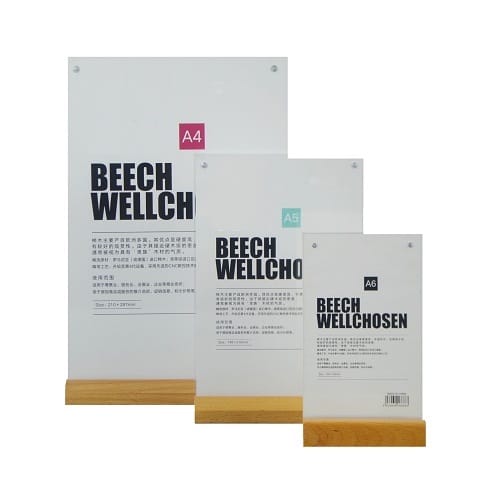
| A6 | 105 × 148 mm | Table number, one-line offer, scan prompt | Bottom edge — the channel takes a visible strip |
| A5 | 148 × 210 mm | The workhorse promo card, both orientations | All four edges if the build is a framed pocket |
| A4 | 210 × 297 mm | Full menu page, counter and buffet labelling | Edges, plus the unprintable margin of an office printer |
| Tent card | Folded, commonly around A6 per face | Double-sided specials, read from both seats | The fold — artwork crossing it never lines up |
Two habits fix this permanently. Put a keyline template into the artwork file showing the trimmed size, the area the pocket covers and a safe zone inside that, and hand the template to whoever produces next month’s card. And if the card carries a scan target, treat that target as a fixed element with its own clearance, because minimum printed QR size at scanning distance is not something a monthly redesign should be allowed to negotiate.
Can the outlet reprint inserts themselves?
For a single café the honest answer is often yes, and designing for it saves a great deal of friction. For a chain it is usually a bad idea, because the tables stop matching within two months. Either way, decide deliberately rather than by default.
If the outlet will reprint, three constraints follow from the office printer, not from your designer:
- No bleed. Desktop printers leave an unprintable margin of a few millimetres all round, so a full-bleed design comes out with a white edge. Design a card with a deliberate white border and it looks intentional instead of wrong.
- Nothing thicker than the printer will take. Most office machines choke above a certain card weight. If the pocket needs a heavy card, the outlet cannot make it and the reprint plan is fiction.
- Lay two A5 cards up on one A4 sheet with a trim line down the middle, and supply the file as a locked template. It halves the paper, and it stops staff resizing artwork to fit.
The alternative is the one we normally recommend for multi-outlet groups: print the whole year in one run, pack the cards by month in labelled envelopes, and ship them with the stands. It is one artwork approval, one print job, and outlets that still match each other in November.
Designing for a promotion that changes monthly
A monthly swap is not twelve separate design jobs. It is one system with twelve payloads. The structure that works looks like this, and it maps onto the Malaysian trading year rather than a generic calendar:
| Slot in the design | How often it changes | Where it should live |
|---|---|---|
| Logo, brand colour, scan target | Never, or once a year | Printed or engraved on the stand itself, so it survives every swap |
| Seasonal frame — CNY, Hari Raya, Deepavali, Merdeka, year-end | A handful of times a year | The insert, printed as a set in one run |
| The offer itself, and any dated terms | Monthly or faster | The insert — and nowhere near the engraved surface |
| Table number or zone code | Only on a refit | A separate fixed panel, never mixed into the promo card |
Put the permanent brand assets on the stand and only the perishable message on the card, and something useful happens: the tables stay on brand even when a month’s card is late, and the outlet can run a plain card in a quiet month without the venue looking unbranded. That is also the argument for spending the branding budget on the stand rather than on the paper, alongside scratching and clouding on acrylic faces, which decides how long that branding keeps looking new.
The insert lines to put in your brief
- Insert format and trimmed size in millimetres, plus orientation.
- The thickest build the pocket must accept, stated as a card weight plus lamination.
- How many times a year the card will be swapped, and by whom.
- Whether inserts are printed centrally or reprinted at the outlet.
- A request for a keyline template showing trimmed size, covered area and safe zone.
Aquaholic Gifts is a Singapore-based corporate gifting specialist working since 2003 and now serving Malaysia from Kuala Lumpur, and we print and laminate coordinated inserts alongside the stands so the fit is proven before delivery rather than discovered afterwards. Compare the A4 menu holder Malaysia formats against A5 before you commit — the smaller card is easier to reprint, easier to store and steadier on the table. Menu holders start at 300 pcs, with production of 21–45 days after artwork approval plus around 15 days shipping; express of 10 working days is available on limited styles and quantities.
Send us next month’s card, not just the logo
Tell us how the card is produced and how often it changes, and we will build the pocket around the real thing and send back a keyline template with the free digital mockup. Our tent card printing Malaysia and table talker printing KL formats take coordinated inserts in the same run.
WhatsApp +60 10 717 5924 · Send your brief through the contact page · AS80, Jalan Hang Tuah 4, Taman Salak Selatan, 57100 Kuala Lumpur.
Frequently asked questions
What size should a menu holder insert be?
Match a standard trimmed size so the card can be reprinted anywhere: A6 for table numbers and single offers, A5 for the usual promo card, A4 for a full menu page or buffet labelling. Then design to the visible area rather than the paper size, because the pocket covers part of the card.
Should menu inserts be laminated?
For anything that stays out for a season, yes — a matt laminate resists finger marks and keeps the card flat in humid air. Tell the supplier at briefing stage, because lamination adds thickness and the pocket has to be built around the laminated card, not the bare one.
Can we print replacement inserts ourselves?
A single outlet usually can, provided the design allows for an office printer’s unprintable margin and uses a card weight the machine will feed. For a group of outlets, printing a year of cards centrally and shipping them by month keeps every venue looking the same.
Can you supply printed inserts with the holders?
Yes. We print and laminate coordinated inserts to fit the holders and can pack a full seasonal set at the same time. The minimum order for menu holders is from 300 pcs, with production of 21–45 days after artwork approval plus around 15 days shipping.