Why the Menu Stand Falls Over: Base Weight, Footprint and a Tip Test Worth Running
The complaint that comes back from a restaurant is almost never that the stand broke. It is that staff stopped putting them out. Somewhere in week three a supervisor tired of righting fallen stands, stacked them behind the service counter, and the whole order became storage. Nothing failed. The object simply could not do the one thing it was bought for — stand up on its own on a busy table while people eat around it.
Falling over is not a quality defect. It is geometry, and it is predictable from a drawing before anything is cut. This guide sets out the arithmetic that decides whether a table stand stays upright, why a double-sided stand behaves differently from a single-sided one, what a rocking table and a ceiling fan add, and the six-minute tip test we run on a sample before a run is signed off.
The short version. A stand tips when the vertical line through its centre of gravity crosses outside the edge of its base. Two numbers decide it: how deep the base is front-to-back, and how high the loaded card sits. Material, finish and print are decoration on top of those two.
Standing up is a geometry problem, not a quality problem
Tilt a loaded stand slowly and it resists, then passes a point where it cannot come back — the point where the centre of gravity crosses the front edge of the base. That angle is the whole stability story, and it comes from two dimensions with no prototype at all:
tip angle = arctan ( half the base depth ÷ height of the centre of gravity )
For a slot-in stand holding a printed card, the loaded centre of gravity sits a little above the middle of the card. Worked through for the formats we cut most often:
| Card format, portrait | Approx. loaded centre of gravity | Base depth 45 mm | Base depth 60 mm | Base depth 90 mm |
|---|---|---|---|---|
| A6, 105 × 148 mm | around 85 mm | about 15° | about 19° | about 28° |
| A5, 148 × 210 mm | around 115 mm | about 11° | about 15° | about 21° |
| A4, 210 × 297 mm | around 160 mm | about 8° | about 11° | about 16° |
Angles are worked from the geometry above, not measured off a batch — compare designs with them, then confirm on your sample.
Read the A4 row again. A tall portrait stand on a shallow base is eight to eleven degrees from going over. Eight degrees is an uneven floor tile, a diner leaning across for the sambal, a plate set down firmly. That is why a design that photographs beautifully becomes a nuisance in a working outlet.
Weight helps, but only where you put it
Buyers instinctively ask for a heavier stand. Mass alone does nothing for the tip angle — the arithmetic above has no weight term. Weight changes how much energy it takes to reach that angle, and where the mass sits decides whether it helps or hurts.
- Mass low and forward — a thick block base, or a weight plate bonded under the foot — pulls the centre of gravity down and buys real degrees.
- Mass in the upright panel — a 3 mm face taken to 5 mm — adds grams above the pivot and makes the stand marginally worse, not better.
- A wooden block base is the quiet winner. Wood is not dense, but a block is thick by nature, so the mass sits where you want it and the footprint comes free with the design.
A stand that feels reassuringly solid in the hand can still be the wrong one: you judge mass in your palm, the table judges base depth against card height. If you are weighing a heavier how acrylic ages over a year of service against a thicker one, decide the stability question first and the material question second.
Single-sided and double-sided stands do not load the same
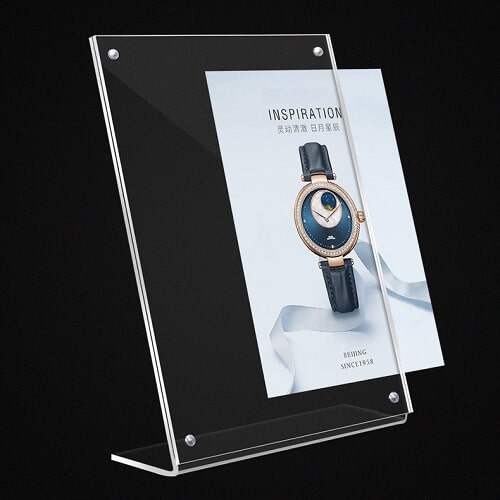
A double-sided stand — a V-shaped tent, or a two-pocket block read from both seats — is symmetrical. Its centre of gravity sits over the middle of the base whether one pocket is loaded or both, and it tips forwards and backwards at the same angle. That is why the tent card survives on tables where nothing else does.
A single-sided stand is asymmetric by construction. The card leans, so its centre of gravity starts displaced towards one edge, giving the stand a strong direction and a weak one. Neither is visible in a photograph. The weak direction usually faces the diner, which is exactly where hands come from, and the outlet will load the pocket inconsistently — two cards during a promotion is enough to take a marginal design past its angle.
Specify the worst case, not the intended case. If the pocket accepts two laminated cards, assume it will hold two on the busiest night of the year. Test the sample loaded to the pocket’s maximum, not to the single card in the mockup.
The table is not flat, and neither is the floor
Every specification is written as though the stand will live on a level plane. Malaysian dining rooms are full of surfaces that are not: tiled floors with a fall towards a drain, teak tables cupped slightly in humid air, marble tops with a bevelled edge, glass over a cloth, and the five-foot-way table with one leg on a joint.
- A flat continuous foot beats four separate feet. Four hard feet on an imperfect table rock, because only three touch at any moment. A continuous foot, or a soft strip that deforms slightly, spreads the contact and stops it.
- A soft foot also stops the slide. A bare acrylic or metal foot on a polished top has almost no friction, and a damp wipe-down turns the table into a slide. A thin silicone or felt strip along the base is the cheapest specification change in this category and it fixes both complaints at once.
Feet control what the stand does against the table; the pocket controls the card inside it, a separate specification with its own failure — see how the printed insert that swaps every month changes what the stand has to hold.
Fans, air-conditioning and the sail you just designed
An A4 portrait card is a flat panel roughly 210 by 297 mm held vertically in moving air. That is a sail. Malaysian outlets are unusually hard on light stands, because so many run ceiling fans over the tables, sit under a sweeping cassette unit, or have an open shopfront where the afternoon squall pushes air down the room.
- Directly under a ceiling fan. The airflow is downward and slightly outward, so it does not merely push the panel — it presses the top edge and rocks the stand about its front foot. A tall portrait card here is the worst combination in the category.
- In the throw of a cassette unit. The air is steady rather than gusty, so the stand does not topple — it creeps. Every stand on that row is nudged the same way by closing.
- Near an entrance during a downpour. A door opening against a pressure difference is a short, hard gust, and this is where an outlet loses several at once.
The design responses are cheap if you make them early: drop from A4 to A5, or go landscape, which cuts height and lever arm together; choose a double-sided tent so the sail is braced from both sides; deepen the base; or specify one stand for the fan zone and another for the sheltered zone. Very few outlets need a single format on every table.
The footprint a restaurant will actually tolerate
The engineering answer to every problem above is a deeper base. The floor manager’s answer is that there is no room. A two-seat table is often 600 by 600 mm, and once a condiment caddy, a tissue box and two sets of cutlery are down, the stand is competing for a strip a few centimetres wide.
A stand survives long term only if it can live permanently in one position and never be moved to lay a table:
| Where it lives | Realistic format | What kills it |
|---|---|---|
| Against the wall on a banquette table | A5 portrait, single-sided | The wall acts as a backstop; the easiest position in any outlet |
| Centre of a free-standing table | A6 or tent card, double-sided | Hands from four directions, and lifting at every wipe-down |
Ask the outlet manager one question before specifying anything: where will this live when the table is set for service? If the honest answer is “we will move it”, the product ends up on the windowsill.
The tip test: six minutes on a real sample
This is the sequence our team runs on a sample before a client commits to a run. It needs no equipment, and it must be done on the actual table in the actual outlet — not on a meeting-room desk, which is flatter and more draught-free than anywhere a diner ever sits.
- Load it to the maximum the pocket physically accepts, with the actual laminated card, not copier paper.
- The rock check. Press each corner of the base in turn. Any movement means four-point contact on an imperfect top — change the foot.
- The finger push. Push the top edge slowly with one finger from the diner’s side. If it goes over under the light pressure you would use to read something, the design is finished.
- The table knock. Rap the top once with a knuckle where a plate would land. The stand should not walk or rotate.
- The slide check. Wipe the table with the cloth the outlet actually uses and push the base sideways while it is damp. Free sliding means it will migrate all service.
- The fan hour. Leave it under the fan on the setting the outlet really uses, through one full service, then see whether it has moved, rotated or gone over.
- The lay-up. Have a server set the table around it. If the stand has to be lifted out of the way, note it — that habit ends with the stand behind the counter.
Run it before signing off 300 pcs, not after. It is also the moment to check the display face from a seated position, because a stand that passes the tip test but sits at an angle where the QR code has to scan from a seated position is only half approved.
What to put in the brief
Most briefs name a material and a logo. These lines actually change the object, and cost nothing to add at enquiry stage. Send them with your artwork and the mockup comes back already solving for stability, across the whole restaurant table stand custom range.
- Card format and orientation, trimmed size in millimetres.
- Minimum base depth front-to-back, and the maximum footprint the table will allow.
- Single or double-sided, and the maximum cards a pocket may accept.
- Foot specification: continuous flat foot, plus a non-slip strip.
- Whether tables sit under a fan, an air-conditioning throw or an open frontage.
- How often it is lifted for cleaning, and whether it must survive a knock to a tiled floor.
Aquaholic Gifts is a Singapore-based corporate gifting specialist working since 2003 and now serving Malaysia from Kuala Lumpur. Stability is the first thing our production team checks on a table-stand mockup, before print and finish. Menu holders start at 300 pcs, with production of 21–45 days after artwork approval plus around 15 days shipping; express of 10 working days is available on limited styles and quantities.
Send us the table, not just the logo
Tell us the table size, where the stand has to live and whether a fan runs above it, and we will return a free digital mockup built around a base depth that holds. Compare formats first across our range of custom menu holders Malaysia, then send us a photo of one laid-up table.
WhatsApp +60 10 717 5924 · Send your brief through our contact page · AS80, Jalan Hang Tuah 4, Taman Salak Selatan, 57100 Kuala Lumpur.
Frequently asked questions
Why does my table stand keep falling over even though it is heavy?
Because weight is not what holds it up — base depth against card height is. A heavy stand on a shallow base still tips at a small angle; it just makes more noise when it lands. Deepen the base front-to-back, or shorten the card, and the same weight becomes an advantage.
Is a double-sided tent card really more stable than a single-sided stand?
Usually yes. Its centre of gravity sits over the middle of its footprint rather than towards one edge, and it has no weak direction, so a push from any seat meets the same resistance. It also reads from both sides of the table, which often removes the need for a second stand.
What is the minimum order and how long does production take?
Our menu holder minimum order is from 300 pcs. Production runs 21–45 days after artwork approval plus around 15 days shipping, delivered across Kuala Lumpur and nationwide. Express production of 10 working days is available on limited styles and quantities — give us your opening or campaign date and we will work backwards from it.