Six Weeks and the Collar Has Gone Wavy: What Actually Holds a Polo Collar Flat
Six weeks into a new corporate polo, somebody sends us a photograph. It is almost never a photograph of a body panel. It is a collar — standing up at the back, lying down at the front, with a soft ripple along the outer edge like the brim of a hat that has been rained on. The shirt underneath is fine. The stitching is fine. The logo is fine. And the whole garment looks second-hand.
That is the thing nobody tells you when you order company polos: the collar does almost all the work of looking expensive, and it is the one component not made on the same machine, from the same yarn, or under the same tension as the rest of the shirt.
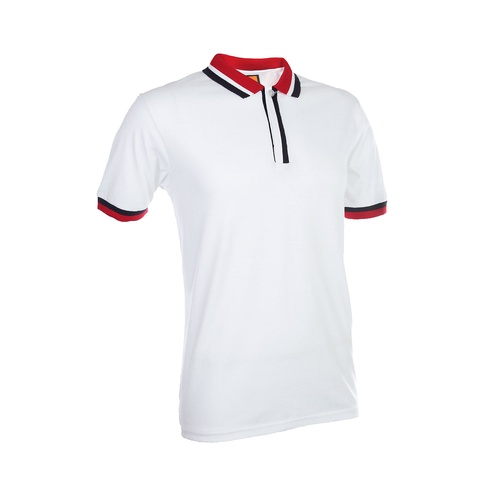
This is what our production team checks on a polo collar before a run goes ahead: how the three collar types behave, what stops the points curling, why a collar goes wavy, and a five-minute fold test you can run on a sample in your own meeting room. To see the styles side by side first, the pique polo custom collar and cuff options on our polo range are the quickest reference.
A polo is two garments sewn together
A polo body is knitted on a circular machine as a continuous tube of fabric, then cut and sewn. The collar is not. A proper polo collar is knitted flat, on a separate flat-bed machine, to a finished shape with its own selvedge edges. It arrives at the sewing line as a discrete component, like a zip or a label — already the right width, already edged, already tipped if you have specified tipping.
That single fact explains most collar failures. Two yarns, two machines, two tensions and two rates of relaxation are joined at one seam and then washed together for two years. If the collar relaxes faster than the neckline it is sewn to, the excess length shows up as waviness. If it relaxes slower, the neckline puckers instead. Neither is a fault of the cotton.
Three ways to make the same collar
Flat-knit rib collar
The default on a corporate polo. Knitted flat in a fine 1×1 or 2×2 rib with a closed edge that needs no hemming. Rib has natural elastic recovery, so it springs back after being pulled over a head. The trade-off is that rib is stretchy by design, and a loose, coarse rib loses recovery earlier than a fine, dense one.
Flat-knit honeycomb or interlock collar
Denser, flatter, and visually closer to the body of a pique polo. This is the construction behind our honeycomb CVC collars, and it is the one that holds a tipped stripe most cleanly because the surface is stable enough to knit a crisp line into. It has less spring than rib but far more resistance to the wavy edge, which is why it suits front-of-house roles where the shirt is worn open and photographed a lot.
Self-fabric collar
Cut from the same pique as the body rather than knitted as a component. Soft and fashion-led on the right garment — and the highest-risk option for a uniform programme, because a cut edge in a knit wants to curl and there is no rib recovery to pull it flat. It works only when the edge is properly finished and the collar is fused.
| Collar build | How it reads | Recovery after wear | Where we would put it |
|---|---|---|---|
| Fine rib, flat-knit | Classic corporate | Strong | Bank branches, dealerships, general staff uniform |
| Coarse rib, flat-knit | Casual, sporty | Moderate | Events, sports days, giveaway polos |
| Honeycomb / interlock | Smart, slightly dressier | Good, holds edge well | Front-of-house, hospitality, tipped-collar programmes |
| Self-fabric, cut from body | Soft, fashion-led | Depends entirely on fusing | Small runs, boutique brands, short-term wear |
Stand height and roll: the two numbers on a collar
Every collar has a stand — the part that rises from the neckline seam before the collar folds over — and a fall, the part that lies down on the shoulder. The relationship between the two is what a tailor calls the roll, and on a polo it is set almost entirely by how tall the stand is and where the fold line sits.
A low stand makes the collar lie flat against the neck, which reads casual. A taller stand lifts the fold clear of the shoulder seam, which is what makes a polo look deliberate rather than default. On the polos we specify, the stand typically sits between three and four centimetres, and moving within even that small range visibly changes the garment. Ask for the measurement; most quotations will not volunteer it.
The fold matters as much as the height. A collar knitted with a defined fold line — a change in structure across the row where it bends — finds the same fold every wash. A collar without one folds wherever it was last pressed, which is why some polos come back from the laundry looking like a different shirt.
Ask for this on the quotation: collar structure (rib gauge or honeycomb), stand height in centimetres, whether a fold line is knitted in, and whether the points are fused. Four lines. If a supplier cannot answer them, they are buying finished collars blind and so are you.
What actually stops the points curling
Curling collar points are the single most common complaint on a corporate polo, and there are only three real defences against them.
The first is structure. A denser knit at a finer gauge resists deformation better than a loose one. It is the honest fix, and it costs something, because it uses more yarn.
The second is interlining. On better polos, a light fusible is applied to the collar — sometimes across the whole collar, more often as a small insert at each point. It is not the heavy fusing you would find in a formal shirt collar; on a knit it has to be light enough to move with the fabric, or the collar becomes a board and cracks at the fold. Where a client wants a genuinely crisp point on a knitted collar, this is the specification that delivers it, and it needs to be agreed before production rather than diagnosed afterwards. The same logic governs the placket box and the buttons that sit under the collar, where a small piece of reinforcement decides whether an edge stays square.
The third is the edge finish. A collar knitted closed at the outer edge is dimensionally stable there. A collar edge that has been cut and overlocked is a raw structure held together by thread, and thread tension changes first. On a sample, look at the corner where the edge meets the point — that corner is where curling starts.
Why a collar goes wavy in the wash
Waviness — the rippling along the outer edge sometimes called fluting — is a length problem. The outer edge has become longer than the fold line it is attached to, so the surplus buckles. It happens in four ways, and each calls for a different fix.
| What you see | What caused it | What to change on the next run |
|---|---|---|
| Ripple along the outer edge only | The collar edge has grown; the knit was too loose to recover | Finer gauge or denser collar structure |
| Whole collar waves, neckline flat | Collar relaxed more than the body it is joined to | Match collar yarn to body composition; pre-relaxed collar component |
| Neckline puckers, collar flat | The collar was sewn on stretched | Sewing tension and neck tape at the joining seam |
| Wave appears only after tumble drying | Heat and mechanical action on the rib | Care instruction; heavier collar structure for laundered fleets |
| Wave appears in one department only | Different wash routine, same garment | Wash guidance issued with the rollout |
A knitted collar and a tumble dryer are not natural allies. Heat plus tumbling is the combination that persuades a rib structure to give up its recovery, and it works far faster on the collar than on anything else in the shirt. If the polos are going to a commercial laundry, say so before you choose the collar; the answer is a denser build, decided at quotation stage.
There is also a habit that quietly destroys collars: hanging a wet polo by its collar over a rail or a door, so the narrowest part of the garment carries the weight of a soaked shirt. Enough repetitions and the collar is permanently longer than the shirt it belongs to.
The collar-fold test: five minutes on a sample
This is what we do with a pre-production sample before it goes to a client for approval. It needs no equipment and catches most failures above.
- The drop test. Hold the shirt by the shoulders and let the collar fall. It should find its own fold and sit level on both sides. If one side rolls further, the collar was sewn off-centre — check the centre-back notch against the centre-back seam.
- The point test. Lift one collar point straight up with a finger and let it go. It should return to flat in one movement. If it stands part-way, or returns with a curl at the tip, the point has no structure and will curl in the field.
- The stretch-and-recover test. Stretch the outer edge between two hands to roughly a hand’s width beyond its resting length, hold for a slow count of five, release. A good collar returns to length while you watch. A weak one stays long, and that extra length is your future ripple.
- The stand test. Button the top button, stand the shirt up and measure from the neckline seam to the fold at centre back. Write that number down — it is what you will quote on a reorder.
- The wash-and-look test. Wash and dry the sample the way the shirts will really be treated, not the way the label suggests — for staff homes across Kuala Lumpur, a domestic machine and a hanger in humid air. Then repeat tests one to three.
The one that catches people out
Test three separates two collars that feel identical in the hand. Recovery is not softness — the collar that feels beautifully soft in a showroom is often the one with the least spring in it. Run it on every colour in the order.
Writing a collar into the order
Most polo quotations describe the body and go quiet about the collar. Ask for five things in writing: structure and gauge; stand height; whether a fold line is knitted in; whether the points carry a fusible insert; and whether the collar is a knitted component or cut from body fabric. Where you are also specifying trim, a tipped collar knitted in two yarns adds a further set of questions about yarn colour that are worth settling in the same conversation.
There is a sixth for an embroidered polo: a nape logo sits directly against the collar seam, so the nape placement that lands just under the collar seam is decided at the same time as the collar build, not afterwards.
None of this adds time to a project. Production runs 20 to 30 working days after artwork approval plus around 15 days shipping, and the collar specification is settled during mockup, before the clock starts. Our polo MOQ is from 100 pcs.
Questions buyers ask about corporate polo shirts
Why does my polo collar curl up at the points?
Almost always because the point has no structure holding it: the collar is knitted too loosely, the edge is cut and overlocked rather than knitted closed, or there is no light fusible insert at the tip. It is a specification issue, not a washing one.
What makes a polo collar go wavy after washing?
The outer edge has become longer than the fold it is attached to, so the surplus buckles. Loose rib structures and tumble drying are the two biggest contributors.
Is a self-fabric collar better than a knitted rib collar?
It is different, not better. Self-fabric looks softer but relies entirely on fusing to stay flat. Knitted rib and honeycomb collars carry their own recovery and are the safer choice for a large staff rollout.
Should staff hang or fold a corporate polo?
Fold, or hang from the shoulders on a broad hanger. The habit that damages collars fastest is hanging a wet polo by the collar itself.
What is the minimum order for custom polo shirts, and how long does production take?
Our polo MOQ is from 100 pcs. Production runs 20 to 30 working days after artwork approval, plus around 15 days shipping nationwide. An express route of 10 working days exists on limited styles and quantities — tell us the handover date and we will work backwards from it.
Send us the collar you want, not just the colour
Tell us the role, the wash routine and the look you want, and we will come back with a collar specification, a free digital mockup and a quotation. Browse custom polo shirts Malaysia teams order by the collar and send the brief across.
A Singapore-based corporate gifting specialist since 2003, now serving Malaysia from AS80, Jalan Hang Tuah 4, Taman Salak Selatan, 57100 Kuala Lumpur. WhatsApp us on +60 10 717 5924 or use the contact page. SST-compliant invoicing and ePerolehan-ready documentation on request.