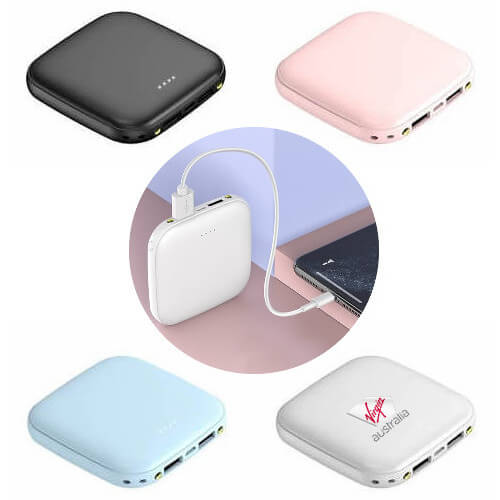
Two Identical-Looking Power Banks, Two Different Products: Cells, Casings and Shelf Life
Put two 10,000mAh power banks side by side on a meeting table and you will not be able to tell them apart. Same moulding, same brushed finish, same printed capacity, near enough the same weight. One of them is a gift your client’s staff will still be using in three years. The other will be swollen, discarded or quietly binned within eighteen months. Nothing visible on the outside distinguishes them — which is precisely why the decision has to be made by asking questions rather than by looking.
This article sets out what actually differs inside two identical-looking units, why the casing you pick silently decides your power bank custom logo options, and why warehousing battery stock for a year is one of the more expensive mistakes in corporate gifting. It ends with the six questions our team puts to a supplier before a model goes on a client shortlist.
What is actually inside: cell format and cell grade
Two variables account for most of the difference in real-world life.
Cell format
Cylindrical cells — the familiar 18650 format — are robust, well understood and easy to source, but they force a thicker, rounder casing. Lithium-polymer pouch cells are flat and let a designer build the slim card-style bank that photographs so well in a gift box. Pouch cells are also more sensitive to physical abuse and to heat, which is a genuine consideration in a country where a gift spends July in a car.
Cell grade
This is the one nobody advertises. Cells come off a production line and are sorted: consistent capacity and internal resistance in one bin, everything that fell short in another. Downgraded, recovered and reclaimed cells all exist in the market and all look identical once they are inside a shell. A pack built from cells with mismatched internal resistance ages unevenly, and uneven ageing is what turns a battery into a swelling battery.
You cannot inspect for this. You can only ask for it in writing: the cell manufacturer’s name, the cell model reference, and a written confirmation that no substitution will occur after sample approval. A supplier who answers those three questions crisply is a different proposition from one who answers with adjectives.
The protection circuit is the part you cannot see—and the part that matters
Between the cell and the USB port sits a protection board. A properly specified one guards against over-charge, over-discharge, over-current, short circuit and over-temperature, and it is the difference between a cell fault becoming a dead unit or becoming an incident. It is also, being invisible, the easiest place to save money.
Ask which protections are implemented. Ask whether the pack has been tested to a recognised portable-battery safety standard and by whom — the documentation side of that question is covered in full in which certificates actually apply in Malaysia. A test report against a named standard describes a design, so pair it with the batch traceability question above.
The watt-hour reconciliation, in one line
Rated capacity in mAh × 3.7 ÷ 1,000 should equal the watt-hour figure marked on the casing. A “20,000mAh” unit marked 55Wh holds about 14,900mAh. The full working, and what it means for how much charge a phone actually receives, is in the usable-capacity conversion table.
The casing decides the decoration, not the other way round
Buyers usually arrive with a decoration in mind and then look for a model. It works far better in reverse, because each casing material accepts only certain marks well.
| Casing | Best decoration | What it looks like | The catch |
|---|---|---|---|
| Anodised aluminium | Laser engraving | A permanent tonal mark revealing the metal beneath the anodising | Single tone only — no full colour. The engraved shade is set by the anodising colour, so approve it on the actual finish, not a render. |
| ABS / polycarbonate | UV printing or pad printing | Full colour, including gradients and photographic artwork | Ink sits on the surface. Curved and recessed faces reduce the usable print area more than the drawing suggests. |
| Soft-touch rubberised coating | UV or pad printing, with pre-treatment | Very premium in the hand | The coating is the problem. Ink adhesion on soft-touch is weaker than on bare plastic, and laser burns through to a differently coloured substrate. Always run an adhesion check on a sample. |
| Bamboo or wood veneer | Laser engraving | A warm, dark burn with visible grain | Grain and tone vary between units, so the same file will not look identical across a run. Set expectations before approval. |
How casing material constrains decoration on a branded power bank. Our production team approves artwork on the actual casing in every case.
Two production notes worth having. Soft-touch generates the most reprints: it feels the best and is the least forgiving of ink, so it is the one finish where a physical mockup is non-negotiable. And a printed logo on a dark anodised body reads as a different brand mark from the same logo laser-engraved — if brand guidelines are strict, settle that at mockup stage, not at delivery.
Ports, Power Delivery, and stock that is already obsolete
A power bank dates faster than any other gadget gift, and the dating happens at the ports.
- A micro-USB input in 2026 is a red flag. It signals stock designed years ago, and it forces the recipient to keep an obsolete cable alive purely to charge your gift. The European common-charger requirement made USB-C the norm for a wide range of devices sold there from 28 December 2024, and the global supply chain followed. Specify USB-C in and USB-C out.
- Power Delivery is about time, not capacity. USB PD moves energy faster, both into the bank and out of it. The current specification reaches far higher power levels than any gift-tier power bank needs, so treat PD as a convenience feature and read the actual output rating rather than the word “fast” on a catalogue page.
- Built-in cables are a genuine feature with a genuine risk. They solve the “I forgot my cable” problem elegantly, and they are a single point of mechanical failure. Confirm which connectors are fitted — a built-in cable with the wrong connector is worse than no cable at all.
- Wireless and magnetic models need a compatibility conversation. They are excellent gifts for the right audience and frustrating for the wrong one, and they carry an extra handling instruction for travellers, as set out in our note on shipping restrictions on bulk battery orders.
Shelf life: why buying a year ahead is a false economy
Here is the habit we most often talk clients out of. A buyer secures a good arrangement, orders generously, and warehouses the surplus “for next year’s intake”. Batteries do not reward that.
Lithium-ion cells lose charge while doing nothing — commonly cited figures put self-discharge in the region of 1–3% per month at room temperature, before any standby drain from the protection board. More importantly, they age on the calendar as well as on the cycle count. Published storage guidance for lithium-ion consistently recommends holding cells at 40–60% state of charge and 15–25°C, because that combination produces the slowest ageing. Heat accelerates both self-discharge and permanent capacity loss.
The Malaysian storeroom problem
A non-air-conditioned storeroom, a warehouse mezzanine under a metal roof, or a car boot in the Klang Valley is not 15–25°C. It is materially warmer for most of the day, for most of the year.
Stock that arrived legally part-charged and then sat in that environment for twelve months has done two things at once: drifted downwards in charge, and aged. A unit that has been allowed to sit at, or near, empty for months also risks over-discharge damage that cannot be reversed by charging it again.
So the practical guidance our team gives:
- Buy to the campaign, not to the warehouse. Ordering twelve months of stock to secure one arrangement usually costs more in dead units than it saves.
- If you must hold stock, hold it cool and half full. An air-conditioned room, and a top-up to roughly half charge every few months, is the whole regime.
- Rotate strictly. First in, first out, by batch. Mixing an old batch into a new distribution puts your worst units in front of your most recent audience.
- Distribute promptly after arrival. The best storage location for a power bank is a recipient’s bag, where it gets cycled.
The six questions that separate the two banks
This is the script. Six questions, and what a good answer sounds like.
| Question | What a good answer sounds like | What should worry you |
|---|---|---|
| Who makes the cell, and what is its model reference? | A named manufacturer and a specific cell reference, supplied in writing | “Grade A cells” with no name attached |
| What is the watt-hour marking on the casing? | A figure that reconciles with the mAh claim, evidenced by a photograph of the actual casing | The catalogue page resent instead of a photograph |
| Which protections does the board implement? | Over-charge, over-discharge, over-current, short circuit and temperature, listed individually | “It has full protection” |
| Will the cell be substituted after sample approval? | A written no, with a batch reference on delivery | Silence, or a reference to supply-chain flexibility |
| What are the input and output port types and ratings? | USB-C in and out, with actual ratings quoted | The word “fast” and a micro-USB input |
| How and where has this stock been stored? | A stated storage condition and an indication of batch age | No idea — which usually means a long time, somewhere warm |
The six-question supplier script our team runs before a power bank model reaches a client shortlist.
Giving electronics to staff: the sensible duty-of-care habits
This is not legal advice, and the risk from a properly specified power bank is low. But an organisation handing a lithium battery to several hundred employees has taken on something it did not have before, and a few cheap habits make it manageable.
- Keep the batch file. Model reference, cell reference, batch number, quantity received and the test documentation, filed against the distribution list.
- Do not mix batches in one distribution. It makes any later follow-up almost impossible to scope.
- Include a short care note. Charge fully before first use; keep away from direct sun and hot vehicles; stop using a unit that swells, deforms or becomes hot; recharge every few months if unused.
- Name a route for problems. Recipients should know whether to contact HR, the event team or the supplier. Without it, faulty units are simply thrown away.
- Hold a small replacement reserve. A handful of spares from the same batch turns a complaint into a two-day resolution.
Aquaholic Gifts has been a Singapore-based corporate gifting specialist since 2003 and now serves Malaysia from Kuala Lumpur. The habits above separate programmes that run quietly from those that generate a difficult email eight months later.
Quality and storage questions buyers ask us
How can I tell a good power bank from a cheap one if they look identical?
You cannot tell by looking. Ask for the cell manufacturer and model reference, a photograph of the casing showing the watt-hour marking, the list of implemented protections, and written confirmation that no cell substitution will follow sample approval. Those four answers separate the two units far more reliably than the finish does.
How long can we store branded power banks before distributing them?
Distribute as soon as practical. Lithium-ion cells self-discharge in the region of 1–3% per month at room temperature and age on the calendar regardless of use. If stock must be held, keep it cool, at roughly half charge, and rotate strictly by batch.
Which casing should we choose for a full-colour logo?
ABS or polycarbonate with UV printing. Aluminium takes laser engraving beautifully but produces a single-tone mark, and soft-touch coatings need pre-treatment and an adhesion check before a full-colour run is approved.
Is a micro-USB input still acceptable in 2026?
We would not specify it. It signals older stock and obliges the recipient to keep an obsolete cable for your gift alone. USB-C in and USB-C out is the sensible baseline.
What is the minimum order quantity, and how long does production take?
From 300 pcs per design. Production runs 21–45 days after artwork approval, depending on capacity and branding, plus about 15 days shipping. Express production in 10 working days is available on limited models and quantities.
Ask the six questions—or let us ask them for you
Send us the model or the catalogue page you are considering and we will run the six-question script, reconcile the watt-hour marking against the capacity claim, check the casing suits the artwork you have in mind, and come back with a mockup on the actual finish rather than a screen render.
Minimum order from 300 pcs per design. Production 21–45 days after artwork approval plus about 15 days shipping; express 10 working days on limited models. SST-compliant invoicing, delivery across Kuala Lumpur and the rest of Malaysia.
Or go straight to the range and shortlist a model: brief a customized power bank charger.
WhatsApp +60 10 717 5924Send a brief
Aquaholic Gifts Malaysia · AS80, Jalan Hang Tuah 4, Taman Salak Selatan, 57100 Kuala Lumpur · nationwide delivery across Malaysia.