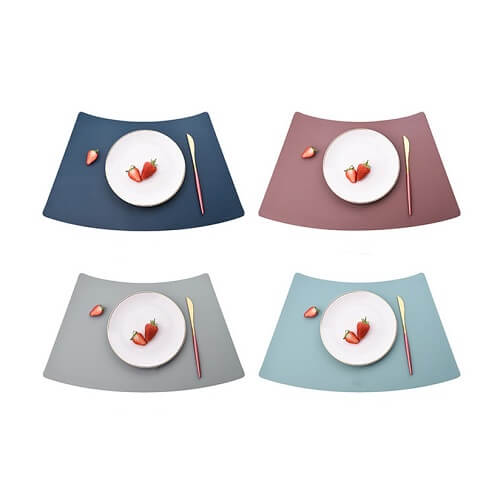
PU Tableware Mats in Daily Service: Heat, Curl and the Edge That Lifts First
A PU tableware mat is judged in an air-conditioned meeting room, by a buyer holding one sample and rubbing a thumb across the grain. It then goes to work in a room where a plate lands on it straight off a heat lamp, a chilled glass sweats onto it for an hour, a cloth carrying a food-safe cleaner passes over it between covers, and it is stacked while still damp. Nothing in the sample review predicts any of that, which is why mat orders look tired long before the property expected to replace them.
We have supplied branded table-top items since 2003 as a Singapore-based corporate gifting specialist, now serving Malaysia, and mats sent back to us for matching almost always fail in the same order: gloss changes where the plate sits, a corner lifts, then the mat stops lying flat. This article explains why that order is so consistent, and sets out the fourteen-day service trial we ask properties to run before committing to a full run of 500 pcs. It is a fortnight of somebody’s attention, and the cheapest quality control available to a food and beverage buyer.
Four loads, arriving in a fixed order
A mat carries four distinct loads, and separating them helps because each acts on a different part of the item. Heat acts on the centre. Moisture acts at the glass position and, more damagingly, at the edges. The cloth acts on the face and the underside. Stacking acts on the whole thing at once, in the store, out of sight. Most specification conversations only cover the first. Properties reaching us through our range of branded hotel supplies for Malaysian properties who describe their clearing and storage routine, not only their brand colour, usually end up with a different edge construction than the one they first asked for — and a mat that survives its second festive season.
Heat: what a hot plate does to a coated surface
Polyurethane on a mat is a coating over a backing, not a solid slab. Warmth does not melt it; it softens it temporarily and makes it willing to take an impression. A plate held under a heat lamp then set down for the length of a main course delivers exactly that: sustained warmth, concentrated on the plate’s foot ring where contact pressure is highest.
Two visible outcomes follow. The first is gloss transfer: the softened topcoat takes on the smoothness of the plate base and reads shinier than the surrounding surface, obvious across the light at a low angle even where colour is unchanged. The second is a faint permanent outline of the foot ring, because the softened coating settles and does not fully recover.
Finish decides how visible this is. High gloss shows ring transfer earliest, because the contrast between marked and unmarked areas is greatest. A matte or lightly embossed grain hides it far longer, and a deeper grain resists the impression itself, since the plate touches only the raised points. If the room uses hot plates routinely, specify a textured finish and accept that a mirror-gloss mat is a photography choice, not a service choice.
The hot-plate spot test, on a sample, in ten minutes
Take one sample mat to the pass. Put a plate on it straight from wherever your plates are hottest — the warmer, the lamp, or the wash — and leave it for as long as a real course sits on a table. Lift it, then look across the mat at a low angle against a window, not from directly above. Run a fingertip over the ring: if it feels tacky, the coating has softened more than it should and will mark permanently in service. Repeat on the same spot. A surface that survives one cycle and marks on the second is telling you what a month looks like.
The edge is where mats actually die
Ask a food and beverage manager which mats they threw out last and why, and the answer is rarely the centre. It is a corner that started to lift, caught on a cloth, and lifted a little more with every wipe until the mat looked scruffy from across the room. The mechanism is straightforward: wherever the mat is cut, the layers are exposed, water sits on that cut line at every wipe, wicks into the backing and works at the bond between coating and substrate. Once a millimetre of edge has released, the corner is no longer flat, so the next cloth catches it rather than passing over it. From there it is a one-way process.
| Edge construction | How it fails | Where it suits | What to specify |
|---|---|---|---|
| Plain cut edge, single layer | Backing wicks moisture, edge frays or greys | Low-frequency use, dry settings, banquet dressing | Sealed or heat-cut edge, radiused corners |
| Heat-sealed or welded edge | Seal line can go brittle and crack at the corner | Daily service where mats are wiped, not washed | Radiused corners, seal width confirmed on sample |
| Stitched border, double-sided build | Thread abrades or discolours before the panel does | Heavy daily service, premium rooms | Colour-matched bonded thread, stitch set back from the cut line |
| Bonded to a rigid board | Adhesive releases at the perimeter; corner peels | Fixed covers, display and buffet positions | Wrapped-and-turned edge rather than flush trim |
Curl: the fault guests notice before the manager does
A mat that does not lie flat makes a well-dressed table look neglected. Curl arrives from three directions: asymmetric drying, when a mat wiped wet on the face is stacked immediately and dries from one side; storage on edge in a rack, which gives a permanent memory of that curve; and heat, which relaxes the coating and lets the backing tension win.
The construction answer is symmetry — the same material on both faces, or a stitched border tying the layers together at the perimeter, cups far less than one coated face bonded to a different backing. The operational answer is simple and rarely followed: mats go back to the store flat, stacked, with the top weighted. Never on edge, never stacked wet.
Ask one question of your clearing team before you specify anything: are mats wiped on the table and left, or collected, wiped and stacked? The second routine is much harder on a mat, and it should change the edge construction you buy.
The wipe-down, phrased in a way that is actually useful
Every property has a cleaner it actually uses, whatever the standard operating procedure says. Rather than debating chemistry with a supplier, test your own bottle on your own sample — on the edge and the underside, not the middle of the face.
The face gets the shortest chemical contact because the cloth keeps moving. The edge is where liquid collects and sits until the mat dries, and the underside is wiped least often, so residue stays on it longest. Two things matter more than the product name: how wet the cloth is, and how long the solution sits before it evaporates — and in a humid dining room, nothing evaporates quickly. One habit is worth writing into the routine: a dry pass after the wet one. It removes most of the standing moisture that works into the cut edge.
The fourteen-day service trial, before you commit to 500 pcs
This is the part we would most like buyers to steal. Samples tell you about material; only service tells you about service life, and a fortnight in one real section surfaces faults the full order would otherwise reveal in month three.
- Take three samples in the exact finish you intend to order — same colour, texture, edge construction and decoration. A different finish invalidates the trial.
- Keep one as the control. It stays in the office, flat, out of light, untouched. Without it you have nothing to compare against on day fifteen, and memory is a poor colour reference.
- Put the other two into your busiest section, not your quietest — the section that clears fastest and turns tables most, because that is where the routine is least careful.
- Brief the section to treat them exactly like everything else. Same clearing, same cloth, same cleaner, same stack, same store. A protected sample is a wasted fortnight.
- On day fifteen, lay all three side by side under one light source, ideally near a window, and look across them at a low angle.
- Work the look-list below and decide before you raise the order, not after.
The day-fifteen look-list
- Plate zone. Any gloss change or foot-ring outline where plates sat, judged at a low angle.
- Corners. Slide a fingernail under every corner. Any lift at all is a fail on edge construction.
- Flatness. On a flat table, press the centre. If a corner rises, it will rise further in service.
- Colour. Compare against the control in daylight, not under warm restaurant lighting.
- Decoration. Rub the logo with a dry thumb, then with your cleaner. A mark that lightens in a fortnight will be gone by the festive season.
- Smell. A sour smell from the underside means moisture and residue are reaching the core, which points at the edge seal.
The decision rule: corner lift on both mats means changing the edge construction before ordering; plate-zone gloss change means changing the finish or texture depth; damage confined to the decoration means moving the logo.
Logo placement on a mat is service geometry, not graphic design
The centre of a mat is the worst place for a mark, because the centre is where the plate goes. A centred logo spends its life under a hot base, is invisible for the whole meal, and wears first. Yet centred artwork is what most first drafts arrive with, because artwork is designed on a screen showing an empty mat.
Lay the mark out against a dressed cover instead. Take your actual charger or main plate, your glassware position and your cutlery lanes, and mark that footprint on a blank mat. What remains — usually a band along the top edge and the two outer corners — is your available branding area, and a mark at the top edge is the one a guest sees while eating rather than only at clearing. Decoration follows placement: a debossed mark in a corner survives longest because nothing sits on it, while a printed mark gives exact colour and meets the cloth first. On a double-sided mat, both faces are working surfaces and both get wiped.
Ordering, floats and reorders
Order for covers plus a float. Mats are pulled from rotation for staining and curl continuously, and a room dressed with a mixture of new and tired mats reads worse than one dressed with tired mats throughout. On reorders, say it is a reorder and send a used mat with the enquiry: coated materials are produced in batches, and matching a colour to an item that has been in service for a year is a different exercise from matching to the original artwork. If mats are being ordered alongside other branded items for an opening or a refit, the sequencing matters as much as the specification — we set that out separately in our guide to kitting a property rather than buying items one by one. And if the same order covers in-room dining, the tray items and the folder in the room should be specified together; our note on what belongs inside an in-room compendium folder covers the other half of that conversation.
Questions food and beverage buyers ask
Can a PU tableware mat take a hot plate straight off the pass?
It takes normal service warmth, which is what plates carry once they reach a table. What it does not enjoy is sustained contact with a plate still very hot from a warmer or a lamp, because that softens the topcoat and leaves a gloss ring. A textured or matte finish hides this far better than gloss, and the spot test above will tell you where your own plates sit.
Why are our mats curling at the corners after a few months?
Almost always moisture entering a cut edge combined with mats being stacked or racked while damp. A symmetric build with a stitched or properly sealed border resists it structurally; a dry pass after the wet wipe and flat, weighted storage resists it operationally.
Should the logo be printed or debossed?
Debossing survives the cloth better and reads as more premium on a leather-look surface, but it is tone-on-tone and needs a simple mark and a material with body. Printing gives exact brand colour and fine detail, at the cost of being the layer the cleaner meets first. Placement matters more than either: keep the mark outside the plate footprint and both last longer.
What is the minimum order and how long will it take?
The minimum order is 500 pcs. Production runs 21–45 days after you approve the artwork on the free digital mockup, plus around 15 days shipping nationwide across Malaysia. Express in 10 working days is possible on limited styles and quantities. Pricing is quote-only, invoiced with SST, and we are ePerolehan-ready for government buyers.
Tell us how your mats get cleared, and we will spec the edge
Send us your plate size, your cleaning routine and how the mats are stored, and we will recommend a construction, a finish and a decoration position — then request a free mockup for custom PU tableware mats, usually back within one business day.
Aquaholic Gifts Malaysia · AS80, Jalan Hang Tuah 4, Taman Salak Selatan, 57100 Kuala Lumpur