Travel Gifts and Airline Rules: What Gets Taken at Security
There is a specific and avoidable failure mode for travel gifts: the recipient packs it, gets to the airport, and has it taken off them at the screening point. Whatever goodwill the gift generated is gone, and it is replaced by a small resentment aimed at whoever chose it.
Most buyers never find out this happened. The recipient does not write in to say their gift was confiscated. This guide covers the rules that quietly decide which gifts for travellers are usable, so you can rule items out at the brief stage rather than after the fact.
One caveat before the detail: security and airline rules vary by country, by carrier and over time, and they do change. Treat everything below as the shape of the problem and the questions to ask, and confirm current limits with the relevant airline or regulator before committing to a large order.
Liquids: the rule that catches toiletry sets
Cabin baggage rules across most of the world restrict liquids, gels, pastes and aerosols to containers of a small maximum volume — commonly 100ml — all of which must fit inside a single transparent resealable bag of limited size.
Two consequences for gift buyers, and the second is the one people miss.
First, any bottle in a travel gift must be at or under that container limit, and the limit applies to the container size, not the amount of liquid in it. A half-empty 200ml bottle is still refused. If you are giving refillable travel bottles, the bottles themselves must be small enough, and it is worth having the capacity printed or moulded on them so the recipient can prove it at the checkpoint.
Second, the transparent bag matters more than the bottles. A wash bag that is opaque, however nice, does not satisfy the requirement — the recipient still has to decant into a clear bag at the airport. A travel gift that includes a compliant clear pouch alongside the wash bag solves a real problem and costs very little. This is one of the highest-value details you can add to a toiletry-based set.
Batteries: why power banks are the riskiest travel gift
Anything containing a lithium battery is governed by rules that are stricter and less familiar than the liquids rules, and power banks are the item most affected.
The pattern, broadly, is this. Spare lithium batteries and power banks must travel in the cabin and are not permitted in checked baggage — which means a recipient who packs their gift in a suitcase can have the whole bag pulled. Capacity is limited, expressed in watt-hours rather than in the milliamp-hours printed on most consumer packaging, with a common threshold around 100Wh for items carried without special approval. Many carriers also require the capacity to be clearly marked on the item, and will refuse an unmarked battery regardless of its actual size. Some now restrict using or charging a power bank during flight.
For a gift buyer that produces a short checklist. Insist the watt-hour rating is printed on the unit itself, not only on the box. Confirm the cell is from a reputable supplier with certification documentation you can actually see. And think hard about whether the audience is right — a power bank given to a thousand people is a thousand chances for a battery incident attached to your logo.
The same logic applies to anything else with a cell in it: luggage trackers, rechargeable neck massagers, lighted mirrors, and travel adapters with a battery pack built in. Adapters without a battery are unaffected — see our notes on choosing a travel adapter for the specification side.
Sharps: the sewing kit problem
Blades, points and tools are restricted in cabin baggage, and the items that catch people out are the ones bundled inside something else.
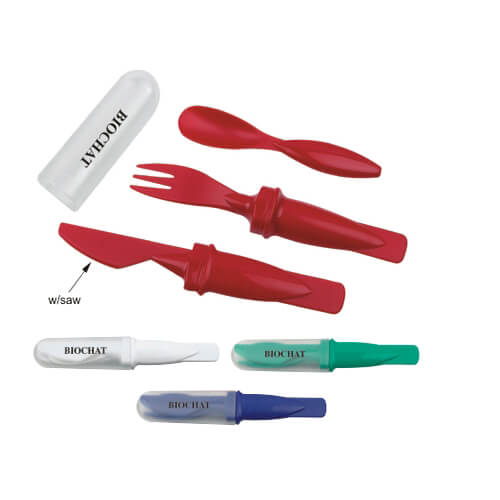
A courtesy sewing kit with scissors, a multi-tool tucked into a wash bag, a manicure set with a metal file, a corkscrew in a hospitality gift — all of these are routinely surrendered at screening, and in each case the recipient loses more than the tool, because the item was inside a gift they were carrying.
If a set needs a tool, choose a version without a blade or point, or accept that it belongs in checked baggage and say so on the packaging. A one-line note — “pack in checked baggage” — on the insert card costs nothing and prevents the loss entirely.
Size and weight: the quiet constraints
Cabin allowances differ substantially between full-service and budget carriers, and in this region a large share of travel is on carriers with tight personal-item limits. A gift that is bulky enough to compete for that allowance will be left at home.
This is why compressible items outperform rigid ones for travel sets. A packable foldable bag, a soft pouch or a flattenable wash bag can be squeezed into a gap; a rigid organiser cannot. It is also why weight matters more than it does for other gift categories: every gram you add is a gram the recipient is choosing over something else.
A pre-brief checklist
Run every candidate item through these questions before it reaches a quotation:
- Does it contain a battery of any kind? If yes, is the capacity marked on the item and is certification available?
- Does it hold liquid? If yes, is the container within the cabin limit, and is a compliant clear pouch included?
- Does it contain anything with a blade, point or sharp edge?
- Can it be compressed, or is it rigid?
- Would it survive being packed inside a suitcase under other items?
- If it has to go in checked baggage, does the packaging say so?
Anything that fails two or more of these is usually the wrong item for a travel gift, however well it suits the budget.
Tell the recipient which bag it goes in
Most of the losses described above happen because the recipient did not know a rule applied to the thing they were carrying. That is fixable with one line of print, and almost nobody does it.
If the set contains a power bank, the insert card should say it must be carried in the cabin and never in checked baggage. If it contains a tool, sewing kit or anything with a point, the card should say the opposite — pack it in checked baggage. If it contains bottles, printing the capacity on the bottle itself, not just the packaging, gives the recipient something to point at if they are questioned.
This costs a few sen per set and it converts your gift from something that might cause a problem into something that visibly anticipated one. It is also the kind of detail that gets mentioned when people talk about the gift, which is more than most branding achieves.
Rules vary by route, so check the route
There is no single global standard, and the differences are large enough to matter when you are buying for a specific audience. Liquid allowances, the size of the permitted clear bag, battery capacity thresholds, whether power banks may be used in flight, and what counts as a restricted tool all vary between countries and between carriers, and several of these have been tightened in recent years.
The practical approach for a gift buyer is not to become an expert. It is to identify the two or three routes your recipients actually fly most, check the current published requirements for those carriers and airports, and specify to the strictest of them. Specifying to the strictest rule you can find is the only version of this that stays correct when the rules move.
Where a set is going to an international recipient list with no dominant route, keep to the categories that are unrestricted everywhere — soft, non-powered, no liquid, no sharps — and the question disappears.
Certification is worth asking for
For anything containing a battery, the supplier should be able to produce documentation for the cell without hesitation. If they cannot, that is the answer to whether you should be buying it.
Ask for the paperwork, ask whether the capacity marking is printed on the unit or only on the packaging, and ask what happens if a unit fails in the field. The last question matters more than buyers expect: a battery item given to a large group will produce a small number of failures, and you want to know in advance whether the supplier replaces them or whether that becomes your problem.
A short list of safe defaults
If you want to skip the analysis entirely, there is a category of travel gift that never causes a problem anywhere: soft, non-powered, no liquid, no sharps, compressible. Luggage tags, passport holders and sleeves, packable bags, cable pouches, wash bags supplied empty, eye masks, and clear compliant toiletry pouches.
Every one of these can be packed in either bag, on any carrier, on any route, without the recipient having to think about it. They are also, not coincidentally, the items that get used most, because a traveller learns quickly which of their possessions cause friction at a checkpoint and stops carrying the ones that do.
The corollary is that adding a powered or liquid item to a set changes the character of the whole gift. It is no longer something the recipient can throw in a bag without thought — it is something they have to make a decision about each time they pack. That is a real cost, and it should be weighed against whatever the item adds.
Frequently asked questions
Can travel gifts include liquids or toiletries?
Yes, provided each container is within the cabin liquid limit that applies on the routes your recipients fly — commonly 100ml. The limit is based on container size, not contents, so a part-filled larger bottle is still refused. Including a compliant clear pouch adds real value.
Are power banks allowed on flights?
Generally in cabin baggage only, never in checked baggage, subject to a capacity limit expressed in watt-hours, and many carriers require the rating to be marked on the unit. Rules vary by airline and change, so confirm current requirements before ordering in volume.
Why do sewing kits and multi-tools get confiscated?
Because scissors, blades and points are restricted in cabin baggage. The item is usually tucked inside a wash bag and the traveller has forgotten it is there. A note on the packaging to pack it in checked baggage prevents the loss.
What is the safest category of travel gift?
Soft, compressible, non-powered items with no liquid or sharp components: pouches, luggage tags, packable bags, passport holders, wash bags and cable organisers. None of them can cause a problem at screening.
Should the packaging mention any of this?
Yes where it applies. A single line on the insert card — the container capacity, or an instruction to pack an item in checked baggage — is cheap and prevents the exact failure that makes a recipient resent the gift.
Rule items out early
Send us your shortlist and we will flag anything that will cause a problem at screening before you commit to a quantity. See travel gift ideas that clear security, or send us your item list to check.
If you are still deciding what goes in the box, our guide to assembling a set that actually gets used covers the structure, decoration that survives a luggage belt covers the branding, and what works as a mass giveaway covers volume orders.