The Sham Is the Product: What a Whisky Glass Base Is Actually Doing
Pick up a heavy whisky tumbler and turn it over. Somewhere between a third and half of what you are holding is solid glass that will never touch a drop of whisky. It holds nothing, chills nothing and pours nothing. It exists to be felt. Glassmakers have a name for it — the sham — and it is the one feature that separates a whisky glass from every other glass on a drinkware list. It is also almost never mentioned on a quotation.
This article is about that block of glass: how it gets there, why a pressed tumbler can carry an interior shape a blown glass cannot, and what the volcano peak and the whirlpool ridges genuinely change about the spirit above them — plus the bench sequence our production team runs on a sample base before an order is signed off.
The sham, and the two ways it gets there
The sham is the solid mass of glass between the inside floor of the tumbler and the surface it stands on. On a plain drinking glass it might be two or three millimetres; on a whisky tumbler it is often thicker than the wall by an order of magnitude, and on the heaviest bodies it accounts for most of the weight.
It is worth separating the sham from the punt, because buyers use the two words interchangeably. A punt is the dimple pushed up into the underside — the dome at the bottom of a wine bottle. A sham is solid. A tumbler can have both, and a shallow punt is worth asking for: it leaves the glass sitting on a narrow contact ring rather than its whole face, so it is far less likely to trap grit and scratch a lacquered table.
How the sham arrives tells you what the glass can and cannot be. Blown glassware — the process behind most stemware — inflates a gather of molten glass into a mould. The mould defines the outside; the inside is whatever the air pressure produces, and there is no practical way to sculpt a feature into the interior floor.
Pressed glassware works the other way. A measured gob of molten glass drops into the mould and a steel plunger descends into it. The mould shapes the outside, the plunger shapes the inside, and the gap between them is the wall. Because the plunger is a solid tool it can be any shape at all — and the glass left beneath it is your sham. Every volcano peak and every whirlpool ridge on the market is a plunger profile. That is the whole trick.
The tell, if you want to spot a pressed body: two faint vertical seams up opposite sides of the exterior, and a crisp, defined interior geometry. Blown glass has a smooth, faintly irregular interior and no interior detailing at all. Nearly every heavy whisky tumbler you will ever be quoted is pressed.
What the weight does before the whisky does
A heavy base does two real jobs and one imaginary one. It is worth knowing which is which before signing off a body.
It lowers the centre of gravity, and it changes the set-down
Concentrating mass at the bottom means the glass resists being knocked over, and it resists it most when nearly empty — exactly when a glass on a crowded table is most likely to be caught by a sleeve. A thin glass placed on a table also clicks; a heavy sham lands with a dull, low thud that people read as solidity. Both are real, repeatable, physical differences rather than marketing inventions.
It signals value in the hand
The association between physical weight and perceived worth is one of the better-documented effects in consumer research, and it is why luxury packaging is deliberately over-engineered. For a recognition gift the recipient picks the glass up once, in the first ten seconds, and forms an opinion. If budget is going anywhere, put it into mass at the base rather than into a taller body or a wider mouth.
It does not keep a drink cold — the opposite, in fact
This is the imaginary job. A thick base is thermal mass, not insulation, and glass conducts heat perfectly well. In a Kuala Lumpur function room that block has been sitting at ambient temperature all afternoon; pour a chilled measure into it and the sham is a warm reservoir working against your ice from the first second. Sell a whisky glass on ritual, stability and presence — never on temperature.
Volcano and whirlpool: what the plunger leaves behind
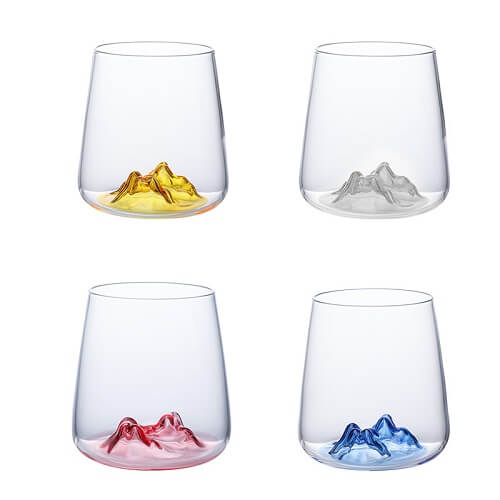
Two interior profiles dominate the whisky tumbler market, and both are plunger shapes cut into the top of the sham. The volcano is a cone rising from the centre of the floor. The whirlpool is a set of curved ridges or a spiral swage, so rotating the glass sets the liquid turning in a visible vortex. Both are handsome, and both are frequently sold with claims about aeration and releasing the nose of the spirit. Here is what actually happens.
The cone removes free surface, it does not add it
Take a tumbler with an interior floor about 70 mm across. A small neat pour sitting flat on that floor presents a liquid disc of roughly 38 cm² to the air. Put a cone through the middle of it with a base about 30 mm across and the cone’s footprint takes about 7 cm² out of that disc — leaving an annulus of roughly 31 cm², around a fifth less free surface than the flat-floored glass. The arithmetic is unglamorous but it is not in dispute.
What the cone genuinely adds is wetted glass. Swirl the tumbler and a film of spirit climbs the cone and clings there, evaporating from a thin layer rather than a deep pool — exactly what a taster does deliberately when coating the walls of a nosing glass. The effect is real, but it comes from the swirl, not from the shape sitting still.
The whirlpool is a movement feature, and that is a legitimate thing to buy
Ridged floors organise a swirl into a clean rotating pattern instead of a random slosh. The glass is satisfying to turn and it photographs beautifully, which is why it performs well as a launch gift that has to earn a moment of attention. Call it a design feature rather than a flavour feature in your internal brief and you will save an argument later.
Both profiles quietly change how much the glass holds
A cone or a ridge set occupies volume in the exact part of the glass where a modest pour lives, so two tumblers with the same stated capacity can behave very differently at low fill. A cone also changes where a large ice ball sits — it perches on the peak instead of settling on the floor. That is the subject of our companion piece on what a 245ml tumbler holds once ice is in it.
Four bodies, read from the base up
This is how we describe our own whisky bodies internally when a client asks which one to put in front of a recipient.
| Body | What the base is doing | What it says in the hand | Where it belongs |
|---|---|---|---|
| Volcano whisky glass | Thick sham with a central cone pressed into the floor; the boldest interior geometry we stock | Theatrical — the recipient notices the glass before the drink | Launches and hampers that need a second look on the desk |
| Whirlpool whisky glass | Thick sham with curved swage ridges; movement without a central obstruction | Designed rather than gimmicky — it reveals itself when the glass is turned | Bar service and hospitality gifting, where the glass is used not shelved |
| Whisky tumbler, 245ml | Plain sham, flat interior floor, no plunger detailing to work around | Classic and unfussy — the body nobody argues about | Mixed-recipient orders where the logo must be the loudest thing |
| Square-base tumbler, 250ml | Sham squared off outside, giving flat facets and a flat underside plane | Architectural — an intentional object, not a decorated one | Executive gifting, and any brief wanting an engraved underside |
The last column keeps circling back to branding, and that is not an accident: on a thick-walled body the base is not only structure, it is an optical component that changes how a mark is seen, which we set out separately in our guide to where a mark reads on a thick-walled body. To see the four bodies side by side, the full range of custom whisky glasses in Malaysia sits on our category page.
The bench sequence we run on a sample base
When a whisky glass sample lands on our table the base is checked before anything else, because a base fault is the one defect artwork cannot fix. This is the order we work in, and it takes about four minutes. Run the same sequence on any sample a supplier sends you.
- Spin it on a flat surface. Set the glass on a hard, level table and give it a gentle rotation. A pressed base with an uneven contact ring will rock or trace a wobble — the most common pressed-glass fault, and instantly visible.
- Look through the sham against a window. Hunt for seeds (small trapped bubbles, usually cosmetic), cords (stringy streaks from unmixed melt that distort anything viewed through them) and stones (opaque unmelted inclusions, always a reject). Thick glass is where these hide.
- Measure the sham at three points. Pressed bodies come from multi-cavity moulds and cavities drift. Check depth at the centre and two opposite edges; meaningful variation tells you the underside is not a reliable engraving surface.
- Run a fingertip around the interior floor. A faint plunger crease where the cone meets the floor, or along a ridge crest, is normal. A sharp lip is not — it holds residue and it is felt during washing-up.
- Set it down twenty times, hard enough to hear it. If the contact ring chips or crazes, it is not a body you want in a bar.
One thing we ask clients to do that they never expect: photograph the approved sample’s base, on white paper, from directly underneath, before production starts. Base appearance is the hardest thing to describe in words and the easiest thing to compare in a photograph, and it settles every later argument about whether a delivered batch matches the approval.
What a heavy base costs you, honestly
Mass is not free. A heavy-based tumbler is one of the densest items per unit of box volume in the drinkware category, so cartons must be smaller and better divided than for a light glass: a stack that would be fine at half the weight becomes a crushing load at the bottom of a pallet, and a boxed pair is a substantial parcel. A heavy glass is also unforgiving to whatever it lands on, and it will chip lighter glassware in a crowded sink. Both are reasons to specify packing properly and to put a hand-washing line on the card in the box.
Questions buyers ask about weight and base thickness
Is a heavier whisky glass automatically a better glass?
No, but it is reliably a better gift. Weight buys stability and the impression of quality, which is what a recipient registers in the first few seconds. What it does not buy is clarity, evenness of pressing or a well-finished rim — and a poorly made heavy glass is worse than a well-made light one. Judge the base by the bench sequence above, not by heft alone.
Does a volcano base actually improve the whisky?
It changes what happens when you swirl, by giving the spirit more glass to cling to and evaporate from. Sitting still, it slightly reduces free surface. We would never write “aerates your whisky” on a client’s gift card, but we would happily write that it is the most striking body we make — which is true, and the actual reason people choose it.
What is the minimum order for custom whisky glasses in Malaysia?
Minimum order is 300 pcs per design. Production runs 21–45 days after artwork approval depending on quantity, plus around 15 days shipping, with express at 10 working days on selected bodies and quantities. All pricing is by quotation, on an SST invoice, and we are set up for ePerolehan buyers.
Tell us who is holding it, and we will pick the base
Send us the recipient, the occasion and whether the glass will be used or displayed, and we will match a body, name its base character plainly and put a sample in your hand before anything is decorated. You can see the whole engraved whisky glass range first if you prefer to shortlist yourself.
Aquaholic Gifts has been a Singapore-based corporate gifting specialist since 2003 and now serves clients across Malaysia from Kuala Lumpur. Minimum order 300 pcs, nationwide delivery, free digital mockup before you commit.
WhatsApp us on +60 10 717 5924 or write to us via the contact page. AS80, Jalan Hang Tuah 4, Taman Salak Selatan, 57100 Kuala Lumpur.