Where a Dry Bag Leaks First: Welded Seams, Film Choice and the Invert Test
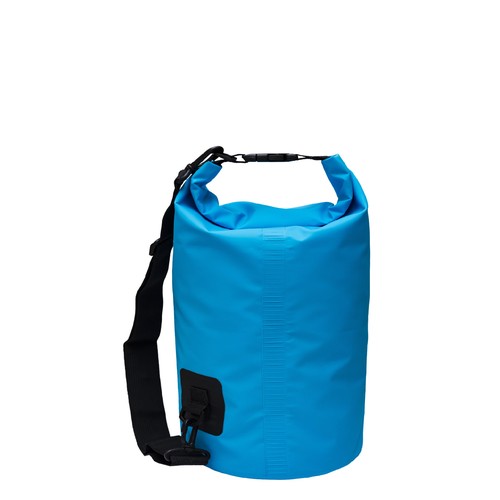
Fill a dry bag with water, seal it, hang it upside down over a sheet of brown paper and walk away for half an hour. It is the crudest test in our sample room and the most useful, because the paper tells you where the drops landed. In our experience the drops almost never appear under a body seam. They appear under a D-ring, under a strap anchor, or in a corner where two welds cross — the places nobody inspects, because everyone is busy inspecting the seams.
This article is about where a dry bag actually leaks, in order, and about the two materials questions that sit underneath it: welded seams against stitched ones, and what really separates PVC tarpaulin, TPU and coated ripstop nylon once the bag is in service. If you are specifying dry bags printed with your logo for a few hundred recipients, this is the section of the brief that decides whether the bag is still trusted in year two.
The leak hierarchy: five places, in the order they fail
We use this ranking when we inspect a pre-production sample, and it is worth sending to whoever will approve yours. It is deliberately ordered by how often we find a problem, not by how dramatic the problem sounds.
| Rank | Where | Why it fails | The tell on a sample |
|---|---|---|---|
| 1 | The closure | Folded too few times, or the band is too stiff to fold properly | A band that springs back open when you let go |
| 2 | Accessory anchors | A strap, D-ring or loop stitched straight through the waterproof face | Visible stitch holes with no welded patch behind them |
| 3 | Corners where welds cross | Two weld lines meeting leave a tiny channel at the junction | A slightly puckered or bubbled point at the base corner |
| 4 | Flex creases | Repeated folding thins or cracks the film along a fixed line | A pale, whitened line where the bag is always folded |
| 5 | The film itself | Almost never, short of a puncture | A visible nick or abrasion scar |
Notice that the top two are both things a buyer can specify and check, and neither is a materials question. This is the single most useful reframing we can offer: a dry bag brief that argues at length about film thickness while leaving the anchor construction unstated has optimised the wrong variable. Rank one belongs to the user, and the fold count that makes the closure watertight covers it in full. Rank two belongs to you.
Welded, taped or stitched — and why only one of them is a dry bag
A seam is where two panels are joined, and how they are joined decides whether the bag has holes in it by design.
High-frequency welding
An electrode applies radio-frequency energy that heats the film from within, fusing the two overlapping layers into one continuous material. It suits PVC and works quickly, which is why it is the standard for tarpaulin dry bags. The joint is not a bond between two layers so much as a single merged layer, and it is as waterproof as the panel either side of it. What matters is overlap width: a wide, evenly welded overlap resists peeling, a narrow one is a line of stress that opens over time.
Hot-air welding
A jet of hot air softens the two surfaces immediately before a roller presses them together. It handles TPU well and is more forgiving on films that do not respond to radio frequency. Weld quality here is a settings question — too cool and the layers are merely stuck, too hot and the film is thinned or scorched at the joint. This is why a weld can look perfect and still fail, and why testing a sample beats reading a specification.
Stitched and seam-taped
The panels are sewn, then a waterproof tape is heat-applied over the stitch line to cover the needle holes. This is respectable construction on garments and rucksacks. On a bag whose whole purpose is water exclusion it is second best, because the tape is a repair for a problem the welded version never creates, and tape edges are where ageing begins.
Stitched only
A stitched seam in waterproof fabric is a row of holes in waterproof fabric. Bags built this way can be genuinely water-resistant — useful, sensible, honestly sold — but they are not dry bags, and the difference shows up under sustained rain rather than in a shower. The exposure classes in the exposure classes we will put in writing are the honest way to describe them.
What to write in the brief: “Body seams welded, not stitched. All accessory attachments welded or fixed to a welded reinforcement patch, with no stitch line penetrating the waterproof face.” Two sentences, and they close off ranks two and three of the leak hierarchy.
Three films, and what actually separates them
The material choice matters less than most buyers expect for waterproofing, and more than most expect for how the bag feels, ages and folds. This is the version we give buyers who have already decided the seams will be welded.
| Material | How it is joined | Hand and weight | How it ages here | Best suited to |
|---|---|---|---|---|
| PVC tarpaulin | High-frequency welded | Heavy, stiff, substantial in the hand | Plasticiser slowly migrates out and the film stiffens, most visibly at fold lines | Boats, rafting, heavy repeated use, high-visibility colours |
| TPU | Hot-air welded | Noticeably lighter and more flexible | Better cold and flex behaviour, but sensitive to years of warm damp storage | Premium gifting, packable bags, anything folded away between uses |
| Coated ripstop nylon | Stitched and taped, not welded | Very light, packs to almost nothing | Coating wears at abrasion points and along creases | Hiking, packable liners, water-resistant rather than waterproof duty |
The row that decides most Malaysian programmes is the ageing column. A PVC tarpaulin bag that spends a year in a hot store room before the event, folded flat in a carton, will have a fold line that is stiffer than the rest of the panel when it comes out. A TPU bag stored the same way stays supple for longer but does not enjoy being sealed in a warm, humid carton indefinitely. Neither is a defect. Both are reasons to ask how long the bags will sit before they are handed out, and to store cartons off a concrete floor in a ventilated room rather than a sealed one.
What repeated folding does to a waterproof film
A dry bag is the only bag in a corporate range that is deliberately creased in the same place every time it is used. Over a few hundred cycles, that line takes on a memory. On a stiff tarpaulin it whitens and becomes a hinge. On a thin, poorly chosen film it can eventually craze into pinholes along the crease, which is rank four in the hierarchy above and the reason a two-year-old bag can start wetting its contents with no visible damage at all.
Two things reduce it, and both are specification decisions rather than user behaviour. Choosing a film with better flex fatigue behaviour for the capacity in question is the first. The second is band design: a band that folds easily in three even turns distributes the crease over three lines instead of concentrating it on one. Small bags suffer most, because their bands are proportionally deeper relative to the body — a point that also drives the sizing arithmetic in rolled litres against packed litres.
Two tests to run on a sample before you approve bulk
The fill-and-invert test
This is the one we lead with, because it needs nothing but water, a sample and somewhere to hang it. It applies steady internal pressure to exactly the places that leak.
- Lay a sheet of brown paper or plain cardboard on the floor. It shows drops that a tiled floor hides.
- Fill the bag with water to roughly the level your contents would reach — not to the brim.
- Close it properly: mouth pressed flat, three even folds, buckled.
- Hang it upside down over the paper by the base or by a strap, so the closure is at the lowest point and under load.
- Leave it for thirty minutes. Do not shorten this — seepage through a stitch hole is slow, and a five-minute check passes bags that would fail.
- Take it down and read the paper. Mark where each damp spot sits relative to the bag: under an anchor, under a corner, along a seam, or at the closure.
The inflate-and-dunk test
This is the factory version, and it finds pinholes the water test can miss. Inflate the bag with air, seal it with three folds, and hold it under water in a basin or tub while pressing gently on the body. Watch for a stream of small bubbles. Bubbles from the closure interface are normal at high pressure and are not a fault. A steady bubble trail from a seam, a corner or an anchor is.
Run both before the bulk order, not after delivery. A pre-production sample is a cheap place to find a stitched anchor. A container of finished bags is not. Tell us at mockup stage that you intend to test, and we will make sure the sample you receive is built the way the bulk run will be.
Three lines for your specification sheet
- Seams: body seams welded, with a stated overlap, not stitched and taped.
- Attachments: all straps, rings and loops fixed to welded reinforcement patches, with no stitch line through the waterproof face.
- Storage: state how long the bags will be held before handover, so material and packing can be matched to it.
Getting the construction right in your order
Seam method, attachment construction and film choice are all decided before the mockup, because they change the tooling and the sample. Our minimum order is 300 pcs per design. Production runs 21–45 days after artwork approval depending on quantity, plus roughly 15 days shipping, with an express route of 10 working days for limited styles and quantities. A digital mockup normally comes back within one business day, and invoicing is SST-compliant with ePerolehan-ready documentation for government and statutory buyers.
Seam and material questions we get asked
Are welded seams really better than stitched ones?
For a dry bag, yes, and not marginally. A welded seam has no holes in it. A stitched seam has a hole every few millimetres and depends on tape to cover them. Both can be well made, but only one starts from a continuous waterproof surface.
Which is better, PVC or TPU?
Neither is more waterproof. PVC tarpaulin is tougher, heavier and better value for hard use. TPU is lighter, more flexible and the better choice where the bag will be packed away and carried. Decide on weight, feel and how the bag will be stored rather than on water resistance.
Why did my old dry bag start leaking with no visible damage?
Most often a whitened fold line that has crazed into pinholes after several hundred closures, or an anchor whose stitching has worked loose. Hold it up to a strong light and look along the crease.
Can you make a dry bag with a clear panel?
Yes. A transparent window or a fully transparent body is welded the same way as an opaque one, so it does not compromise the seams. It does show wear and scuffing more readily over time.
What is the minimum order for welded-seam dry bags in Malaysia?
300 pcs per design. Welded construction is our standard rather than an upgrade, so specifying it does not change that figure.
Send us a sample brief and we will build it the way the bulk run will be
Tell us the activity, the storage window and how the bag will be carried, and we will come back with a digital mockup, a construction specification and a quote. A Singapore-based corporate gifting specialist since 2003, we now produce and deliver nationwide across Malaysia from our Kuala Lumpur base. You can also look through our full custom dry bag range first.
Aquaholic Gifts Malaysia · AS80, Jalan Hang Tuah 4, Taman Salak Selatan, 57100 Kuala Lumpur