Eight Kilos on Two Shoulders: Backpack Harness Geometry and the Back Panel That Survives a KL Afternoon
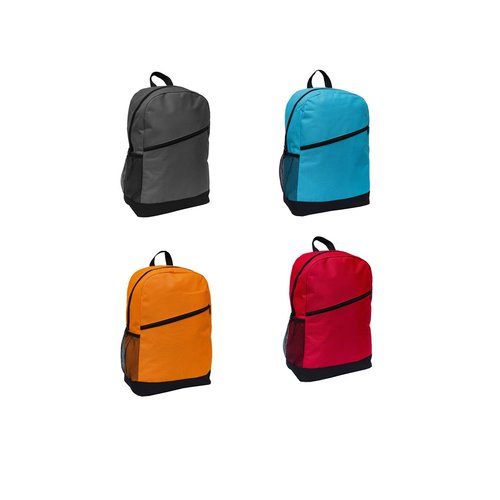
In May 2026 we delivered 1,000 branded heavy-duty backpacks for a Tiger Beer sports event. Nobody asked us about the zip. The questions that come back after a backpack rollout — every time, on every cluster we have shipped — are about the wearer’s body: it digs in at the top of my shoulder, my shirt is soaked by the time I reach the lift lobby, it swings when I walk fast. A backpack does not fail the way a shoulder bag fails. A shoulder bag fails at one strap on one side, and the wearer compensates without thinking. A backpack loads both shoulders through a single fixed yoke, and there is nothing left to compensate with.
That is why the two components almost nobody specifies in a corporate brief — harness geometry and the back panel — decide whether your logo gets worn for three years or lives in a store cupboard. This is the check our production team runs on a sample before a client approves it: the four measurements we take at the yoke, the sternum strap detail that fixes most “it digs in” complaints, what a padded back panel is really doing in a humid 30-plus-degree afternoon, and the 20-minute loaded wear test that catches what a photograph never will.
The load path: why the yoke matters more than the strap
Put a loaded pack on and the weight travels a fixed route: main compartment, into the back panel, up into the yoke — the stitched junction where the two shoulder straps meet the top of the pack — then down both straps onto the soft tissue outside the collarbone. Everything after the yoke is downstream. If the yoke is wrong, no amount of strap padding rescues it.
Two things go wrong at the yoke on budget-tier bags. First, the straps are attached too far apart, so they slide outboard over the deltoid and the pack rocks side to side as the wearer walks. Second, they are attached too high on the back panel, which pitches the load away from the spine and pulls the wearer backwards. Both are pattern-stage geometry decisions, not adjustments the wearer can make later — the crucial difference from a single-strap bag, where you can shift the strap, shorten it or swap shoulders.
Size matters too. Before you look at any harness, it is worth being honest about how many litres a daypack really holds, because a pack that is too big invites people to fill it, and a harness sized for 5 kg does not behave at 9 kg.
The four-number harness check we run on every sample
When a sample lands on our table we take four measurements before photographing it. None appear on a supplier spec sheet or in a product render. They take ninety seconds with a tape measure and predict complaints better than anything else.
| What we measure | Where | What a bad result feels like |
|---|---|---|
| Yoke spacing — the gap between the inner edges of the two straps where they leave the panel | Top of the back panel | Too wide: the pack rocks and the straps creep outward onto the shoulder ball. Too narrow: the straps rub the base of the neck |
| Strap curve — does the strap follow an S-shape around the chest, or run dead straight down? | Lay the pack flat and look along the strap | A straight strap cuts inward across the chest on a larger frame and outward on a smaller one — the classic “it digs in” complaint |
| Padding taper — how far down the strap the foam continues before it becomes bare webbing | From the yoke down the strap | Foam that stops high leaves bare webbing under the armpit on tall wearers |
| Sternum strap travel — the vertical distance the chest clip can slide on its rail | Along the rail or daisy chain on each strap | Little or no travel means the clip sits at one height and is unusable for half your recipients |
The ninety-second version: load the sample with a laptop and two full bottles, hang it from the yoke on one finger, and look at how it hangs. A well-patterned pack hangs with the back panel roughly vertical. A badly patterned one tips its top away from you before it has even touched a shoulder.
The sternum strap: the cheapest fix on the whole bag
A sternum strap costs almost nothing at the factory and solves the commonest physical complaint in a corporate backpack programme. Its job is not to stop the pack falling off; it is to pull the two shoulder straps inboard so they stop migrating onto the shoulder ball — exactly where the “it digs in” sensation comes from.
Three details separate a useful sternum strap from a decorative one. It needs vertical travel — a rail or daisy chain letting the clip move up and down, because chest height varies enormously across a staff list. It benefits from a short section of elastic, so the strap gives when the wearer breathes deeply rather than acting as a chest band. And the buckle should be a side-release clip workable one-handed; a clip needing two hands does not get used twice.
There is a fit-inclusivity argument here that rarely makes it into a corporate brief: a fixed-height clip that suits an average male frame can sit uncomfortably high on a smaller frame and across the bust on a female wearer. When you are buying one pack for an entire organisation, adjustable travel is the difference between a gift everybody can wear and one that quietly gets handed to a family member.
The back panel in a Malaysian commute
In a temperate market, a padded back panel is a comfort feature. In Kuala Lumpur it is a climate-control component, and the trade-off it manages is brutal: the more panel area touching your back, the better the load feels — and the wetter your shirt gets. Every back panel design is a negotiation between contact area and airflow.
Flat foam panel
A single slab of foam under a lining. Cheapest, most common on entry-tier promotional packs, worst in humidity — full contact across the whole back, every bit of moisture trapped, and the rectangular sweat patch people photograph and send to procurement. Fine on a foldable giveaway carried empty; poor for a daily commuter.
Channelled or quilted panel
Foam split into blocks with recessed channels between them, usually one vertical channel down the spine and horizontal channels across. The channels are not decoration — they are the air path. What matters is channel depth: a channel that is merely a stitch line through flat foam compresses shut the moment the pack is loaded and moves no air at all. A real channel is a moulded recess deep enough to stay open under load. Press the sample hard with your thumb over a channel; if the gap disappears, so does the ventilation claim.
Spacer mesh over channelled foam
The premium option, and worth paying for in this climate. A three-dimensional knitted mesh with an open middle layer sits over the channelled foam, so even the “contact” areas are mostly air, and it dries far faster than a woven lining. Ask specifically for spacer mesh or 3D air mesh; plain mesh printed over foam is not the same thing.
Local detail most briefs miss: back panels take the worst of a rain-and-air-con cycle. A panel that soaks up water and stays damp will develop a musty smell within weeks, and the wearer blames the bag, not the weather. Quick-drying spacer mesh and a lining that does not hold water are the practical answer — and they pair with the fabric weight that carries that load on the outer shell.
The 20-minute loaded wear test
Photographs and empty samples hide harness faults completely. An empty backpack is comfortable on everybody. Before you sign off a sample for a full run, put it through this sequence — it takes twenty minutes and it is the closest thing to a real commute you can do in an office.
- Load it the way it will actually be used. A laptop in the sleeve, a charger, a full bottle in the side pocket, an A4 file and an umbrella. Not paper stuffing. Weight distribution changes how a harness behaves more than total weight does.
- Fit it on three different builds. The tallest and the smallest people who will volunteer, plus somebody average. If the sternum strap cannot be made comfortable on all three, the rail travel is too short.
- Walk a full twenty minutes, including stairs. Straps that feel fine at two minutes will have migrated outboard by twelve if the yoke spacing is wrong.
- Do the stair test. Climb two flights briskly. A pack that thumps the lower back on every step is riding too low or has no load stability at the base.
- Take it off and look at the wearer’s back. A uniform damp rectangle means the panel has no working airflow. Damp stripes with dry channels between them means the channels are doing their job.
- Check the strap ends. After twenty minutes of adjustment, is there a metre of loose webbing flapping? Ask for elastic keepers at the sample stage — it is a trivial addition that stops the bag looking untidy in every photograph taken at your event.
Run this and you are buying the pack your recipients will actually experience, not the catalogue photograph. It is also when to confirm branding, because the harness and panel dictate where a stitched logo can actually sit without being folded in half every time the bag is worn.
Matching harness specification to the job
Not every programme needs a full comfort specification. A pack handed out at a one-day roadshow is carried for four hours; a staff welcome-kit pack is carried five days a week for years. Specify accordingly.
| Programme | Harness specification worth insisting on | Back panel |
|---|---|---|
| Staff welcome kit / daily commuter | S-curve straps, foam continuing well past the armpit, sternum strap with real travel and elastic | Spacer mesh over channelled foam |
| Event, roadshow and participant giveaway | Straight straps acceptable; prioritise secure yoke stitching and webbing keepers | Channelled foam is sufficient |
| School, campus and orientation | Wide padded straps, sternum strap essential, bar-tacked yoke for book weight | Channelled foam with a firm frame sheet |
| Heavy-duty and outdoor programmes | Reinforced yoke, load-bearing base, sternum strap plus optional waist webbing | Deep channels and a stiffened panel |
Weight is the honest tell. Across our own custom laptop backpack Malaysia line-up, a slim two-compartment Oxford pack weighs around 510 g empty, while a three-compartment reflective nylon pack in 400D comes in around 775 g and a vegan-leather commuter pack around 967 g. That difference is not just outer fabric — a large part of it is foam, frame sheet and harness structure. A pack that is suspiciously light for its size has usually saved the weight exactly where the wearer would have felt it.
Getting this into your order
Harness and panel specifications are pattern-level decisions, not finishing options, so they must be settled before production starts. Our minimum order is from 300 pcs per design, production runs 21–45 days after artwork approval depending on quantity and construction, and shipping adds around 15 days nationwide. Express production in 10 working days is available on limited styles and quantities. Padded laptop and heavy-duty builds sit at the longer end of that band precisely because there is more structure to assemble.
Practically: ask for the sample early, run the twenty-minute test the week it arrives, and confirm panel type and sternum strap travel in writing before artwork approval. We have produced branded bags since 2003 as a Singapore-based corporate gifting specialist, now serving Kuala Lumpur and the rest of Malaysia, and the harness is the part of a backpack we argue about most — because it is the part recipients feel every day.
Common questions
Can you add a sternum strap to a stock backpack model?
Usually yes, if specified before production. Adding a chest clip and rail is a straightforward pattern-stage change and one of the highest-value additions to a commuter or campus pack. It cannot be retrofitted after delivery.
Is a ventilated back panel worth it for a one-day event giveaway?
Less so. For a few hours of light carrying, channelled foam is enough. Reserve spacer mesh for programmes where people carry a real load daily — that is where comfort converts into a bag that stays in use.
Does a heavier backpack mean a better one?
Not automatically, but weight is a useful cross-check. When two packs of similar size differ by a couple of hundred grams, the heavier one usually has denser foam, a frame sheet or a reinforced yoke. Ask what the extra weight buys rather than assuming light equals premium.
Send us the brief and we will check the harness for you
Tell us the style, quantity, colours and how the bag will be carried, and we will come back within one business day with a digital mockup and a no-obligation quote — and a straight answer on harness and back-panel specification. Minimum order from 300 pcs, delivered across Kuala Lumpur and nationwide.
Request a free mockup for a corporate backpack KL rollout · WhatsApp +60 10 717 5924 · Send your brief through our contact page