
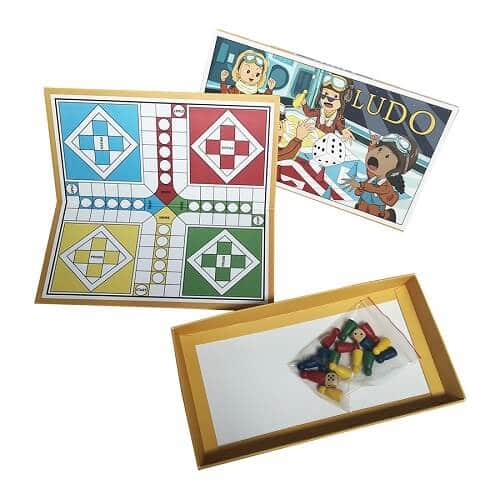
The Component Census: What Actually Goes in a Custom Board Game Box
The single most expensive thing you can leave off a board game brief is a list. Not a design, not a colourway — a list. A boxed game is not one product; it is a small assembly of separately manufactured things that all have to arrive in the same factory, in the same week, in the right numbers, and end up in the same box. We call that list the component census, and it is the document that decides your schedule, your box size and whether a client opens a game with a hole in the tray.
This article is the census itself: every item that realistically goes into a custom board game box, what each one adds to the timeline, why the insert quietly costs more than anyone expects, and the count-and-check sequence that stops an order of 500 sets going out with a missing piece in an unknown number of them.
A board game is an assembly, not a product
Most promotional items are one process: print a thing, pack a thing. A board game is five or six processes running in parallel and converging at a packing bench. The board is a lamination job. The cards are a separate print-and-cut job. Tokens may be injection-moulded, die-cut board, or turned wood. Dice are bought or moulded and then printed. The insert may need a tool made for it. The box is a rigid-box or folding-carton job with its own artwork and its own approval. The rulebook is a small print job that almost nobody schedules until it is late.
Every one of those has its own artwork file, its own proof, and its own slowest step — and the game ships at the speed of the slowest one. That is why our first question on a game brief is never “what does it look like” but “what is in it”. Once the census exists, the schedule writes itself. Without it, you get the classic failure: everything is ready except the tokens, and the tokens were the thing with a tool.
The component census
Work down this table and tick what your game actually contains. Anything you tick adds an artwork file, an approval and a lane on the production schedule.
| Component | What it really is | Where it goes wrong |
|---|---|---|
| Folded board | Printed wrap laminated to a greyboard core with a backing liner | Fold pattern chosen after artwork; board size that does not match the box |
| Game cards | A separate print run, cut and banded by deck type | Content still being written while the board is already on press |
| Tokens and pawns | Moulded plastic, turned wood, or die-cut printed board | Bespoke shapes need a tool; a tool needs a frozen design |
| Dice | Stock dice, or branded faces on a moulded blank | Branded faces reduce readability at arm’s length across a table |
| Paper currency or scorepads | Light-stock print, guillotined and banded | Cheap to make, fiddly to count — the classic packing-error source |
| Insert or tray | Polybags, a die-cut board insert, or a vacuum-formed tray | Specified last, when every component it must hold is already fixed |
| Rulebook | A folded sheet, a stapled booklet, or print inside the lid | Written last, translated later, proofread never |
| Box base and lid | Rigid box or folding carton, printed and wrapped | Sized to the board but not to the loaded insert depth |
| Seal and sleeve | Shrink film, belly band or sticker seal | Sealing damp contents; no way to spot-check without breaking the seal |
| Export carton | Outer shipper with a labelled count and batch mark | Unlabelled cartons make a sampled recount impossible on arrival |
The rule we apply to every game brief: the component with a tool is the critical path. If anything in your box is a bespoke moulded shape, that item — not the board, not the artwork — is what your delivery date is actually made of.
Why the insert costs more than people expect
Clients budget for the board and the box. The insert is the line item that surprises them, and the reason is that an insert is not a material — it is a fitting job.
Three routes, three cost profiles
Polybags. The cheapest and the least loved. Components go into small bags and the bags go into the box. It works, it protects nothing from rattling, and it makes the unboxing feel like a spare-parts kit. It is also the only route with no tooling and no fit risk, which is why it survives on tight timelines.
Die-cut board insert. A folded or glued board tray with compartments cut into it. Middle cost, no mould required, and it reads as considered because it is made of the same family of material as the board and box. Its limits are depth and shape: it holds flat and blocky things well, and awkward organic shapes badly.
Vacuum-formed tray. A sheet of plastic heated and drawn over a mould so each component gets a shaped well. This is the one that makes a box feel like a retail product, and it is where the unexpected cost lives — because a mould has to be made, and a mould can only be made once every component in the box is physically final. Not designed. Final, in hand, measured.
That sequencing is the real expense. Change a pawn from round to hexagonal after the tool is cut and the tool is scrap. Add a component the census missed and the tray has nowhere to put it. We have seen more schedules lost to a late component decision than to any printing problem, and it is always the same shape of mistake: the insert treated as packaging rather than as the last assembly step it actually is.
There is a payoff that offsets the cost, and it is not aesthetic. A shaped insert is a counting device. An empty well is a visible defect — a packer sees it, and so does the recipient. With loose bags, a missing item is invisible until someone tries to play. That single property is why we push clients towards a shaped tray on any order where a component shortage would be embarrassing to discover in front of a room full of guests.
The bill of materials sheet we ask every game client to fill
Copy this structure into a spreadsheet before the first sketch. One row per component. If a row cannot be completed, that row is your risk.
| Column | What goes in it | Why it matters |
|---|---|---|
| Component name | The name the packing team will use out loud | Ambiguous names cause the wrong item to be counted |
| Quantity per set | The exact number in one finished box | This is the number every later check is measured against |
| Material and process | Moulded, die-cut, printed, turned, bought-in | Identifies which rows carry tooling and sampling time |
| Artwork required | Vector, layered, or none | Missing artwork on a small row stalls the whole assembly |
| Approval type | Digital mockup, physical sample, or tool sign-off | Tool sign-off rows must be frozen earliest |
| Insert position | Which well, bag or compartment it lives in | Turns the insert into the packing standard |
| Owner | Who signs it off on your side | Unowned rows are the ones that arrive late |
The board row deserves particular attention, because its fold pattern sets the box footprint that everything else has to fit inside — worth reading up on how the folded board is built before you fill that line in. The rulebook row deserves attention for the opposite reason: it is the cheapest item in the census and the one most likely to be written the night before, which is a poor way to decide how long a game should take at a company dinner.
The count-and-check sequence
A missing component is the only board game defect that is invisible until the worst possible moment. You cannot see it through a sealed box, a recipient cannot report it until they play, and by then the order is distributed. This is the sequence our production team runs so that a complete-set failure is caught on the bench rather than at the table.
- Build the golden set. Before mass packing begins, one set is assembled and approved against the census, then kept sealed and untouched. Every later question — is this the right token colour, does this belong in that well, is the rulebook the approved version — is answered against the golden set, not against a file or a memory.
- Photograph the loaded insert. The open golden set, fully loaded, is photographed from directly above and printed at the packing bench. That photograph becomes the packing standard: a packer is not counting from a list, they are matching a picture. It is far faster and it removes the language dependency on a mixed packing line.
- First-article approval. The first sets off the line are opened, counted item by item against the census, and signed off before the run continues. If a component is going to be systematically short — a bag filled by scoop rather than by count, a card deck banded wrong — this is where it surfaces, while it is still cheap.
- Weigh the sealed box. The golden set gives you a target weight and a tolerance band. Every sealed box is weighed, and anything outside the band is pulled and opened. This is the only check that touches every single unit without breaking a single seal, and it reliably catches an omitted bag, an omitted rulebook or a missing tray of tokens.
- Sampled open-and-recount. Cartons are pulled at random across the run, opened, counted against the census, then resealed and marked as checked. Sampling across the whole run — not just the first cartons — is what catches a fault that started midway through packing.
- Label the cartons honestly. Each export carton carries its count and a batch mark. If a complaint arrives from one event, a batch mark tells you which cartons to recheck instead of forcing a recall of the entire order.
None of this is exotic. It is the difference between an order that arrives complete and an order where nobody can tell you how many boxes are affected. It is also why the census matters so much: every check above is measured against that document, and a check can only be as good as the list it is comparing to. If you want a specification that survives this process, start from the custom board game components and packaging we already build and work outwards from there.
What this means for your timeline
Minimum order for a custom board game is 500 sets. Production runs 21–45 days after artwork approval, plus around 15 days shipping, with an express route of 10 working days available on limited formats and quantities. A game with a bespoke moulded component and a vacuum-formed tray sits at the long end of that band, because the tool has to be cut and sampled before the tray can be drawn. A game built from stock tokens and stock dice with a die-cut board insert sits at the short end. If your date is fixed — Hari Raya, Chinese New Year, Deepavali, a Merdeka campaign or a year-end dinner — tell us the date first and we will shape the census to fit it rather than the other way round. We invoice with SST and supply through ePerolehan for government and statutory buyers.
Game component questions we get asked
Do we need a vacuum-formed insert, or will bags do?
Bags are perfectly workable and are the fastest route when a deadline is tight. A shaped tray is worth it when the game is a premium gift, when there are many small components that would otherwise rattle, or when you want the packing process itself to catch a missing item. Remember that a tray requires every component to be physically final before the mould can be made.
Which component usually delays a board game order?
Almost never the board. It is usually whichever item requires a tool — a bespoke moulded pawn or a shaped tray — or the rulebook, because its content is written last and its translation is commissioned after that. Both are cheap items with expensive positions on the critical path.
How do you verify that every box is complete?
Through a golden reference set, a photographed packing standard, first-article approval at the start of the run, a weight check on every sealed box against the reference weight, and a sampled open-and-recount spread across the whole run with batch-marked cartons.
Send us the list before you send us the artwork
Give us your component census — even a rough one — and we will tell you which rows carry tooling, which rows set your delivery date, and what the insert needs to be. A Singapore-based corporate gifting specialist since 2003, now producing and delivering across Malaysia from Kuala Lumpur.
Ready to price it up? Request a free mockup for your board game and we will come back within about one business day.
Aquaholic Gifts Malaysia · AS80, Jalan Hang Tuah 4, Taman Salak Selatan, 57100 Kuala Lumpur


