A Tenth of a Millimetre: Why Block Tolerance Decides Whether a Tower Plays
A stacking tower that collapses is doing its job. A stacking tower that jams is broken, and everyone in the room can tell within about ninety seconds. The player pushes a block, it does not move, they push harder, the whole stack shifts sideways, and the game ends on a shove rather than on a nerve-racking placement. Nobody blames the blocks. They blame the game, and by extension the logo printed on it.
The difference between a tower that plays beautifully and one that jams is measured in tenths of a millimetre across the width of a block. This article is the part of the specification that almost no supplier page discusses: what the clearance budget of a block tower actually is, the two opposite ways milling ruins it, the four-block gauge test our production team runs on pre-production samples, and why a set that behaves perfectly in an air-conditioned meeting room can turn stiff by mid-morning at an outdoor family day.
The tower is one long arithmetic problem
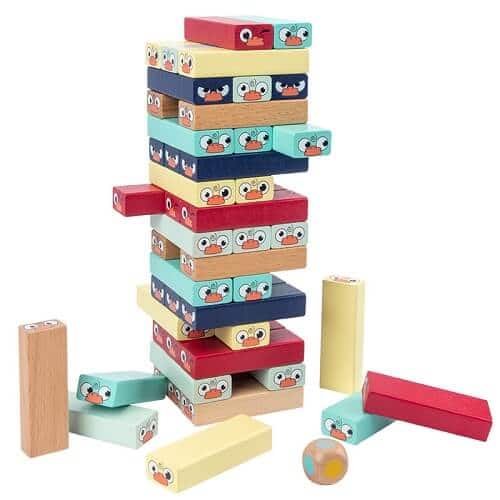
Strip the game back and it is a stack of layers, three blocks to a layer, each layer rotated a quarter turn against the one below. That single arrangement forces a relationship between two dimensions of every block: its length has to equal three of its widths, plus whatever gap you want between neighbours.
That leftover space is the clearance budget, and it is the entire game. It is what lets a finger slide a middle block out without disturbing the layers resting on it. Too much of it and the tower is a loose pile. Too little and the blocks bind against each other and the game stops working. Because the budget is shared between two joints in every layer, a width error does not stay the size it started at — three blocks each a tenth of a millimetre wide eat three tenths out of the budget, and they do it in every single layer of the tower.
This is why block tolerance is not a pedantic manufacturing detail. It is the only specification on a set of custom jenga blocks Malaysia buyers order that decides whether the product does the thing it exists to do.
Two ways to lose the budget, and only one of them looks like a fault
Blocks can be milled too wide or too narrow relative to their length. Neither error arrives labelled as a dimensional problem.
Over-width blocks: the tower that fights back
When three widths add up to more than the block length above them, the outer blocks in each layer are pinched between the layer edges. Friction rises, the pull needs real force, and the force arrives as a jerk rather than a slide. Players learn to grip the tower with one hand while pulling with the other, which is the exact behaviour a stacking game is supposed to punish. At an event this reads as a cheap game.
Under-width blocks: the tower that gives up
Too much slack and blocks shuffle sideways as the tower is built. Layers stop sitting square, the stack develops a lean before anyone has taken a turn, and blocks fall out under their own weight when the table is nudged. The game is over early and feels random. Curiously, buyers complain about this far less than about jamming, because a fast collapse still looks like play — it just means the tower never reaches the height that makes the game tense.
| What a player says | What is actually happening | Where it came from |
|---|---|---|
| “It’s stuck.” | Three widths exceed the layer length; outer blocks are pinched | Rip width drifted wide, or swelling after milling |
| “It fell out by itself.” | Excess clearance; blocks slide under vibration alone | Over-sanding after sizing, or shrinkage in dry air |
| “It leans from the bottom.” | Thickness varies between blocks, so layers are not level | Planer or drum-sander setting drifted across the run |
| “This one rocks.” | Cup or twist in an individual block; it never sits flat | Timber not conditioned before machining |
| “The ends look messy.” | Length varies, so layer ends are ragged | Cross-cut stop moved; cosmetic, not a play fault |
The last row deserves separating out: length variation is the fault buyers spot in photographs, and it is the least important of the five. Width and thickness decide the game.
Where the tenths are actually lost on the shop floor
Blocks are made in a short sequence, and every stage can move a dimension.
- Thicknessing. Boards are planed to the block height. Any drift here shows up as layers that are not level.
- Ripping to width. The single most important cut. Blade deflection, feed speed and a worn fence all move width by fractions that matter.
- Cross-cutting to length. Fast, repetitive, and dependent on a stop that must not creep.
- Sanding and edge break. This is the stage buyers forget. Sanding removes material after the block is already at size, and it removes more from some blocks than others.
- Finishing. A lacquer or sealer adds a film. It is thin, but it is added to two opposing faces, so it is counted twice in every joint.
The sanding trap. A supplier who mills to a perfect width and then sands aggressively has not made accurate blocks — they have made randomly narrow ones. Ask whether the target width is measured before or after sanding. The right answer is after, on finished blocks, from more than one point in the run.
One more stage quietly eats the budget on branded sets, and it belongs to decoration rather than milling: a deep laser engrave lifts a fine burr along the edge of the mark, and a heavy pad print sits proud of the surface. Both land on faces that slide against something, an interaction covered in our guide to branding the block faces without changing how they slide.
The four-block gauge test
This is the check our production team runs on a pre-production sample before a run is released, and it is deliberately built so that a buyer can run it on a meeting-room table with nothing but the sample itself. It takes about five minutes and it catches every fault in the table above.
Five minutes, four blocks, one table
- The three-and-one check. Lay three blocks side by side, tight against each other. Rest the fourth across them at ninety degrees. It should overhang slightly at both ends, and the overhang should be even. No overhang means the set will jam.
- The shuffle test. With the fourth block resting on the three, slide the middle block out with one finger, no second hand steadying anything. It should move under light, continuous pressure and never require a jerk.
- The rotate-and-repeat. Turn each of the three blocks over and swap their positions, then repeat. If some combinations bind and others do not, width is inconsistent across the run even though the average is right.
- The rock check. Press diagonally opposite corners of each block on a flat table. Any rocking means cup or twist in that block.
- The stack-of-four. Stack all four flat, one on top of another, and look along the side at eye level. Steps in the side face show thickness variation, which is what makes towers lean from the bottom.
The rotate-and-repeat step matters most and is the one nobody does. When we assess a run we take sample blocks from the start, middle and end of production rather than from one tray, because drift across a run is the normal failure — not a single bad batch.
Why the same set plays differently indoors and outdoors
Here is the effect that surprises buyers most. A set checked and approved in an air-conditioned Kuala Lumpur office can be noticeably stiffer by mid-morning at an open-air family day in the same city, on the same day.
Timber exchanges moisture with the air around it, and it does so far more across the grain than along it. A block therefore changes its width and thickness with the surrounding humidity while its length stays almost fixed. Move a set from conditioned air into humid outdoor air and every block gains a little width — but the length of the layer above it does not grow to match. The clearance budget shrinks from both sides at once, in every layer of the tower.
The reverse is just as real. A set kept in a strongly conditioned office loses moisture, the blocks narrow, and the tower becomes looser than when it arrived. This is not a defect and not permanent — it is why the clearance budget is specified with room to move rather than as tightly as a machine can hold. The full picture of timber choice, drying and what a monsoon week does to a set left in a cupboard is set out in our companion piece on how Malaysian humidity moves a wooden block set.
Event-day rule. Unpack the set at the venue, in the air it will be played in, at least an hour before the first game. Blocks that have been sitting in a closed carry bag or a cool office need that time to settle. It is the cheapest fix here and costs nothing but a diary note.
Tolerance does not scale up neatly to a giant tower
A giant outdoor tower is not simply a tabletop set enlarged. Moisture movement is proportional, so a wider block moves more in absolute millimetres for the same change in air humidity. The load is heavier: blocks above press down harder, and a joint that is merely snug on a tabletop set becomes genuinely stuck at giant scale. And giant towers live outdoors, where the humidity swing cannot be controlled at all.
So a giant tower needs a more generous clearance budget, and a well-made one feels slightly looser in the hand. That is correct, not sloppy. There is a safety dimension too: a giant block that has to be wrenched free means somebody applying two-handed force to a chest-high stack of hardwood in a crowd.
| Consideration | Tabletop set | Giant tower |
|---|---|---|
| Clearance budget | Tight; the game rewards precision | Deliberately more generous; must survive weather swings |
| Environment | Mostly conditioned indoor air, fairly stable | Open air, direct sun, occasional rain interruption |
| Effect of a jam | Irritating; game feels cheap | Two-handed pulling on a tall stack in a crowd — a safety matter |
| Edge treatment | Light break to stop sharpness | A fuller chamfer helps blocks self-align when re-stacked quickly |
| Re-stacking | One person, unhurried | Rebuilt dozens of times a day by whoever is nearest |
What to put in your block tower brief
You do not need to write a machining specification. You need to ask four questions that force the right answers out of a supplier.
- Where will it be played? Conditioned office, open-air venue, or both. This changes the clearance target, not just the size.
- Is the width measured on finished, sanded, sealed blocks? If the answer is “after ripping”, the number is meaningless.
- Will sample blocks come from more than one point in the run? Consistency is the property you are buying.
- How deep is the engraving? Decoration depth belongs in the tolerance conversation, not only the artwork one.
Aquaholic Gifts has been a Singapore-based corporate gifting specialist since 2003 and now serves clients across Malaysia from Kuala Lumpur. Minimum order is 300 sets. Production runs 20–30 working days after artwork approval depending on quantity, plus roughly 15 days shipping, with an express route of 10 working days on limited styles and quantities. Pricing is quote-only and invoiced with SST; government buyers are served through ePerolehan.
Block tolerance questions we get asked
My sample block measures correctly. Why does the full set jam?
Because one block cannot show you consistency. Three blocks that are each slightly wide combine into a layer that no longer fits under the block above. Test combinations, not individuals — that is what the rotate-and-repeat step exists for.
Can a jamming set be rescued?
Sometimes. If the set has been stored in humid conditions, several days in normal conditioned air may bring it back on its own. If it jams straight out of a sealed carton in ordinary air, it is a milling problem and no amount of storage will fix it.
Should I ask for the tightest tolerance available?
No. Tolerance and clearance are different things. You want tight tolerance — blocks that closely resemble each other — combined with a clearance budget matched to where the set will live. Chasing zero clearance produces a tower that jams the first time the weather changes.
Tell us where it will be played, before you tell us the size
A tabletop set for a conditioned office and a giant tower for an open-air family day are specified differently from the first millimetre onwards. Tell us the venue and the season, and we will recommend the format and clearance before we discuss branding. You can request a free mockup for a custom block tower and we will send artwork and a quote, usually within one business day.
WhatsApp +60 10 717 5924 or use our contact page. AS80, Jalan Hang Tuah 4, Taman Salak Selatan, 57100 Kuala Lumpur. Nationwide delivery across Malaysia.