Wood Moves in Malaysian Air: Timber, Moisture and the Set in the Cupboard
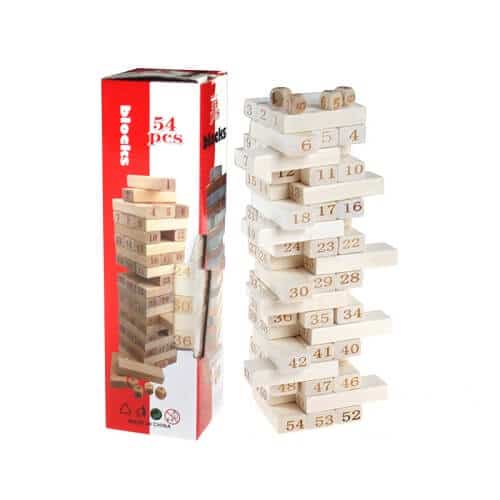
The most common way a branded block tower dies is not breakage. It is a cupboard. The set arrives before a company family day, gets played with once, goes back into its carry bag, and the bag goes into a store cupboard next to the pantry. Eight months later somebody digs it out for the next event, opens it, and finds blocks that will not slide, a faint musty smell, and two or three that rock on the table.
Nothing broke. The wood simply did what wood does in Malaysian air, and nobody told the buyer that a wooden game has a storage requirement. This article covers the timber decisions that make a set survivable here — species, how dry the wood is when it is machined, why movement across the grain is the one that matters, what sealing and finish actually buy you — and ends with a storage protocol short enough to tape inside the cupboard door.
Wood never stops exchanging moisture with the air
Timber is hygroscopic: it takes up water vapour from humid air and gives it back to dry air, continuously, for the whole life of the object. It settles towards an equilibrium moisture content determined by the surrounding temperature and relative humidity. Nothing you do to a block stops this. Finishes only slow it down.
That matters more here than in most markets a supplier ships to, because our ambient humidity is both high and variable. A set can pass between a strongly air-conditioned office, a sealed cupboard, a car boot in the afternoon sun and a garden at dusk in one working day. Each is a different equilibrium, and the wood starts travelling towards each in turn.
The important detail is the direction of the movement. Timber expands and contracts far more across the grain than along it — the difference is a matter of several times over, not a few per cent. A block cut with its length running along the grain therefore changes its width and thickness noticeably while its length barely moves at all. In a stacking tower, where the length of one block has to span three widths beneath it, that is precisely the worst possible geometry, and it is why the milling tolerance that decides whether a tower plays cannot be separated from moisture.
Which timbers actually turn up in block sets
Most block towers sold into the corporate gifting market come from a small handful of species. Their differences show up in weight, in how cleanly they take a mark, and in how much they move.
| Timber | Character in a block | Watch for |
|---|---|---|
| Rubberwood (hevea) | Pale, close, even grain; regionally grown; machines cleanly and marks predictably | Needs proper treatment and drying; untreated stock is prone to staining fungus |
| Beech | Dense, fine, very uniform; the premium tabletop feel; excellent engraving surface | Moves relatively freely with humidity; wants a finish and sane storage |
| Pine | Light, soft, cheap to make big; the usual choice for giant towers | Dents at events; resin pockets and knots make engraving inconsistent |
| Birch or mixed hardwood | Pale and neutral; a good middle option for printed and coloured blocks | “Mixed hardwood” is a category, not a species — ask what is in the batch |
| Bamboo (technically a grass) | Hard, stable, distinctive laminated edge; a strong sustainability story | The glue lines show on cut faces and can interrupt an engraved logo |
The choice differs by format. For a tabletop set that will be handled, gifted and kept, a dense close-grained hardwood earns its place — it feels like an object rather than a toy and takes a crisp mark. For a giant outdoor tower a lighter timber is the sensible answer: blocks are carried to the venue, re-stacked all day and lifted by people who are not being careful. When we quote a custom wooden block tower Malaysia buyers will keep for years, the species conversation always starts with where it will live.
The question to ask instead of “what wood is it?” Ask “is it kiln dried, and to what target?” A named species dried badly performs worse than a humble species dried properly. Species is a preference; drying is a specification.
Moisture content at milling: the number nobody quotes
Timber for furniture and toys is kiln dried, and the drying target is chosen to suit where the product will live. Stock aimed at heated, air-conditioned interiors is typically dried lower than stock destined for open tropical conditions, because the wood should be milled at roughly the moisture content it will settle at in service. If it is not, it moves after machining — and machining is the moment the block gets its dimensions.
This produces two opposite defects, and both are avoidable.
- Milled too wet. The blocks dry after they are cut. They shrink across the width, sometimes unevenly, and a proportion of them cup or twist. This is where the block that rocks on the table comes from, and it appears weeks after production — often while the set is in transit or in the buyer’s store room.
- Milled too dry for the market. The blocks are shipped into humid air and take moisture up. They swell across the width, the clearance in every layer disappears, and a set that passed inspection at the factory jams on arrival.
The second failure is the one Malaysian buyers meet most often, because a great deal of the world’s block stock is milled for temperate, heated markets where indoor air is much drier than ours. It is also the reason a supplier who has shipped into this region for years will specify a slightly more generous clearance than the drawing suggests — not because the machining is loose, but because the wood is expected to gain a little width on the way here and stay that way.
One second-order effect is worth knowing. Blocks are stacked densely in a carton, so the ones on the outside exchange moisture far faster than those buried in the middle. A carton opened soon after a long humid transit can hold blocks at two different moisture states — which is why a set sometimes plays inconsistently for a week, then settles by itself.
What a monsoon week does to a set in a cupboard
Peninsular Malaysia runs on two monsoons — the north-east monsoon roughly from November to March, which brings the heaviest and most sustained rain to the east coast, and the south-west monsoon from around May to September, with wetter inter-monsoon transitions between them. For a wooden game the relevant fact is not the rain itself but the run of days when the air simply never dries out.
A closed store cupboard is the worst place to be during that run. It sits against an outside wall or a wet area, has no air movement, and the air-conditioning that keeps the rest of the office dry never reaches it. Put a zipped carry bag inside the cupboard and you have a sealed pocket of humid air held against bare timber for months. That combination produces the three complaints we hear after long storage: blocks that bind, surface mould specks on unsealed faces, and the musty smell that comes from the bag rather than the wood.
| Period | What the air is doing | What to do with the set |
|---|---|---|
| North-east monsoon, roughly November to March | Longest sustained wet spells, especially on the east coast | Store inside the conditioned zone, bag open. Air the set before CNY events. |
| Inter-monsoon, around April and October | Hot, humid, heavy afternoon convective storms | Outdoor event season risk: have a covered fallback for a giant tower |
| South-west monsoon, roughly May to September | Drier overall on the west coast, still humid by world standards | The best window for family days, Merdeka activities and outdoor towers |
| Any time, in a strongly conditioned office | Consistently drier than outdoor air, all year | Expect a looser tower here and a tighter one outside; allow settling time |
Sealing and finish: what it buys and what it does not
A finish is a moisture brake, not a moisture barrier. It slows the rate of exchange so that the wood rides out short humidity swings — an afternoon outdoors, a rainy week — without fully following them. Over months in a damp cupboard, the wood still gets there.
Unfinished or lightly sanded
Best grip in the hand and the truest wood feel, and the surface engraving looks most natural on. It is also the fastest to respond to humidity and the most vulnerable to marks, fingerprints and surface mould in storage. Acceptable for a tabletop set that will live in conditioned air; a poor choice for anything going outdoors.
Oil or wax
Keeps the tactile, matt character and adds real resistance to fingerprints and light damp. It adds negligible film thickness, so it does not disturb the clearance budget. It does wear where hands touch most, and it can be renewed — the one finish an owner can maintain themselves.
Lacquer or clear coat
The strongest brake and the most durable surface, and the right answer for a giant tower that lives outdoors. Two cautions. A gloss coat makes blocks slide more freely, which changes the feel of the game and needs to be allowed for. And the film sits on every face, so a heavy coat consumes clearance in every joint — it must be applied after the blocks are sized, not treated as an afterthought.
Coloured or stained blocks
Brand-coloured blocks are popular and they behave like whatever coat carries the colour. A penetrating stain under a clear coat keeps the grain visible; an opaque paint hides it entirely and changes how any subsequent mark reads, which is a decision to take alongside laser engraving across timber grain rather than after it.
The cupboard protocol
This is what we send to buyers who are ordering a set that will be used a few times a year rather than daily. It is deliberately short enough to print and tape inside the cupboard door, because a storage instruction nobody reads is not an instruction.
Six rules for storing a wooden block set in Malaysia
- Store it inside the conditioned zone. The office, not the store room by the pantry, not the loading-bay cupboard, never a car boot.
- Leave the bag or box open. A zipped bag traps humid air against bare wood. If it must be closed, close it in the conditioned room, not after an outdoor event.
- Never put it away damp. After an outdoor event, lay the blocks out in a single layer indoors overnight before they go back in the bag. This one rule prevents most mould complaints.
- Do not stack the box under heavy things. Long-term point loading on a stack of blocks encourages the ones underneath to take a set.
- Air it before an event. Out of the bag, in the room where it will be played, an hour ahead. For a giant tower going outdoors, longer.
- Check it a fortnight before, not on the day. If blocks bind, a few days in conditioned air usually restores the play. You cannot buy those days on the morning of the family day.
Aquaholic Gifts has been a Singapore-based corporate gifting specialist since 2003 and now serves clients across Malaysia from Kuala Lumpur, which means every wooden product we quote is specified for this climate rather than a temperate one. Minimum order is 300 sets, production runs 20–30 working days after artwork approval depending on quantity plus roughly 15 days shipping, and an express route of 10 working days exists on limited styles and quantities. Quotes are issued with SST invoicing, and ePerolehan is available for government buyers.
Timber and storage questions we get asked
Can a giant tower be left outside between events?
No. A lacquered giant tower is built to be used outdoors, not stored outdoors. Rain plus sun plus overnight dew is a cycle no finish survives for long, and blocks that have been through it will not stack square again. Play outside, store inside.
Do silica gel sachets in the bag help?
A little, and only in a genuinely sealed container. In an ordinary carry bag the sachet saturates quickly and then does nothing. Air movement and a dry room beat desiccant in every case we have seen.
One block has warped. Can it be replaced?
Ask for spare blocks at order time. They are made from the same batch, dried the same way and branded identically, and a small allowance of spares in the carton is far easier than matching a single block to a run that finished months earlier.
Specify the timber for the climate it will live in
Tell us where the set will be stored and where it will be played, and we will match the species, the drying and the finish to that answer before anything is quoted. You can browse our jenga block sets for Malaysian offices and events, then send us the brief and your logo file for a free digital mockup, usually within one business day.
WhatsApp +60 10 717 5924 or use our contact page. AS80, Jalan Hang Tuah 4, Taman Salak Selatan, 57100 Kuala Lumpur. Nationwide delivery across Malaysia.