Your Logo at 15mm: What Silkscreen, Woven and Dye-Sublimation Do to Small Text
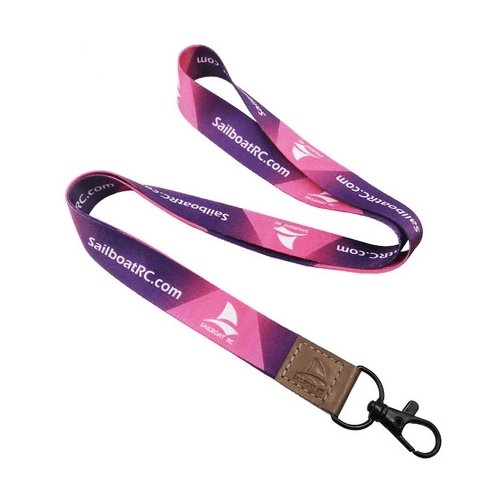
The single most common artwork problem we see on Malaysian lanyard briefs has nothing to do with taste. It is arithmetic. A logo lock-up designed for a business card is sent for a 15mm strap, and the tagline underneath it — the one that reads perfectly at 90mm wide — lands at roughly 1.2mm cap height on the webbing. At that size, silkscreen fills the counters of the letters, woven jacquard rounds them into the weave grid, and dye-sublimation renders them as a soft grey bruise. The strap is simply shorter than the logo thinks it is.
This guide is the artwork conversation our production team has before a lanyard goes to print: what each decoration method physically does to the yarn, the cap-height and stroke-weight floor we will sign off for each one, what happens to gradients and drop shadows, and the back face of the strap that almost nobody briefs. It is written for whoever has to hand a file to a supplier and would rather find out now.
First: how much of the strap you can actually print on
A lanyard’s stated width is the full width of the tape, not the printable band. Both long edges carry a safety margin: the tape is cut and heat-sealed, folded through the hardware, and moves fractionally under the screen or transfer roller. Our working rule is to keep roughly 1.5mm clear of each edge and design to the band that remains.
| Strap width | Band we design to | What realistically fits |
|---|---|---|
| 10mm | about 7mm | Wordmark only, one line, no tagline, no stacked lock-up |
| 15mm | about 12mm | Symbol plus wordmark side by side, or a wordmark with a short URL |
| 20mm | about 17mm | Full lock-up with tagline, or a two-logo host-and-sponsor pairing |
| 25mm | about 22mm | A sponsor row of three to four marks, or a full-bleed photographic panel |
Those bands are the ceiling on every decision that follows. If your brand guidelines say the tagline is never removed, you have already chosen 20mm or 25mm and the conversation about which strap width your artwork actually needs is over before it starts.
What each decoration method does to the yarn
Silkscreen: ink sits on top of the weave
A mesh screen is cut per colour and opaque ink is pushed through it onto the tape. Because the ink is a physical layer sitting on a textured surface, it behaves like paint on canvas rather than ink on paper. Solid shapes come out crisp and dense. Fine reversed-out detail — white type knocked out of a dark block — is where silkscreen struggles, because ink spreads very slightly into the weave and closes up the gaps. Each colour is a separate screen and a separate pass, so a four-colour logo is four registrations that must line up on a moving tape.
Woven jacquard: the logo is the fabric
Nothing is applied to a woven lanyard. The design is produced on the loom by switching coloured threads, so the logo is built from a grid of interlacing yarns. That is why woven straps survive years of daily staff use without cracking — there is no surface layer to crack — and also why woven has the coarsest resolution of the three: every curve is quantised to the thread pitch, so a circle becomes a fine staircase and a hairline serif disappears into the next pick. Thread colours come from a physical shade card, and colour count is limited by the yarns the loom carries.
Dye-sublimation: the dye becomes the fibre
Artwork is printed onto transfer paper, then heat and pressure turn the dye into a gas that bonds inside the polyester filament. The colour is in the fibre, not on it, so the strap keeps its soft hand-feel and the print cannot peel. Sublimation is the only one of the three that handles photographs, gradients and unlimited colours, which is why it is the default for delegate and sponsor lanyards. Its weakness is the opposite of silkscreen’s: because the dye migrates a fraction into the fibre as it bonds, very fine dark-on-light detail gains a soft halo instead of a hard edge.
One method only works on polyester. Dye-sublimation bonds to polyester. It does not bond to nylon or to natural fibre in the same way, which is why nylon straps are normally silkscreened. If you have specified nylon for its silky premium finish and then asked for a photographic print, one of those two decisions has to give.
The reproduction table we check artwork against
This is the internal reference our team uses when a file arrives. The cap-height figure is the height of a capital letter measured at final printed size on the strap — not on your screen at 400% zoom. If your smallest text falls below the floor for your chosen method, we will say so at mockup stage and ask you to either enlarge it, delete it, or move to a wider strap.
| Check | Silkscreen | Woven jacquard | Dye-sublimation |
|---|---|---|---|
| Smallest cap height we sign off | 3mm | 4–5mm | 2.5mm |
| Thinnest stroke that survives | around 0.5mm | around 0.8mm, snapped to the weave | around 0.35mm |
| Gradients and photographs | No — solid colours only | No — flat thread blocks only | Yes, edge to edge |
| Colour count | Typically up to four, one screen each | Limited by threads on the loom | Unlimited |
| Back face of the strap | Second set of screens, second setup | Automatic — but colours invert | Second pass, artwork can differ |
| How colour is matched | Mixed spot ink, closest to your reference | Nearest yarn on the shade card | Process build, screen-accurate not exact |
| Feel after months of wear | Surface layer, can soften with abrasion | Unchanged — it is the fabric | Unchanged — dye is inside the fibre |
The tagline test
Here is a two-minute check that settles most arguments before they reach a mockup. Open your logo file, set the artboard to the printable band from the first table, and scale the lock-up to fit that band with the strap running horizontally. Now measure the capital letters of your smallest element — usually a tagline, a department name, a website or a “member of” line — in millimetres.
- Above 4mm: safe on all three methods. Proceed.
- 3mm to 4mm: fine on sublimation and silkscreen, marginal on woven. Choose a printed route or simplify the woven version.
- 2.5mm to 3mm: sublimation only, and only if the type sits on a plain background rather than over a photograph.
- Below 2.5mm: the element is decoration, not communication. Delete it, or move up a width band.
The result is usually uncomfortable and always cheaper than reprinting. A lanyard is read at conversational distance, in a glance. Anything that needs a squint is not doing a job.
Gradients, glows and the effects that do not survive
Dye-sublimation prints gradients beautifully across a wide band, but not inside a 3mm-tall letter, where the transition distance is shorter than the dye’s own migration. The same logic disposes of most digital effects once they are shrunk onto webbing:
- Drop shadows read as a smudge and make small type look out of focus. Remove them at lanyard scale.
- Outer glows reduce contrast against the strap colour, which is the one thing small type cannot spare.
- Hairline rules and keylines set at a fixed screen pixel width vanish entirely. Set them in millimetres, not points or pixels.
- Light tints of a colour — anything under roughly a tenth of full strength — disappear into the tape colour. Use a distinct second colour instead.
- Thin white type on a mid-tone background is the classic failure. Bold the weight or darken the background block.
Where those effects are non-negotiable brand assets, the honest answer is to move the detailed artwork onto a surface that can carry it — the badge insert rather than the strap — and let the lanyard carry the bold mark. That split also affects how the hook is joined to the webbing, because a heavier rigid insert changes what the attachment has to hold.
The back face nobody briefs
A lanyard twists. Over an eight-hour conference day, every strap in the room will show its reverse side to somebody. Most briefs never mention it, and the default answer differs by method in a way that surprises people:
- Silkscreen leaves the back blank unless you order it printed, which means a second set of screens and a second setup.
- Woven jacquard gives you a back face for free, but it is the negative of the front: where the face is navy on white, the reverse is white on navy. Some brands love this. Others discover it at delivery.
- Dye-sublimation prints both sides as two passes, and the two sides do not have to match. This is the most under-used option in Malaysian event work — the front carries the host brand, the reverse carries the sponsor row, the wifi password, or the emergency number.
One related detail: artwork repeats along the tape at a fixed pitch, and where a repeat lands relative to the hook is not something to specify to the millimetre. If a single hero element must sit dead centre at the chest, say so at briefing so the repeat can be planned around it.
Colour: three different promises
Brand teams often ask for an exact colour reference across all three methods and are told yes three times. In practice the three methods make three different promises. Silkscreen mixes a spot ink, so it gets closest to a specified corporate colour, particularly for strong solid brand blues and reds. Woven matches to the nearest yarn held on the shade card — a physical thread, not a printed chip — so approve it against a thread sample, never a screen. Dye-sublimation builds colour from process inks on polyester; deep navies, rich burgundies and fluorescent tones are the ones most likely to shift, and the shift is consistent rather than random. Our practical advice for a mixed order — printed delegate straps plus woven staff straps in the same brand colour — is to nominate the woven thread first and then match the printed run to it, because thread choice is the least flexible of the three.
The five-check artwork triage
- Send vector, with type converted to outlines. Adobe Illustrator or PDF. A 300 DPI PNG is acceptable for sublimation, but only at final size or larger.
- Measure your smallest cap height at final strap width. Compare it to the reproduction table above before you send anything.
- Strip the effects that do not survive: shadows, glows, pixel-width hairlines, tints under a tenth strength.
- Decide the back face now: blank, mirrored, inverted, or a different design entirely.
- Name your colour route: spot ink for silkscreen, nearest thread for woven, or process build for sublimation — and say which one is the master if you are ordering more than one type.
Three briefs, three different answers
The methods are not ranked; they answer different briefs. Three recent runs on our own project wall took three different routes for good reasons. The beIN Sports staff access order — 20mm polyester, silkscreen, corporate brand colours, safety buckle and holder — used silkscreen because a clean corporate mark on a solid strap is what silkscreen does best. The Sembcorp Marine mass-distribution order — 20mm nylon, one-colour silkscreen, fast turnaround — used the fewest screens possible, because a single colour is the shortest route through production when the deadline binds. The Doraemon event visitor order — 20mm polyester, full-colour dye-sublimation — needed character artwork with continuous tone, which only sublimation holds.
The pattern is clear: colour complexity chooses the method, strap width decides how much of your lock-up survives, and the deadline quietly chooses between them when both would work. Our full printed lanyard Malaysia and tubular lanyard styles page sets out which materials pair with which decoration route, and every quotation comes back with a free digital mockup showing your artwork at true strap scale before anything is committed.
Where artwork sits in the timeline
Artwork is the one stage you control entirely, and where most delay is created. Minimum order is from 300 pcs per design; production runs 21–45 days after artwork approval depending on quantity and method, plus roughly 15 days shipping nationwide. Express production in 10 working days exists for limited styles and quantities. The clock starts at approval, not at enquiry — so a week spent debating whether the tagline stays is a week added to the delivery date, not absorbed by it.
If your straps are heading for a conference rather than an office, the artwork decision also feeds directly into the operation on the day — tier colours, sponsor rows and reverse-side printing all shape the job of kitting badges and lanyards before the doors open.
Send the file. We will tell you what survives.
Send your logo and your strap width, and we will come back with a free digital mockup at true scale, flagging any element that falls below the reproduction floor — before you commit to a run. Minimum order from 300 pcs per design, quote-only pricing with an SST invoice, ePerolehan-ready for government buyers, delivered across Kuala Lumpur and the rest of Malaysia.
Aquaholic Gifts is a Singapore-based corporate gifting specialist since 2003, now serving Malaysia from Kuala Lumpur.
WhatsApp +60 10 717 5924 · Send your brief through our contact page · Request a free sublimation lanyard Malaysia mockup