10, 15, 20 or 25mm: Choosing Lanyard Width and When a Breakaway Is Non-Negotiable
Two lines on a lanyard specification get decided in about four seconds each, and both of them deserve longer. Width usually gets chosen because 20mm “looks normal”. The breakaway usually gets chosen — or skipped — because someone is unsure whether it is a real safety component or an upsell. Neither is a style question. Width is a typography constraint that decides how much of your name and how many sponsor marks a strap can legibly carry. The breakaway is the only part of the assembly whose entire job is to fail, on purpose, in a room where a strap being pulled is a foreseeable event.
This guide sets out what each of the four common widths — 10mm, 15mm, 20mm and 25mm — actually carries, then works through how a breakaway behaves, where it stops being optional, and how to write both into a purchase order so nobody has to guess.
Width is a typography decision before it is a comfort decision
The strap width is the height of your canvas. Once you subtract the edge margin needed for cutting, folding through the hardware and print drift, what remains is the band your artwork lives in. Everything that has to appear on the strap — organisation name, event name, sponsor row, department, a URL — is competing for that band, and the competition is won by whatever you set largest.
| Width | What it legibly carries | Best decoration route | Typical use |
|---|---|---|---|
| 10mm | One short wordmark, one line, no tagline. A symbol on its own works better than words. | Silkscreen, one or two colours | Discreet executive passes; slim tubular cord styles |
| 15mm | Symbol plus wordmark side by side, or a wordmark with a short second line. | Silkscreen or dye-sublimation | School and campus passes; slimmer corporate ID |
| 20mm | A full lock-up with tagline, or a host mark plus one partner mark. | Any — the widest choice of methods | The workhorse: staff ID, conferences, exhibitions |
| 25mm | A sponsor row of three or four marks, or a full-bleed photographic panel with type over it. | Dye-sublimation | Sponsor-funded events, festivals, large expos |
The quickest way to settle an internal debate is to work from the smallest element rather than the largest. Take the shortest thing on the strap that still has to be readable — a partner logo, a department name — and check its capital-letter height at final size against the cap-height floor for printed logos. If it falls short, the answer is a wider strap or a shorter message, and no amount of print quality will substitute for either.
Sponsor rows are a width problem, not a design problem. If commercial partners have been promised strap presence, agree the number of marks before you agree the width. Four logos on 20mm and four logos on 25mm are different orders — and it is far easier to buy a wider strap than to explain to a sponsor why their mark is 2mm tall.
A note on tubular straps
Flat tape and tubular cord are measured differently, and the difference catches people out. A tubular lanyard is a round or flattened-round cord, so the face that presents to a viewer is narrower than the stated width and curves away at both edges. Type set to the full width will visibly bend around the curve. In practice, treat a tubular strap as one band narrower than its flat-tape equivalent: brief it like a wordmark-only strap, keep the artwork centred, and reserve tubular for high-volume distribution where the value and the smooth feel are the point rather than a detailed lock-up.
Length, drop and where the badge lands
Width gets debated; length usually does not, and it should. A lanyard is specified as a loop, and the drop — how far the badge hangs below the neck — is roughly half the loop. A standard adult loop puts the badge at about mid-chest, which is where a wall-mounted reader expects it and where a badge stays visible when someone is seated at a table.
Two situations justify a shorter loop. Primary-school lanyards should sit high, because a long strap on a small child is both a snag risk and a nuisance. And any environment where people lean over a bench, a patient, a counter or a conveyor benefits from a shorter drop, since a badge that swings forward when the wearer bends is the badge most likely to be caught. Confirm the loop length on the mockup rather than assuming the default — it costs nothing at that stage and cannot be changed afterwards.
What a breakaway is, and what it is not
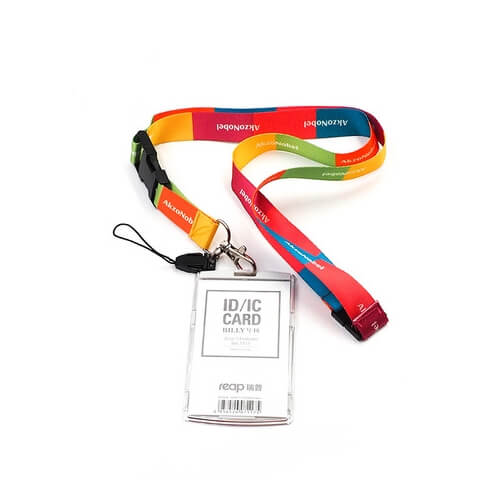
A safety breakaway is a small two-part connector fitted at the back of the neck. Under a modest pull it separates, the loop opens, and the lanyard comes off the wearer instead of tightening around them. It then clicks back together and the lanyard is reused — it is not a single-use component.
Two components are routinely mistaken for it. A detachable side-release buckle sits partway down the strap and is opened deliberately by the wearer to take the card off; it does nothing under an accidental pull, because it is designed to resist exactly that. An adjustable slider shortens the loop; it is comfort, not safety. A strap can carry all three, and on staff passes it often should — but only the breakaway is a safety component, and the other two do not substitute for it.
There is a fourth item worth naming: a breakaway placed at the neck protects the person, not the pass. If the risk you are managing is losing an expensive access card, that is a different fitting entirely — and it interacts with the joints where lanyards fail further down the chain.
Tensile behaviour: the failure you want
This is the part that gets skipped, and it is the part that matters. A woven polyester strap is genuinely strong — it will comfortably support far more than the weight of a card, and it will not tear if someone grabs it. That strength is the whole problem. A component that cannot break is a component that transfers the entire pulling force to whatever it is looped around, which in the case of a lanyard is a neck.
A breakaway inverts that. It introduces a deliberate weak point calibrated to open under a pull far below anything that could injure someone, while staying firmly closed under the everyday load of a badge, a reader tap, and being pulled on and off over a head. The design target is a component that never separates by accident during normal wear and always separates during an abnormal one.
Which gives a simple, uncomfortable test for any environment: if a strap were caught by something that keeps moving, what stops? If the honest answer is “the person”, the strap needs a breakaway. Rotating machinery, conveyor lines, escalators, vehicle doors, laboratory equipment, kitchen mixers, and — the one people forget — another human being in a room where someone might be grabbed all give the same answer.
Where a breakaway is non-negotiable
| Environment | Breakaway | Why |
|---|---|---|
| Schools, kindergartens, campuses | Mandatory | Play, roughhousing and playground fittings; children pull each other’s straps |
| Hospitals, clinics, care settings | Mandatory | Staff lean over patients; a distressed patient may grab |
| Laboratories | Mandatory | Centrifuges, stirrers and benchtop equipment with moving parts |
| Manufacturing, warehousing, logistics | Mandatory | Conveyors, rollers, forklifts and shutter doors |
| Commercial kitchens and F&B back of house | Mandatory | Mixers, slicers and open flame; a dangling strap is also a hygiene issue |
| Conferences and exhibitions | Strongly recommended | Crowd density, escalators, and delegates you do not control |
| Office and corporate staff ID | Recommended | Low risk day to day, but lifts, doors and site visits are not zero risk |
| Outdoor events, sports, festivals | Strongly recommended | Movement, barriers, ride and vehicle access points |
One practical note for Malaysian buyers: on our own orders the breakaway is added at no extra cost, so the usual reason for leaving it off — a line item somebody wants to trim — does not apply. If a supplier is presenting a breakaway as a chargeable upgrade on a school or hospital order, that is worth questioning.
The two-release rule
A framework we use when specifying any pass that will be worn daily. Ask two separate questions and answer both:
- Release one — the neck. If the strap is pulled hard, what comes apart? That is the breakaway, and it is a safety answer. It is decided by the room, never by the budget.
- Release two — the card. How does the wearer get the pass off the strap without lifting the loop over their head? That is a detachable buckle or a retractable reel, and it is a workflow answer. It is decided by how the pass is used.
Most disappointing lanyard orders have answered one of these and assumed it covered the other. A hospital order with a detachable buckle and no breakaway has solved the convenience problem and left the safety one untouched. A factory order with a breakaway and no way of detaching the card sends people ducking out of the loop at every reader.
Writing it into the purchase order
Procurement teams, particularly those buying through ePerolehan, need a specification that reads unambiguously to a third party. Six lines cover it:
- Width and material — for example 20mm polyester, or 15mm tubular
- Loop length — standard adult, or a stated shorter drop for children or bench work
- Decoration — method, number of colours, one side or both
- Safety — “safety breakaway at rear of neck, re-connectable”, stated as a requirement not an option
- Access — detachable buckle yes or no; reel yes or no
- Attachment — hook type and finish
Writing “safety breakaway” as a requirement line rather than a tick box has a second benefit: it survives the reorder. Specifications get copied forward for years, and the batch that quietly loses its breakaway is almost always a repeat order placed by someone who was not there for the first conversation. The safety breakaway lanyard specifications we work to are listed on the lanyard page so they can be pasted straight into a tender document.
Ordering, quantities and lead time
Width and safety fittings do not change the order mechanics, but they do interact with them. Our minimum order is from 300 pcs per design, which means a 15mm student strap and a 20mm staff strap are two designs against that minimum, not one order of two halves. Where a single organisation needs several widths, the usual resolution is to standardise on 20mm for everyone and separate the groups by strap colour and hardware instead — one artwork family, one run.
Production runs 21–45 days after artwork approval depending on quantity and method, plus roughly 15 days shipping nationwide. Express production in 10 working days is available on limited styles and quantities. If the order is for a dated event rather than rolling staff issue, the width and safety decisions should be locked before artwork rather than during it, because a late change from 20mm to 25mm is a new mockup and a new approval date — and the schedule for that is set out in our guide to sizing quantities across attendee tiers.
Tell us the room, and we will specify the strap
Send us where these lanyards will be worn and what has to appear on them, and we will come back with a width, a safety fitting and a free digital mockup at true scale. Breakaway buckles included as standard. Minimum order from 300 pcs per design, quote-only with an SST invoice, ePerolehan-ready for government and statutory buyers, delivered across Kuala Lumpur and the rest of Malaysia.
Aquaholic Gifts is a Singapore-based corporate gifting specialist since 2003, now serving Malaysia from Kuala Lumpur.
WhatsApp +60 10 717 5924 · Send your requirement through our contact page · Get a quote for polyester lanyard widths