Screw Post, Sewn, Cord or Slip-In: Four Ways to Hold a Menu
Every menu cover brief we receive describes the material, the colour and the logo. Almost none of them describe the job that actually decides which cover to buy: how a member of staff, standing at a side station at four in the afternoon with a stack of freshly printed price lists, gets the old page out and the new page in. That job happens far more often than anyone budgets for, and the binding format you choose either makes it a two-minute task or a two-hour one.
There are four ways a menu is held inside a cover — screw post, sewn, elastic cord and slip-in pocket — and they are not four styles of the same thing. They are four different trade-offs between how good the cover looks, how fast a page changes, and how much there is to lose. As a Singapore-based corporate gifting specialist producing branded folders since 2003, now serving Malaysia, we have watched all four succeed and all four fail, and the failures are almost always a mismatch with how often the menu changes rather than a fault in the format.
Start with one question: how often does the price list move?
Before comparing formats, answer this honestly for your own venue. Not how often you intend to reprint — how often a page actually changes. Count seasonal menus, festive set menus, supplier-driven price revisions, the removal of an item that keeps running out, and the promotional card the marketing team sends over. A room that changes something once or twice a year has a completely different requirement from one that reprints a page monthly, and the second room will grow to resent a format the first room would love.
The reason this matters more than it appears is that changeover cost is invisible in a quotation and relentless in operation. A format that takes a few extra minutes per cover, multiplied across a full dining room, multiplied across every reprint of the year, becomes real staff hours that nobody planned for. That is the number the format choice is really about.
Screw post: the serviceable one
A screw post is a two-part barrel-and-screw fastener passing through punched holes in the insert stack and, usually, through the spine of the cover itself. It is the format most restaurants end up with, and for good reason: it holds a genuinely thick stack, it lets pages lie flat when open, and any page can be replaced individually.
Its cost is that it has parts. A screwdriver or a firm thumbnail is needed for each post, each post is a small object that can roll off a side station and vanish, and posts back themselves out over months of opening — which is the mechanism behind the screw post that works itself loose. It is also the format that most rewards getting the punch position right at the artwork stage, because a hole punched through a line of type is permanent.
Practical detail that gets missed: order spare posts with the run, in a small bag that lives at the host stand. They are the cheapest insurance in the whole order and the hardest thing to source in a hurry once the run is closed.
Sewn: the one that looks best and moves least
A sewn cover has the insert stitched into the spine, or has stitched-in inner panels that the menu is permanently mounted to. There is no visible hardware at all, the spine is clean, and the whole object reads as one considered piece rather than an assembly. In a fine-dining room where the menu is part of the design language, sewn is very often the right answer.
The trade-off is unambiguous: you do not change a page on a sewn cover. You change the menu, which means a new insert assembly, and in some constructions it means a new cover. That is entirely workable for a room with a fixed seasonal menu and a proper reprint cycle, and completely unworkable for a room whose prices move with the market. Sewn construction is also the strongest of the four along the spine, because stitching distributes load along a line rather than concentrating it at two holes.
Elastic cord: the fastest change in the room
Cord retention runs a length of elastic down the inside of the spine; the menu leaf is slipped under the cord and held by tension alone. Some covers run a single cord, others run two or three so several separate leaves can sit side by side without touching. Changing a page needs no tools and no hardware — the old leaf slides out, the new one slides in, and the cover is back in service.
Two things to watch. The first is elastic fatigue: cord stretches, and a cord that has relaxed lets the menu slide when the cover is tilted, which looks careless the moment a guest opens it. Specify replaceable cord with accessible anchor points rather than cord bonded permanently into the spine, and the cover outlives the elastic instead of dying with it. The second is capacity. Cord holds a modest number of leaves elegantly and a large number badly, so the format wants a slim menu, which loops back to spine capacity and how many pages it carries.
Slip-in pocket: the slimline answer
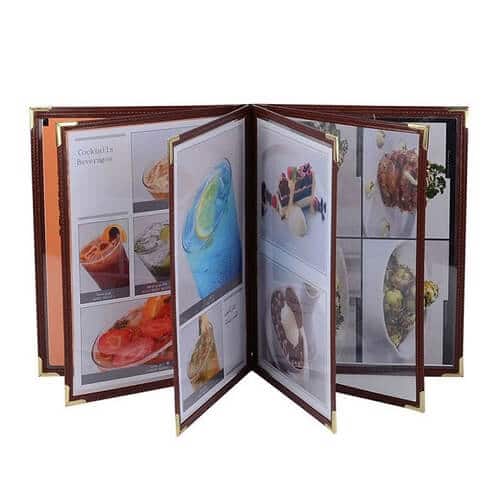
A slip-in cover holds the menu in pockets or corner slots formed in the inner panels. It is the format behind most slimline covers, it is the quickest of all to change, and it is the one that photographs best because there is no hardware and no cord to interrupt the panel.
Its limitation is capacity and grip. A pocket holds one or two leaves per panel comfortably; push more in and the pocket mouth stretches permanently and stops holding anything. Corner slots are gentler on the pocket but leave the leaf free to bow in the middle, so the paper stock has to be stiff enough to hold its own shape. Slimline slip-in covers suit a one-page food menu, a wine-by-the-glass list, a breakfast card or a room-service sheet — anywhere the content is short and changes often.
The four formats side by side
| Format | Tools to change a page | Stack capacity | What can be lost or fail | Best suited to |
|---|---|---|---|---|
| Screw post | Screwdriver or thumbnail, per post | High — stepped by post length | Posts loosen and go missing; punched holes tear on light stock | Multi-page menus that are revised page by page |
| Sewn | None — the insert is not designed to be changed | Set at manufacture | Nothing to lose; thread abrasion at the fold over years | Fine dining with a fixed seasonal menu |
| Elastic cord | None | Low to moderate | Cord relaxes and stops gripping; leaves slide when tilted | Rooms that reprint a page every month |
| Slip-in pocket | None | Low — one or two leaves per panel | Pocket mouth stretches; thin stock bows in the middle | Slimline covers, drinks cards, room-service sheets |
The changeover drill: measure it on your own bench
We will not publish a number of seconds, because the honest answer depends on the person, the hardware and the room. What we can give you is a repeatable drill that produces your own number in about a quarter of an hour, before you commit to a run.
Run this on a sample of each shortlisted format
- Give it to the person who will actually do it — a service team member, not the manager who chose the cover.
- Time one full page swap with a stopwatch, from picking the cover up to setting it down closed and correct.
- Repeat it three times and take the third figure. The first is unfamiliarity; the third is the real working speed.
- Multiply by your cover count and then by the number of reprints you counted earlier in the year. That is your annual changeover load.
- Note what fell on the floor. Posts, cords and loose leaves that hit the ground during the drill will hit the ground in service too.
Nine times out of ten the drill settles the argument on its own. A room that reprints monthly discovers that a hardware-free format pays for itself in the first quarter. A room with a fixed seasonal menu discovers that changeover speed was never the constraint and it should buy for appearance and spine strength instead. Where a venue runs several documents in the room, the answer can differ per document, which is worth reading alongside cover formats for drinks and dessert lists.
What to write into the brief
- How many times a page changed in the last twelve months, and who does the changing.
- Peak stack thickness, so the format can be checked against capacity rather than page count.
- Whether the punch line or cord line clashes with anything in the menu design.
- Whether you want spare hardware or spare cord supplied with the run.
- Whether the same room needs a second, different format for its drinks list.
All four formats sit inside our standard terms: a minimum order of 200 pcs, production of 21–45 days after artwork approval plus around 15 days shipping nationwide, and an express route of 10 working days on limited styles and quantities. Quotations carry an SST invoice and can be prepared for ePerolehan. If you already know the format you want, the full range of menu cover insert systems is a good place to see how each one is built.
Menu binding questions we get asked
Which menu cover binding is best if we change prices often?
Elastic cord or slip-in pocket, because neither needs a tool and neither has hardware to remove. If your menu is too thick for those, a screw-post cover with spare posts kept at the host stand is the next best option. Sewn is the wrong choice for a frequently revised menu, however good it looks.
Can we change from one binding to another later?
Not on the same covers. The binding is built into the inner panels and the spine at manufacture, so switching formats means a new run of covers. This is the main reason we push the changeover drill before an order rather than after — it is a decision you live with for the life of the covers.
Do screw-post holes tear the menu pages?
They do on light stock, and it is one of the most common complaints we hear about existing covers. The fix is heavier stock at the punched edge, a reinforcing strip, or moving the punch line slightly further in from the edge. All three are decided at the insert design stage, not at the cover stage, which is why we ask to see the insert before quoting.
What is the minimum order per menu cover design, and how long does it take?
Minimum order is 200 pcs across all four formats. Production runs 21–45 days after you approve the artwork, depending on quantity, material and decoration method, with roughly 15 days for shipping anywhere in Malaysia. Express production in 10 working days is available on limited styles and quantities.
Tell us how often your menu changes, not just how it should look
We will recommend a binding that matches your reprint cycle and your stack, and send a free digital mockup usually within one business day. Ready to specify a screw-post menu cover or a cord-retained one? Send us the menu and we will do the rest.
Aquaholic Gifts Malaysia · AS80, Jalan Hang Tuah 4, Taman Salak Selatan, 57100 Kuala Lumpur