The 300-Piece Shoe Bag Order: Where a Low-Cost Gift Goes Wrong
A shoe bag is usually the cheapest line on a gifting budget and one of the very few items on it that a recipient uses every week. That asymmetry is the entire commercial argument for the product — and it is also why the small things go wrong. Nobody stress-tests a giveaway that costs almost nothing. Then the cord pulls out of the channel on the third use, or an eyelet tears, and an item that was supposed to run for two years of weekly gym visits stops working after a month.
This is the article about the economics rather than the product: which programmes a shoe bag genuinely belongs in, how to work out your quantity when your recipient count is not your unit count, the four failure points that decide whether the item survives long enough to earn its keep, and what a 300-piece order actually looks like when it lands on a pallet. If you are specifying a gym shoe bag KL members will use weekly, the durability maths matters more than the unit rate.
Four programmes a shoe bag actually belongs to
A shoe bag rarely works as a standalone handout on a roadshow table — it is not visually exciting and its value is not obvious until someone is packing a suitcase. It performs best as a component inside a larger transaction. There are four of those, and each one imposes a different specification.
1. Gift with purchase, inside the box
A footwear retailer, a sports brand or a department store adds a branded bag to the shoe box at the point of sale. The bag has to be flat enough to sit in the box without deforming the lid, soft enough not to mark the product, and folded to a consistent size so the packing step takes seconds rather than minutes. This is the most volume-efficient use of the product and the one with the clearest commercial logic — the customer takes the brand home twice.
2. Insert in a travel or welcome kit
The bag is one item among several in a boxed set — onboarding kits, client welcome packs, property handover gifts. Here the shoe bag is the practical item that justifies the set, and its folded dimensions have to be agreed against the box before anything is produced. It also has to be clean inside, because it is going into a gift box next to other items, which is a containment question in its own right: see contamination control inside a gift set.
3. Amenity stock for hotels and gyms
A wardrobe bag in every room, or a bag issued to every new member. This is the only one of the four that is a recurring consumable rather than a one-off campaign, which changes the whole calculation — you are buying into a replenishment cycle, not a project. It also means the specification is locked for years, so getting it right the first time is worth more here than anywhere else.
4. Sponsor and club giveaway
Sports sponsorship, corporate family days, running events and club membership drives. The bag is handed out in a context where its purpose is instantly obvious — everyone present is holding sports shoes. A run of 1,000 branded drawstring shoe bags we produced for Shell Malaysia’s sponsor event at the Petronas Twin Towers in June 2026 is a good example of this shape of brief: simple construction, strong front-panel branding, and a use case the recipient understood on sight.
Your quantity is not your headcount
This is where shoe bag budgets go wrong before anyone has spoken to a supplier. Three multipliers sit between the number of people you are gifting and the number of bags you need to order.
| Multiplier | When it applies | Effect on units |
|---|---|---|
| One bag per shoe, not per pair | Retail dust bags, premium footwear | Doubles the order for the same recipients |
| Two sizes instead of one | Boots in scope, or a graded product range | Splits the run, and each size carries its own minimum |
| Replenishment allowance | Hotel rooms, gym membership, ongoing GWP | Adds the consumption between this order and the next |
The replenishment allowance is the one that is genuinely hard, and there is no shortcut worth trusting — you have to measure your own consumption. For a hotel, that is bags taken by guests per room per month. For a gym, it is new joiners per month plus replacements. For a retailer running a gift with purchase, it is units of the qualifying product sold per week. Take your own figure, multiply it by the number of months until you would realistically place the next order, and add that to your base quantity. Then add the lead time on top, because the reorder has to be raised before you run out, not after.
The reorder trigger nobody sets
Production runs 21–45 days after artwork approval, plus around 15 days shipping. Work backwards from that and set a stock level that triggers a reorder — not a date. An amenity programme that reorders when the shelf looks empty is already out of stock by the time the next run lands.
Where a cheap shoe bag actually fails
Almost nobody reports a shoe bag failing because the fabric wore out. The fabric usually outlives the item. Failure happens at four small, cheap components, and each one has a specific cause and a specific line you can add to a brief to prevent it.
| Failure | What actually happens | Line to add to your brief |
|---|---|---|
| Cord pulls out of the channel | The cord ends are loose, and one end works its way back through the channel until the bag will not cinch | “Cord ends knotted and bar-tacked, or fitted with a toggle stop” |
| Eyelet tears out | A metal eyelet is set into single-layer fabric with no reinforcement, and the pull load rips the fabric around it | “Eyelets set through a reinforced or doubled patch, not single-layer fabric” |
| Channel hem opens | The top hem is a single row of stitching that unravels from one end after repeated cinching | “Cord channel closed with a locked or double-stitched hem, back-tacked at both ends” |
| Base seam splits | Outsole tread and stud tips abrade the base seam from inside until it opens | “Base seam overlocked and turned; reinforced base panel for sports use” |
Note what these four have in common: none of them is solved by paying for heavier fabric, and all four are solved by four sentences in a brief. This is the highest-leverage thing you can do on a low-cost item — you are not buying up, you are specifying properly at the same specification level.
A fifth item belongs on the watch list for sports programmes specifically: any ventilation hardware you have added. Mesh panels abrade against tread, and vent eyelets are eyelets, with the same tear-out behaviour. Worth weighing when you are choosing between mesh and a closed face.
What 300 shoe bags physically look like
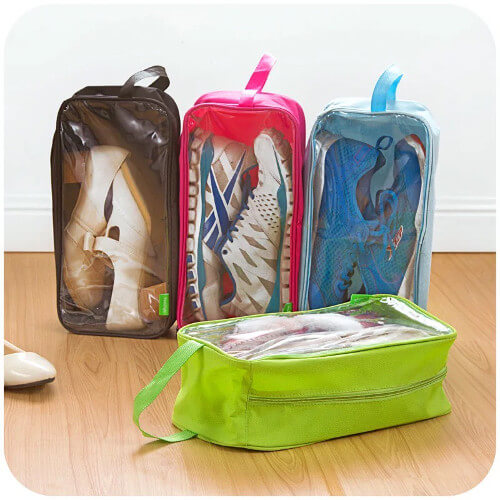
Our minimum order is from 300 pcs, and shoe bags are the rare gift item where the minimum quantity arrives smaller than people expect rather than larger. They are light and they compress. A flat drawstring bag folds to a fraction of its finished size and stacks without air gaps, so a 300-piece run of simple drawstring bags is typically a handful of cartons that one person can move — not a pallet event.
Three things change that picture sharply, and they are worth knowing before you specify:
- Boxed bases do not compress. A boot bag or a gusseted travel bag has a built structure that resists flattening. The same unit count occupies noticeably more carton volume, and freight across Peninsular Malaysia or over to Sabah and Sarawak is charged on volume as much as weight.
- Individual polybagging multiplies volume. If each bag is individually bagged for retail or gift-set insertion, you have added a stiff sleeve around every compressible item. Ask for it only where the programme needs it.
- Zips and toggles set the stacking height. Hardware does not fold. A carton of zip bags stacks to a height governed by the zip tape, not the fabric.
The practical consequence for a Malaysian buyer: if the bags are going to a single KL office, none of this matters much. If they are being split across branches, hotels or outlets nationwide, ask for the carton count and carton dimensions when you receive the quotation, and decide then whether you want the run pre-split into per-location cartons at the factory rather than re-counted by hand at your end. Pre-splitting has to be requested before production, not after.
Branding a floppy sack
A shoe bag has no rigid face. It is printed flat and then spends its life curved around a shoe or gathered at the top, which has two consequences worth designing around.
First, keep artwork away from the cinch zone. The top portion of the front panel disappears into the gathered rosette every time the bag is closed. A logo that sits high on the panel is beautiful on the mockup and invisible in use. Anchor the artwork to the middle third of the panel, where the shoe holds the fabric flat.
Second, the face material sets the method. A bonded non-woven face takes a solid-colour silkscreen well and is the value choice at volume; a woven polyester face is what allows full-colour sublimation and edge-to-edge artwork. Choosing an all-over photographic design on a non-woven bag is the mismatch we correct most often at mockup stage. Our indicative front-panel area sits around 16–22 cm wide across common styles, confirmed on your mockup — and remember that the panel width follows the bag size, so it is set by one size across a mixed-gender list rather than chosen independently.
The one-page programme brief
1. Programme type. Gift with purchase, kit insert, amenity stock or sponsor giveaway — this sets everything downstream.
2. Units, showing your working. Recipients, times bags per recipient, plus replenishment to the next order date.
3. The four durability lines. Cord ends, eyelet reinforcement, channel hem, base seam — copied straight from the table above.
4. Folded dimensions, if it goes inside something. The box or kit it must fit, stated as a measurement.
5. Delivery split. One address or many, and whether you want per-location cartons.
6. The date that cannot move. The event, the store launch, the Hari Raya or year-end distribution window. We work the schedule backwards from it.
Frequently asked questions
What is the minimum order for a shoe bag giveaway?
From 300 pcs. That is per design, so if you are splitting into two sizes or two colourways, tell us the split when you send the brief and we will advise how it affects the quotation and the schedule.
Are shoe bags worth it as a giveaway compared with a flashier item?
Their advantage is retention, not first impression. A shoe bag solves a small problem that recurs every week — separating shoes from clothes — so it stays in a gym bag or a suitcase long after a novelty item is discarded. Specify the durability lines and it keeps working for as long as the recipient does.
Can you deliver to multiple branches across Malaysia?
Yes, nationwide from Kuala Lumpur. If you want the run pre-split into per-location cartons, request it before production so it is packed that way at source rather than re-counted on arrival.
How fast can we get them for an event?
Standard production is 21–45 days after artwork approval depending on quantity, plus around 15 days shipping. Express runs of 10 working days are available on limited styles and quantities — tell us the date up front and we will work backwards from it.
Can we get an SST invoice and buy through ePerolehan?
Yes. Quotations are issued on a quote-only basis with SST invoicing, and ePerolehan-ready documentation is available for government and statutory body purchases.
Send the six-line programme brief and we will quote it properly
Programme type, units with your working shown, the four durability lines, folded dimensions, delivery split and the date that cannot move. Send that with your logo artwork and you will have a free digital mockup and a no-obligation quotation within about one business day. Minimum order from 300 pcs, delivered nationwide across Malaysia. See the full range from our non-woven shoe bag supplier Malaysia line-up.
WhatsApp +60 10 717 5924 · Send your brief through our contact page
Aquaholic Gifts Malaysia · AS80, Jalan Hang Tuah 4, Taman Salak Selatan, 57100 Kuala Lumpur · a Singapore-based corporate gifting specialist since 2003, now serving Malaysia.