Wet Soles, Clean Clothes: What a Shoe Bag Actually Has to Contain
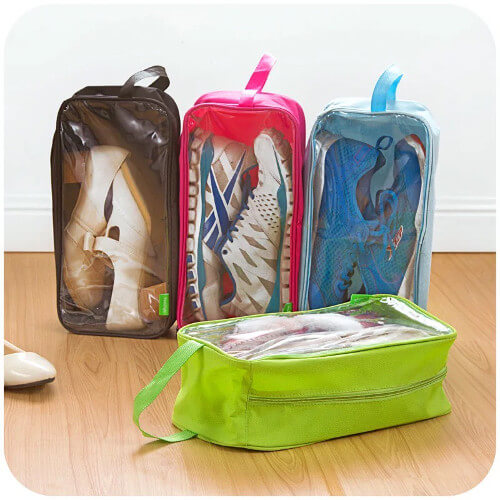
The complaint we get about shoe bags is almost never “it tore”. It is “the shirt underneath smelled”. That single sentence tells you what a shoe bag is for, and it is not carrying — a shoe bag is a barrier. It keeps one dirty, damp, slightly biological object away from everything else in a suitcase, a gym bag or a wardrobe. The cord, the print and the colour are decoration on that one job.
That matters when you are ordering in volume. Most briefs we receive for custom shoe bags Malaysia buyers send over describe the bag as a giveaway — colour, print position, quantity — and say nothing about what will be put inside. Then the bags reach recipients who use them for exactly what the name promises: a used pair of shoes, often still warm, sometimes still wet, going straight in with clean clothes in a climate that sits at high humidity most of the year. This article is about specifying for that reality rather than for the mockup.
A shoe bag has a job description, and almost nobody writes it down
A shoe bag is not a carriage problem — it is a containment problem. It is a thin, unstructured sack that almost always travels inside something else: the boot of a car, a locker, the bottom third of a suitcase, a wardrobe shelf. It is a component, not a piece of luggage.
Once you accept that, the specification questions change. You stop asking “how strong is the fabric” and start asking four others: what is going in, how wet and dirty is it, what is it kept away from, and how long does it stay shut. Our production team’s shorthand for this is the sole side and the clean side. Every containment decision comes down to which side you are protecting.
The two directions of protection
Outward containment — a used shoe is the contaminant, and the bag protects everything around it. Gym, sports club, travel, event giveaway, hotel guest wardrobe.
Inward protection — the shoe is the valuable thing, and the bag keeps dust, scuffing and shelf grit away from it. Retail dust bags, premium footwear, long-term wardrobe storage.
These two briefs pull the specification in opposite directions, and a surprising number of orders try to do both with one bag. A soft non-woven dust bag is superb at inward protection and nearly useless at outward containment; a coated polyester bag is the reverse. Getting this wrong is the most common mismatch we see, and it usually surfaces only after distribution.
Three things a shoe carries in, and what each one ruins
1. Dry particulate — grit, sand, dried mud, court dust
The easiest to stop and the one people worry about most. Any woven face holds it comfortably; non-woven holds most of it. The escape route is almost never the fabric — it is the closure. A single-draw cord leaves an open rosette at the top that grit walks out of the moment the bag is tipped on its side in a car boot. If dry soil is your concern, the fix is a double-draw cord or a zip, not a heavier fabric.
2. Free moisture — rain, sweat through the upper, a wet pitch
This is where uncoated fabric fails quietly. An uncoated polyester or canvas panel wicks and passes moisture to whatever it is pressed against — usually a folded shirt. The bag looks dry on the outside for a while, then a damp patch appears on the clothing under it. In Malaysia this is not an edge case: an afternoon downpour in the monsoon months, or a futsal session at seven in the evening, produces it week after week.
3. Odour and what causes it
Odour is what people remember, and it is the by-product of moisture plus warmth plus time in a closed space. A shoe bag creates all three on purpose. That is the tension at the heart of the product: the tighter you seal it to contain the mess, the better the environment you have built for the smell that offends the recipient. Worth reading alongside how breathable a shoe bag needs to be before you lock a material down.
The overnight problem: a sealed bag in a Malaysian wardrobe
Picture this before signing off a material. A recipient plays badminton after work, showers, puts damp shoes into the branded bag, cinches it shut, drops it in the car, then carries it into an unaired apartment. The bag is not opened until the following evening — roughly twenty-four hours of a wet object in a closed, warm, humid pocket.
Nothing about that is unusual in Kuala Lumpur, and nothing about it is fixable with better fabric. A fully sealed bag holds the moisture against the shoe for the whole period, and a lining holds it more effectively still. The bag does its job perfectly, the recipient opens it to something unpleasant, and blames the bag rather than the shoe. If you are producing for a sports club, a gym or a corporate sports day, that is the outcome you are designing against — and it is why a mesh panel or a vent eyelet is a functional specification, not a styling flourish.
The instruction most orders forget
If your bag is a sealed, coated or laminated style, print or sew in a one-line care note: open and air the bag when you reach home. A small silkscreen line on the reverse panel or a woven label in the side seam costs almost nothing at production stage, and converts a predictable complaint into branding that stays with the item.
One compartment, two compartments, or two bags?
This decision quietly doubles or halves your unit count, so it belongs early in the brief. There are three workable configurations.
Single compartment, pair together. Both shoes go in sole-to-sole. Cheapest, simplest, most common for event giveaways. The uppers touch each other’s soles, so a clean shoe is dirtied by its own pair — which nobody minds much, because both belong to the same person.
Dual compartment, one shoe each side. A centre divider keeps the pair apart, which matters for polished leather and premium retail where sole marking on an upper is a visible defect. It also makes the bag wider and flatter, changing how it packs and how much print area you get per face.
Two separate single bags. The retail dust-bag convention — one soft bag per shoe. Inward protection, not containment, and the right answer for footwear brands and boutiques. It also means your quantity is per shoe, not per pair, which is arithmetic worth doing before you commit — one of several places where a low-cost item behaves in ways a spreadsheet does not expect, alongside what 300 shoe bags actually cost you in handling.
| Use case | Contamination direction | Compartment | Interior treatment | Closure |
|---|---|---|---|---|
| Gym, futsal, sports club | Outward — wet and dirty | Single, pair together | Coated base panel plus a vent panel | Double-draw cord |
| Business travel, hotel guest kit | Outward — dry, occasionally damp | Single or dual | Fully coated or laminated interior | Zip |
| Footwear retail dust bag | Inward — protect the shoe | Two separate bags, one per shoe | None — soft unlined face | Single cord |
| Event and roadshow giveaway | Outward — unknown, assume dirty | Single, pair together | Uncoated, printed both sides | Single cord |
| Boots, safety footwear, site kit | Outward — heavy soil, mud | Single, oversized | Coated interior, reinforced base | Zip or heavy cord |
When a coated interior earns its place — and when it backfires
A coated or laminated interior is the standard answer to moisture transfer, and it works. It is also the standard cause of the odour complaint, because it removes the last escape route for water vapour. Our position, after years of shipping these, is that the coating should be placed by zone rather than applied everywhere by default.
The base panel — the strip the outsole actually rests on — is where every meaningful transfer happens. Coat that. Leave one upper side panel uncoated, or replace part of it with mesh, and the bag still stops the wet patch on the shirt while letting some vapour leave. It is a small construction change, it does not affect your print position if you plan for it, and it turns a hard trade-off into a tolerable compromise. Full coating is still correct in two cases — hotel and airline guest bags, and travel-kit inserts — where the bag is opened within a day and containment matters more than airing.
The sole-side spec: four lines to add to any shoe bag brief
Most shoe bag briefs are three lines long: style, colour, logo. These four extra lines decide whether the bag works.
Line 1 — Contents state. “Used sports shoes, frequently damp” or “new retail footwear, dry”. This single phrase sets material, coating and closure at once.
Line 2 — What it sits next to. “Folded office clothing in a cabin case” or “an open wardrobe shelf”. Sets how much outward containment you need.
Line 3 — Closed duration. “Up to 24 hours” or “opened within the hour”. Decides whether you need ventilation.
Line 4 — Units per recipient. One bag per pair, or one bag per shoe. Decides your quantity before it decides your budget.
Send those four lines with your artwork and the mockup comes back with the right construction on it. The fifth question — how big — is a separate discipline, because a bag that contains perfectly and will not close over a size 11 boot has failed anyway; see our guide to sizing a shoe bag for boots and trainers.
The two-minute check we run on a pre-production sample
You get a sample before a run goes ahead. Use it for more than checking the logo colour.
- The tissue test. Put dry tissue paper inside, a damp cloth on the outside of the base panel, and leave it ten minutes. If the tissue marks, the base passes moisture in the direction that matters.
- The tip test. Put a spoonful of dry sand or soil in, close it as a recipient would, and tip it on its side. Watch the closure, not the seams.
- The real-shoe check. Put the largest pair you can find in and close it fully — not the sample shoe the factory used.
How this fits an order timeline
Containment decisions are construction decisions, so they need to be settled before artwork approval. A coated base, a divider or a vent panel changes the cutting and sewing sequence; asking for one mid-run restarts the clock. Our standard timeline is a free digital mockup within about one business day, production of 21–45 days after artwork approval depending on quantity and construction, and roughly 15 days shipping, with express runs of 10 working days on limited styles and quantities. Minimum order is from 300 pcs.
One example of how forgiving this product is when the brief is clear: a 1,000-piece run of branded drawstring shoe bags produced for Shell Malaysia’s sponsor event at the Petronas Twin Towers in June 2026 — single compartment, single cord, no coating and no divider, because it was specified as an event giveaway from the start. The right specification is not the most elaborate one; it is the one that matches what the bag will hold.
Frequently asked questions
Does a shoe bag need a waterproof lining?
Rarely a fully waterproof one. Most briefs need a coated base panel so the outsole cannot transfer damp to whatever is underneath, with the upper panels left breathable. A completely sealed bag contains moisture beautifully and creates the odour problem recipients complain about.
Should I order one bag per pair or one per shoe?
One per pair for giveaways, sports and travel. One per shoe for retail dust bags, where the point is stopping the pair marking each other. Decide before you set your quantity — it doubles the unit count for the same recipients.
What is the minimum order for custom shoe bags in Malaysia?
From 300 pcs. Send material, size, closure and quantity with your logo artwork and we will return a free digital mockup and a quotation, with SST invoicing and ePerolehan-ready documentation for government buyers.
Can you add a divider to a standard drawstring style?
Yes. A centre divider is a sewing operation rather than a different product, so it can be added to most drawstring and zip styles. Flag it before artwork approval — it changes the finished width and your usable print area per face.
Tell us what goes in the bag, not just what goes on it
Send the four brief lines — contents state, what it sits next to, how long it stays shut, units per recipient — with your logo, and we will reply within one business day with a free digital mockup and a no-obligation quotation. Minimum order from 300 pcs, delivered across Kuala Lumpur and nationwide. Browse our travel shoe pouch corporate gift styles to see the constructions we run.
WhatsApp +60 10 717 5924 · Send your brief through our contact page
Aquaholic Gifts Malaysia · AS80, Jalan Hang Tuah 4, Taman Salak Selatan, 57100 Kuala Lumpur · a Singapore-based corporate gifting specialist since 2003, now serving Malaysia.