The 10-Metre Promise: Bluetooth Speaker Range, Pairing and TWS in a Real Room
The datasheet said Bluetooth 5.3 and a 30-metre range. At the annual dinner, the person controlling the playlist put their phone in a pocket, walked twenty steps to the buffet, and the music stuttered and dropped. Nothing was faulty. The speaker was doing exactly what its radio was built to do — and the numbers on the listing had never been describing music in the first place.
Range, pairing and speakerphone specifications are the least-read lines on a speaker quotation and the ones that generate the most complaints after distribution. They are also the easiest to get right, because they can be checked on a single sample in about five minutes. Here is what they actually mean and what to test before you approve a production run.
Where “4x range” comes from — and why your music never gets it
Bluetooth 5 was announced with a headline that has been copied onto product listings ever since: four times the range of Bluetooth 4.2. That figure is real. It is also not about music.
Bluetooth is two technologies sharing one brand. Bluetooth Low Energy (LE) is the low-power side used by trackers, sensors and beacons. Bluetooth Classic (BR/EDR) is the older, higher-throughput side, and it carries stereo music over the A2DP profile from a phone to a speaker. The four-times-range improvement comes from an optional LE feature called the Coded PHY, which trades data rate for error correction — at its longest setting it drops throughput to around 112 kbps. Fine for a sensor reading; nowhere near enough for a stereo audio stream, and not what your speaker uses to play a song.
So a listing that reads “Bluetooth 5.3, range up to 30 m” is quoting a version number that governs one thing and a distance that comes from another. The version number does bring genuine benefits — faster, more reliable connection setup and better coexistence with other radios — but on its own it is not a range promise for audio.
Power class, not version number, sets the distance
What actually determines how far a music stream reaches is the transmit power class of the radio in the speaker — and, just as importantly, the one in the recipient’s phone.
| Power class | Typical transmit power | Nominal open-air range | Where you meet it |
|---|---|---|---|
| Class 1 | ~100 mW (20 dBm) | ~100 m | Industrial and automotive modules. Rare in a gift-sized speaker. |
| Class 2 | ~2.5 mW (4 dBm) | ~10 m | Nearly every portable speaker and nearly every phone. This is your real budget. |
| Class 3 | ~1 mW (0 dBm) | ~1 m | Very short-range accessories. Not a speaker specification. |
A link is only as strong as its weaker end. A Class 1 speaker paired to a Class 2 phone still behaves close to Class 2.
Ten metres, clear line of sight, is the honest working assumption for a corporate gift speaker. Anything beyond is a bonus, not something to write into a brief. If your event genuinely needs the phone thirty metres away, you do not need a better speaker — you need someone standing nearer to it.
What a real Malaysian room does to 2.4 GHz
That ten metres is an open-air figure, and almost nowhere a corporate speaker is used is open air. Bluetooth shares the crowded 2.4 GHz band, and the things that weaken it are exactly the things a Malaysian office or event space is full of.
- People. A human body is mostly water, and water absorbs 2.4 GHz well. A phone in a trouser pocket with the body between it and the speaker is one of the worst real-world cases — which is precisely the annual-dinner scenario above.
- Reinforced concrete and lift cores. Steel mesh inside a wall is far more damaging than the concrete itself. One such wall can cost more range than ten metres of open corridor.
- Radio congestion. Office Wi-Fi, wireless mice, other people’s earbuds and the pantry microwave crowd the same band. Bluetooth copes by hopping around busy channels — but coping costs margin, and margin is range.
- The speaker’s own body. A metal casing is a better-looking gift and a worse antenna environment than plastic. It is a genuine trade-off, not a defect, and it is one reason to test the finish you actually intend to order rather than a plastic sample of the same model.
In practice, plan for reliable playback within about five to eight metres in a furnished room with people in it, and treat anything further as a pleasant surprise. Set that expectation in the brief and nobody is disappointed on the day.
Pairing behaviour is the feature nobody specifies
Range complaints are usually loud but rare. Pairing complaints are quiet and constant, and they decide whether a gift stays on a desk or goes into a drawer. Four behaviours are worth asking about by name, because they vary between models that look identical:
- Auto-reconnect. Does the speaker rejoin the last device on power-up without any button pressing? On a good model this takes a couple of seconds. On a poor one the user re-pairs from scratch every morning, and by the second week the speaker has stopped being used.
- Multipoint. Can it hold two source devices at once — a laptop and a phone — and switch between them? Genuinely useful for a desk gift, and much rarer at this size than listings suggest.
- Pairing-mode entry. How does a new user put it into pairing mode? If the answer is an undocumented three-second hold of an unmarked button, that instruction needs to be on the insert card, in English and Bahasa Malaysia.
- The prompts. Many modules ship with a loud voice prompt in a language your recipients may not expect, or a startup chime at fixed maximum volume. Both are usually configurable at the factory. Neither gets changed unless someone asks.
The free branding slot almost nobody claims
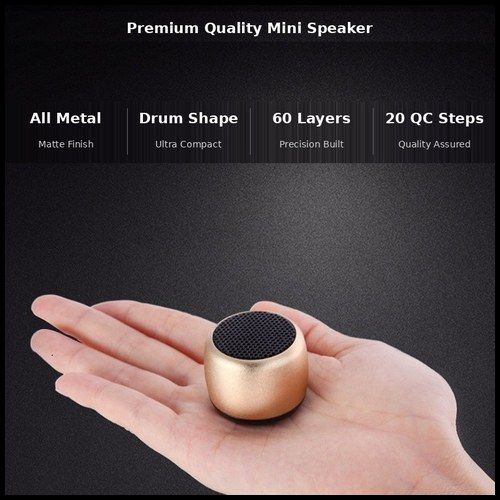
When your recipient opens their phone’s Bluetooth menu, the speaker announces itself with a device name — and on most models that name is a factory code like “BT-518” or “MINI SPEAKER”. It can usually be set at the factory to your company or campaign name at no tooling cost. It then appears on every phone the speaker ever meets, for the life of the product, in a place no printed logo can reach. Ask for it at the same time you send your artwork; it is a firmware setting, not a decoration, so it has to be requested before production rather than after.
TWS: what it is, and the two conditions for it to work
TWS — true wireless stereo — lets two identical speakers link to each other and split the signal into a left and a right channel. It is a real upgrade in a room: wider sound, more total volume, and a small piece of theatre when the recipient discovers it. Two conditions have to hold, and both are procurement decisions rather than technical ones.
First, the two units must be the same model from the same production run, because the pairing handshake is firmware-specific. Second — and this is the one buyers forget — a recipient needs two units for the feature to exist at all. A TWS speaker given out one per person is a feature nobody will ever use. If TWS is part of why you chose the model, it belongs in a boxed pair for senior recipients, or in a prize tier, not in a single-unit giveaway. The same goes for stereo width generally, which is worth reading alongside why a pocket-sized driver cannot produce bass — TWS widens the sound, it does not deepen it.
One naming trap: “TWS” is also used loosely to describe wireless earbuds. When a supplier’s listing says TWS, confirm they mean speaker-to-speaker pairing on this model, and ask them to demonstrate it on the sample pair. It is a thirty-second test that avoids an expensive misunderstanding.
The speakerphone question
Most compact speakers include a microphone and a call button, and it is worth something specific: it turns a desk gift into a hands-free device for informal calls. It is not a conference speakerphone. A single small microphone with basic echo handling works well for one person a metre away and poorly for six around a table — the far end hears the room, not the speaker.
So specify it honestly. If the recipients are individual staff or clients, the mic is a genuine bonus and worth having. If the intended use is meeting rooms, that is a different product category and a speaker gift will disappoint. Whichever way you go, test the microphone on the sample by calling a colleague and standing at a normal desk distance rather than leaning over it.
Latency: why the speaker is the wrong choice for the launch video
This one catches marketing teams. Bluetooth audio arrives late. With SBC, the codec every device supports and most gift speakers default to, measured latency is commonly in the region of 200–250 milliseconds. For music that is invisible. For video it is not: the ITU’s tolerance for lip-sync error is 125 ms and the ATSC’s is 45 ms, so a quarter-second delay is well past the point where a presenter’s mouth stops matching their voice.
Lower-latency codecs exist — aptX sits around 112 ms and aptX Low Latency around 32 ms — but both ends of the link have to support the same one, and at this product size you cannot rely on it. The practical rule: a branded speaker is for music, background audio and calls. If someone plans to play the corporate video through it at a roadshow, run a cable.
The five-minute acceptance test on your sample
Run this before approving artwork, not after the shipment lands. Every step uses one phone and a stopwatch.
- Pair it, switch it off, switch it on again. Time the reconnection. Anything over about ten seconds will annoy someone daily.
- Walk away with the phone in your pocket, body between you and the speaker, until it stutters. Note the distance — that is your honest range figure, not the listing’s.
- Walk through one doorway and behind one wall at five metres. If it survives that, it will survive an office.
- Pair a second phone without unpairing the first, to see whether multipoint really exists.
- Make one call at arm’s length and ask the far end whether you sound close or distant.
- Check the device name shown in the phone’s Bluetooth list, and the volume and language of the startup prompt.
Anything that fails here is a specification conversation with the supplier while it is still cheap. We run this test on the physical sample for every model we quote, and we will run it for a model you have been offered elsewhere too. It sits alongside the sound and finish checks we apply across the personalised Bluetooth speaker options we produce for Malaysian buyers.
Questions buyers ask us
Should we insist on the newest Bluetooth version?
Prefer it, do not obsess over it. Bluetooth 5.x brings quicker, more robust connections and better coexistence with Wi-Fi, all of which help. It does not by itself extend the distance a music stream will travel — that comes from the power class at both ends.
Can we have our company name appear when the speaker is paired?
Usually yes, as a factory firmware setting, provided it is requested before production. Keep it short and unambiguous — it is read on a small phone screen, often by someone who has just unwrapped the box.
Does a waterproof casing reduce the range?
Sealing itself does not, but the materials sometimes do — thick rubber overmoulding and metal both affect the radio more than thin plastic. It is one more reason to range-test the exact finish you intend to order, and to be clear about the water-resistance ratings explained for outdoor events before choosing a rugged model.
Will the logo affect the antenna?
Ink will not, but a metal badge or plate over the antenna area can. It is one of several placement constraints worth knowing before artwork, along with the acoustic ones we set out in our guide to printing a logo on a speaker without muffling it.
What is the minimum order and the lead time?
From 300 pcs per design. Production is 21–45 days after artwork approval depending on quantity and branding method, plus around 15 days shipping; express is 10 working days on limited models and quantities. Quote-only, SST invoice, ePerolehan-ready for government buyers.
Tell us the room, and we will test the radio
Send us the model you are considering and where it will be used, and we will run the five-minute acceptance test on a sample and report what we find — including the device name you would like recipients to see. You can also request a free mockup on any Bluetooth speaker custom build.
MOQ from 300 pcs · 21–45 days after artwork approval + ~15 days shipping · express 10 working days on limited models · quote-only, SST invoice · nationwide delivery.
WhatsApp +60 10 717 5924Send your brief
Aquaholic Gifts Malaysia · AS80, Jalan Hang Tuah 4, Taman Salak Selatan, 57100 Kuala Lumpur.