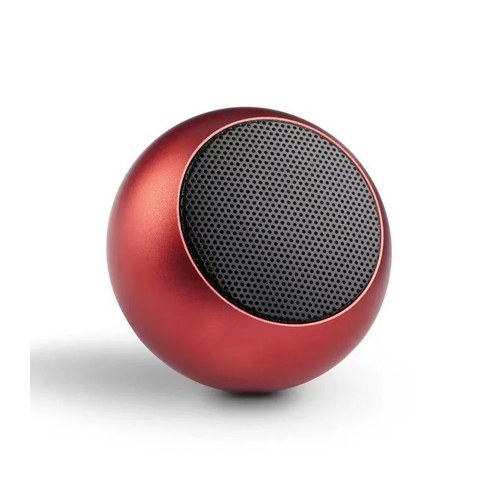
Why a Palm-Sized Speaker Cannot Make Bass (and What 10W Really Means)
There is a moment in almost every speaker shortlist meeting that decides the whole order, and it lasts about eight bars. Someone puts the sample on the table, plays the first thing on their phone, and the room goes quiet in the wrong way. It is loud. It is also thin and harsh, and the bass line everyone hears on their earbuds has gone missing. The sample was quoted at 10W. It sounds like a phone in a biscuit tin.
That gap between the datasheet and the sound in the room is not a manufacturing fault. It is physics, and it is predictable before you hold the sample. This is the check our team runs on a speaker datasheet before quoting it: what driver diameter can and cannot do, why the enclosure matters more than the amplifier, and what a quoted output in watts is actually measuring.
The short version
Bass is a volume of moved air, not a quantity of watts. A single 40 mm driver in a sealed pocket body has almost no useful output at the bottom of the range, whatever the amplifier is rated at. A watt figure with no qualifier beside it is close to meaningless, and an honest one buys roughly 3 dB per doubling. Read driver diameter, body volume, then the word next to the watt number.
A low note is a quantity of air, not a quantity of watts
Sound is moving air. To produce a note, a driver pushes a parcel of air back and forth at that frequency, and the lower the note, the bigger the parcel. Sound travels at roughly 343 metres per second, so a 60 Hz note — the low thump that makes a pop track feel complete — has a wavelength of about 5.7 metres. You are asking a cone the size of a two-ringgit coin to disturb a wave nearly six metres long.
There are two ways to do it: a bigger cone, or more travel per stroke. A gift-sized speaker has room for neither. Its excursion — the distance the cone moves before it hits its own suspension — is a couple of millimetres at best. Feed it more power and it does not go lower; it runs out of travel, distorts, and the limiter pulls it back. That is why a cheap mini speaker turned up loud gets harsher rather than fuller.
The enclosure matters just as much. The air sealed inside the body acts like a spring pushing back on the driver, and the smaller the body, the stiffer that spring — which raises the frequency at which the system stops producing useful output. Shrink the box and you raise the floor. It is why two speakers with identical drivers can sound completely different, and why the larger of two similar models on a shortlist usually wins the demo.
Hoffman’s Iron Law, in a gift-sized box
Loudspeaker designers have a name for this trade-off: Hoffman’s Iron Law. You may have a small cabinet, deep bass and high sensitivity — but only two of the three, never all three. Every compact speaker on your shortlist has already made that choice for you, and nearly all of them made the same one: keep the box small, chase a little bass with processing, sacrifice sensitivity. That lost sensitivity is precisely why the amplifier has to be rated high. The big watt number is not a promise of performance; it is partly compensation for a design that is inefficient by necessity.
Once you see it that way, speaker marketing stops being confusing. A model advertised as small, loud and bass-heavy has either found a genuine compromise — usually a passive radiator and a body slightly larger than “pocket” — or it is boosting the low midrange with processing so the ear reads it as bass. The second trick works well in a shop and much less well on a desk at half past four.
Driver diameter and what it can honestly deliver
This is the table our production team works from when a buyer sends a model over. It is indicative rather than measured, but it predicts the outcome of a boardroom demo far more often than the datasheet does.
| Driver & body | What you actually hear | Honest use case |
|---|---|---|
| Single ~40 mm driver, sealed pocket body | Clear voices, no low end. Podcasts and radio are fine; music sounds like a phone on speaker, only louder. | Mass giveaways where portability is the point. |
| Single ~45–52 mm driver with one passive radiator, cylinder or cube body | A real, if modest, bottom end — you can feel the panel move. The first tier where a pop track sounds complete. | Staff and client gifts — the tier that survives the eight-bar demo. |
| Two drivers plus dual passive radiators, larger horizontal body | Fills a meeting room or small garden; stereo separation becomes audible. | VIP and long-service gifting, where the recipient owns something to compare it with. |
| Any of the above with an aggressive processing preset | Impressive for thirty seconds, fatiguing after ten minutes; voices turn boxy. | Avoid for anything used daily at a desk. |
Indicative behaviour by class, based on the models we handle. Exact response is confirmed by listening to the sample, never by reading the specification sheet.
The pattern is blunt: the jump between the first row and the second is far bigger than the jump between any two watt figures. If the brief is “it must sound good”, you are choosing a body size, not an amplifier — the same trade-off built into the custom speaker models we quote for Malaysian corporate gifting.
The passive radiator, and how to tell a real one from a disc
A passive radiator is a driver with no motor — a cone or weighted diaphragm pushed by the pressure changes the real driver creates inside the body. Tuned properly it extends the low end without a bigger box, the most useful trick available at this size, and it is why a good small speaker visibly vibrates a table.
Check the one on your sample is real. Play a steady bass line and rest a fingertip on the panel: a working radiator moves unmistakably in time. Then press it gently with the speaker off — it should give and spring back with a soft, damped feel. A decorative disc glued on for the look does neither. Both exist; only one changes the sound.
What “10W” is actually measuring
A watt figure on a compact speaker’s sheet can mean at least four things, and only one is useful.
- Continuous (RMS) output — what the amplifier can sustain into the driver. The meaningful number, and the one least often quoted on gift-market models.
- Peak output — what it produces for an instant. Always higher, never sustainable, and the gap is at the manufacturer’s discretion.
- PMPO — “peak music power output”. There is no standard definition for it. Two suppliers can calculate it differently and both be equally correct, which makes it useless for comparison.
- A summed figure — “2 × 5W = 10W”, or an amplifier chip’s maximum quoted as the speaker’s output when the fitted driver cannot handle it.
That last one causes most of the disappointment here: the number on the box is the amplifier’s capability, not the driver’s. A 10W amplifier paired with a 40 mm driver that handles a fraction of it simply hits its limiter earlier — headroom the moving parts cannot use.
The one question that clears it up
Ask your supplier, in writing: “Is the quoted output continuous or peak, and what is the driver’s rated power handling?” A supplier who answers both has a real specification sheet behind the listing. One who answers half of it has told you something useful anyway.
Why twice the watts is not twice as loud
Even an honest figure does not scale the way buyers expect. Doubling amplifier power raises the level by about 3 dB — most people call that “slightly louder”, not “twice as loud”. Perceived loudness roughly doubles around a 10 dB increase, which needs about ten times the power. The gap between a genuine 5W and a genuine 10W model is therefore real but modest, and much smaller than the gap a passive radiator creates. Sensitivity is doing more work than power here — and since you cannot see sensitivity on a gift-market listing, the shortcut stands: size and driver count predict the demo better than the amplifier rating does.
The three-line datasheet check we run before quoting
Before a model goes onto a shortlist, it gets three lines of scrutiny. A minute per model, and most of the risk of a bad demo disappears.
- Driver diameter and count. If the listing does not state it, ask — a supplier who will not say is telling you something. Convert the answer using the table above before reading any other figure.
- Body dimensions, and whether there is a passive radiator. If the whole thing is smaller than a mug, treat any bass claim as decoration. If there is a radiator, ask which panel it sits on — that matters later when you place the logo.
- The word next to the watt figure. “RMS” or “continuous” — good. “Peak” — halve your expectations. “PMPO” or nothing at all — ignore the number and judge on the first two lines.
Battery capacity is the fourth number people ask about. It behaves exactly as it does on any other rechargeable gift, so rather than repeat it here, see our explanation of how a quoted mAh figure converts into real delivered energy and get back to the sound.
Matching the sound to the occasion, not to the spec sheet
The right answer changes with the room. A delegate gift that lives on a desk playing background radio needs voice-range clarity far more than low end; a smaller driver is genuinely correct, and the money is better spent on the finish and the box. A Hari Raya or Chinese New Year gift for clients gets opened in a living room with family present — that is a demo, and it needs the passive radiator. A sports day or family day speaker lives outdoors, where the low end disappears into open air anyway, so volume and water resistance matter more; that is where you should first check what an IPX rating actually survives.
One last piece of geometry: against a wall or in a corner, a small speaker gains real reinforcement at the bottom of its range — free bass. In the middle of a table it loses it. Worth remembering when a colleague says the sample “sounded better in my kitchen”. It probably did.
Questions buyers ask us about speaker sound
Is a 10W speaker twice as good as a 5W one?
No. If both figures are honest and continuous, the difference is about 3 dB — audible, but far smaller than the difference between a sealed pocket body and one with a passive radiator. Compare size and driver diameter first; treat watts as a tie-breaker.
Why does our sample sound thin compared with a branded speaker of the same size?
Usually the enclosure rather than the driver. Well-engineered compact speakers spend their effort on a sealed, braced body and a correctly tuned passive radiator; a body that flexes or leaks air at a seam loses exactly the frequencies you hoped to hear. Tap both bodies side by side — a dead, solid knock is a good sign.
Will TWS pairing give us more bass?
It gives stereo width and more total volume, which reads as fuller in a room, but it does not lower the frequency either unit can produce. It is a genuinely nice premium-gift feature, and we cover what it needs to work in our guide to how far a Bluetooth speaker really reaches in a meeting room.
Does the logo position affect the sound?
It can — the part buyers least expect. Print laid over a bass port, a passive radiator or a fabric grille changes how the body breathes. Safe and unsafe placements are set out in our piece on where a logo can go on a fabric-wrapped speaker.
What is the minimum order, and how long does production take?
Our speaker minimum order is from 300 pcs per design. Production runs 21–45 days after artwork approval, depending on quantity and branding method, plus around 15 days shipping; express is 10 working days on limited models and quantities. Pricing is quote-only, invoiced with SST, and ePerolehan-ready for government buyers.
Send us the model — we will read the datasheet for you
Send the shortlist you have been quoted, or just the occasion and quantity, and we will come back with driver sizes, honest output figures and a free digital mockup, usually within one business day. Or compare the full custom Bluetooth speaker line-up before you brief us.
MOQ from 300 pcs · 21–45 days after artwork approval + ~15 days shipping · express 10 working days on limited models · quote-only, SST invoice · nationwide delivery.
WhatsApp +60 10 717 5924Send your brief
Aquaholic Gifts Malaysia · AS80, Jalan Hang Tuah 4, Taman Salak Selatan, 57100 Kuala Lumpur. A Singapore-based corporate gifting specialist since 2003, now serving Malaysia.