An Adapter Changes the Plug, Not the Voltage — and That Is How Appliances Die
There is one sentence that belongs on the packaging of every travel adapter a company gives away, and almost nobody prints it: this changes the shape of the plug, not the voltage in the wall. Everything that goes wrong with a travel adapter as a corporate gift, other than a poor fit, traces back to a recipient who assumed otherwise.
The confusion is understandable. Both jobs are described with the word “convert” in ordinary speech, both products are small boxes that sit between a device and a socket, and the difference only becomes visible at the moment something is destroyed. This article sets out the difference precisely, gives you the marking on the power brick that settles the question in ten seconds, names the devices that are almost never safe to plug in abroad, and ends with the exact insert-card wording we supply with adapter orders — in English and Malay. If you are briefing any travel adapter supplier Malaysia buyers trust, this is the paragraph of the brief that protects your recipients.
Two entirely different jobs, blurred by one word
A plug adapter is a mechanical part. It has metal on one side that matches a foreign socket and metal on the other side that matches your plug, and it joins them. Electrically it is a piece of wire. Whatever voltage is present in the wall arrives, unchanged, at the device.
A voltage converter is an electrical machine. It takes one voltage in and produces a different one out, either through a transformer with windings of copper or through switching electronics. It has a wattage limit, it gets warm, it is heavy, and it costs real money to build properly. It is not a thing you slip into a delegate bag.
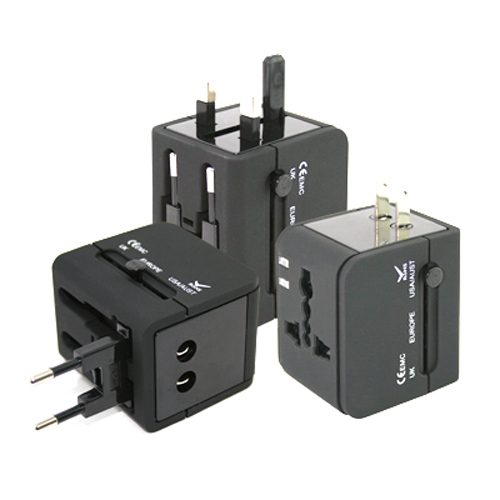
Universal travel adapters, including every model in our range, are in the first category. So is essentially every adapter sold as a corporate gift anywhere. That is not a shortcoming; it is what the product is. The shortcoming is failing to say so on the box.
Malaysia runs at 240 V. A good number of destinations do not
Our mains supply is nominally 240 V at 50 Hz. Roughly speaking, the world divides into a high-voltage group in the 220–240 V band and a low-voltage group around 100–127 V. The plug shape does not track the voltage, which is why the two get confused — and it is why a corporate traveller can carry the same adapter from Jakarta to Tokyo and meet a completely different supply behind an identical-looking socket.
| Destination | Nominal mains | Relative to home | Risk to a single-voltage Malaysian device |
|---|---|---|---|
| Malaysia | 240 V / 50 Hz | — | — |
| United Kingdom, Europe, Australia, New Zealand | 230 V / 50 Hz | Same band | None from voltage. Adapter alone is fine. |
| China, Indonesia, Vietnam, Thailand, India, UAE | 220–230 V / 50 Hz | Same band | None from voltage. Plug shape is the only issue. |
| United States, Canada, Mexico | 120 V / 60 Hz | About half | Runs weakly or not at all. Heaters barely warm. |
| Japan | 100 V / 50 or 60 Hz | Lowest in common use | Same again, more so. Motors may stall. |
| Taiwan | 110 V / 60 Hz | About half | As above. |
| Brazil | 127 V or 220 V, varies by city | Either | Unpredictable. Dual-voltage devices only. |
Note which direction the danger runs. Taking a 240 V Malaysian appliance to Tokyo mostly produces disappointment: the hairdryer blows cool, the kettle takes forever, the motor labours. Taking a 100 V or 120 V appliance bought abroad and plugging it into a Malaysian socket is the direction that destroys hardware — roughly four times the intended power in a heating element that was never designed to dissipate it. That is the failure mode worth warning about, and it happens most often when someone brings a bargain grooming appliance home from a trip.
Read the brick: the ten-second check that settles it
Every mains-powered device carries an input marking, printed on the power brick, moulded into the plug, or on a label near where the cable enters. Find the line that begins “INPUT”. It answers the question completely.
| What the marking says | What it means | Is an adapter enough? |
|---|---|---|
| INPUT: 100–240 V~ 50/60 Hz | Dual voltage. Designed for the whole range. | Yes. This covers nearly all phone and laptop chargers. |
| INPUT: 220–240 V~ 50 Hz | High-voltage only. | Only in the 220–240 V band. Not in Japan or North America. |
| INPUT: 120 V~ 60 Hz | Low-voltage only. | No. Do not connect this to a Malaysian socket. |
| A switch marked 115 / 230 | Manually selectable. | Only if the switch is set correctly before it is plugged in, every time. |
| No legible marking at all | Unknown. | Treat as unsafe to travel with. Leave it at home. |
The shortcut worth teaching: if the device has a separate power brick on the cable, it is very probably dual voltage. If the device plugs straight into the wall and produces heat or spins something — hairdryer, iron, kettle, curling tongs — assume it is not, until the marking proves otherwise.
The appliances that cause the trouble
Three families of device account for nearly every travel-adapter mishap:
- Heating elements. Hairdryers, travel irons, kettles, hair straighteners and curling tongs. A bare resistance wire has no electronics to protect it and no ability to adapt; give it double the voltage and it takes roughly four times the power. These are also, by a wide margin, the highest-wattage things anyone tries to plug into a small travel adapter.
- Motors. Small fans, some grooming appliances, older shavers. Beyond voltage, these care about frequency, and a 50 Hz motor on a 60 Hz supply runs faster and hotter.
- Anything bought abroad on impulse. The classic case is a well-priced grooming appliance from a Japanese or American shop, carried home, marked for the local supply only, and plugged into a Malaysian socket. The adapter used to make that connection is not the cause — but it is what made it possible.
By contrast, the devices your recipients care most about — phones, tablets, laptops, cameras, earbuds — are almost universally marked 100–240 V, because manufacturers build one power supply for every market. For that traffic the adapter is exactly the right product, and the only remaining questions are fit and the port specification.
Why we will not build a converter into a corporate gift
Buyers occasionally ask whether we can source something that does both. The honest answer is that we do not recommend it for a giveaway, for three reasons.
First, a real step-down transformer able to run a hairdryer is heavy, roughly the size and weight of a brick, and nobody packs it twice. Second, the light cheap devices sold as “travel converters” typically chop the waveform rather than transform it, and are suitable only for simple heating loads — connect a laptop charger and the result ranges from refusing to work to damaging the charger. Third, a converter carries a wattage limit that recipients will exceed, because the number is printed on the base of a device nobody reads.
A gift that quietly invites misuse is a poor gift. Our recommendation is always the same: give a well-specified plug adapter, say clearly on the packaging what it does not do, and let anybody who genuinely needs voltage conversion buy the right tool for it. That principle also drives what we ask suppliers to evidence before a run is approved, set out in the fuse and shutter questions to ask before you order.
The insert card wording we supply with adapter orders
This is the block we hand to clients for the insert card or the inside of the box lid. It is deliberately short, because a warning that runs to a paragraph is a warning nobody reads. Adapt the branding, keep the substance.
PLUG ADAPTER ONLY — IT DOES NOT CHANGE VOLTAGE.
Before use, check your device is marked 100–240V. Do not use with hairdryers, irons, kettles or other heating appliances. Push the adapter fully into the socket. Do not use if it feels loose or warm.
PENYESUAI PLAG SAHAJA — IA TIDAK MENUKAR VOLTAN.
Sebelum guna, pastikan peranti anda bertanda 100–240V. Jangan guna dengan pengering rambut, seterika, cerek atau alat pemanas lain. Masukkan penyesuai sepenuhnya ke dalam soket. Jangan guna jika ia longgar atau panas.
Two languages, six lines, and it fits comfortably on a card the size of the box lid. Where that card sits, how it is printed and why it ends up carrying more of your brand than the product itself is the subject of the insert card that travels inside the box.
What we ask before an adapter brief is signed off
- Will the packaging carry the voltage line? If a client declines it for design reasons, we ask for it on the insert card instead. It goes somewhere.
- Is the rating marked legibly on the unit itself? The current and voltage rating must remain readable after decoration — a point that constrains the artwork more than most buyers expect.
- Who is the audience? A delegate bag going to an international conference and a long-service gift for staff who travel monthly justify different models and different port mixes, and which plug shapes matter is settled by which plug types a universal unit really carries.
Questions buyers ask us about adapters and voltage
Does a universal travel adapter convert voltage?
No. It changes the shape of the plug so it fits a foreign socket. The voltage that reaches your device is whatever the building supplies. Voltage conversion needs a separate, much heavier product.
Can I use a travel adapter with a hairdryer?
We advise against it. Even where the voltage matches, a hairdryer draws far more current than most travel adapters are rated for, and the heat is concentrated at the plug contacts. If the hairdryer is single-voltage and the supply is higher than it expects, the outcome is worse than a failed appliance.
Is my laptop charger safe to use abroad with just an adapter?
Check the input marking. Nearly all modern laptop and phone chargers read 100–240 V, which means a plug adapter alone is the correct and sufficient solution anywhere in that range.
What happens if a 110 V device is plugged into a Malaysian socket?
It receives about twice the voltage it was designed for. Electronics typically fail immediately; heating elements draw roughly four times the intended power, which can burn out the element and, in the worst case, start a fire. This is the direction to warn recipients about.
What is the minimum order for branded travel adapters?
From 300 pcs per design, with the insert card included in the specification at no separate design charge. Production is 21–45 days after artwork approval depending on quantity and branding, plus about 15 days shipping. Express production in 10 working days is available on limited models and quantities.
Get the warning on the box before you get the logo on the lid
Aquaholic Gifts is a Singapore-based corporate gifting specialist working since 2003, now serving Malaysia from Kuala Lumpur. Tell us the audience and the destinations and we will send the insert-card wording, a physical sample and a free digital mockup, so you can browse the USB-C travel adapter Malaysia models knowing exactly what your recipients will be told. MOQ from 300 pcs, nationwide delivery, SST invoicing and ePerolehan supported.
WhatsApp +60 10 717 5924 · Contact the KL team
AS80, Jalan Hang Tuah 4, Taman Salak Selatan, 57100 Kuala Lumpur