Handing Out Thousands: Bulk Water Bottle Giveaways for KL Marathons, Sports Days and Walkathons
A mass-participation event does not fail on the bottle. It fails on the twelve minutes at the end of the race when four thousand people arrive at one table. The Kuala Lumpur Standard Chartered Marathon has drawn well over thirty thousand runners in recent editions; a corporate walkathon or a school sports day is smaller but arrives in an even tighter window. Whether a branded bottle is a triumph or a logistics incident comes down to three numbers most briefs never mention: cartons per pallet, bottles handed over per volunteer per minute, and how many hours those cartons spend sitting in a van in Malaysian heat before anyone opens them.
This is the operational article for high-volume bottle giveaways in KL and across Malaysia, written by a Singapore-based corporate gifting specialist that has been shipping event drinkware since 2003 and now produces for Malaysian organisers. It covers the countdown calendar, the storage and heat problem, the handout maths and the leftover-stock question that nobody plans for and everybody faces on the Monday after.
Start from the event date and count backwards
Bottle production is not the long pole; artwork approval is. Production runs 20 to 30 working days after artwork is approved, and shipping adds roughly 15 days. Add a mockup round, an artwork revision, a sample approval and internal sign-off, and a bottle order that looks like “about six weeks” on paper is comfortably a three-month project once real approvals are involved. Here is the countdown we build with organisers.
| Weeks before event day | What must happen | The thing that slips |
|---|---|---|
| Week 14–13 | Model and cap chosen; quantity fixed against expected registrations plus a buffer; brief issued. | Waiting for final registration numbers instead of committing to a band. |
| Week 12 | Digital mockup received and circulated; sponsor logo files chased. | Sponsor artwork arriving as a low-resolution image lifted from a website. |
| Week 11 | Artwork approved in writing. The clock starts here, not before. | One sponsor approving a week late and consuming the entire buffer. |
| Week 10–5 | Production: 20 to 30 working days depending on quantity and decoration. | Adding a second colourway mid-run. |
| Week 4–2 | Shipping, around 15 days, then goods-in check against the approved sample. | No named receiver, so cartons sit unopened in a loading bay. |
| Week 2–1 | Split into distribution lots by station; brief the volunteers; agree the storage point. | Discovering the storage room has no ventilation. |
| Event day | Cartons opened in advance, bottles pre-staged, one runner per table replenishing. | Volunteers opening cartons in front of a queue. |
Our event countdown planner. Express production in 10 working days exists on limited styles and quantities, but it is a recovery tool, not a plan.
The clause we now put in every event brief. Artwork approval must be a single named person with a deadline, not a committee with a group chat. On event orders, the approval step is where nearly all lost time goes — never production. If sponsors must review, give them a fixed 48-hour window and state in writing what happens to the delivery date if it passes.
The heat problem: storage between delivery and event day
Bottles usually arrive two to four weeks before the event, and where they wait matters more than most organisers expect. Research on parked cars carried out in Malaysia has recorded dashboard surface temperatures around 75°C in a closed vehicle, and an unventilated store room under a metal roof is not far behind on a still afternoon. Three things happen to bottles held at those temperatures for days at a time.
- Decoration is stressed. Surface-applied prints and adhesive-backed films are the least tolerant of repeated heat cycling — the reason it pays to specify decoration for the environment, as set out in our guide to decoration that survives months in a bag.
- Cartons soften. Corrugated board loses stiffness with heat and humidity. A stack that was stable on delivery can lean by event week, and a leaning stack crushes the bottom layer of bottles.
- Sealed bottles develop an internal smell. A bottle capped tight at the factory and then baked for a fortnight can carry a faint plastic note on first opening. It disperses with a rinse, but the first impression at a finish line is not the place to discover it.
The fixes are cheap. Store indoors, off the floor, out of direct sun, and no more than five or six cartons high. Never leave the stock overnight in a vehicle. If the bottles are being transported the day before, load in the evening or early morning rather than mid-afternoon, and get them out of the vehicle on arrival rather than leaving the van as the store room.
The handout maths nobody does
Distribution rate, not stock, is what creates the queue. Work it through before the event and the table layout designs itself.
The four-step distribution calculation
- Peak arrival window. Not total participants — the busiest 20 minutes. At a road race that is the mass finish; at a sports day it is the closing ceremony; at a walkathon it is the moment the last wave crosses.
- Bottles needed in that window. Take a realistic share of the field arriving in the peak — often the majority of a mid-pack finish.
- Handover rate per volunteer. A pre-staged bottle passed to an outstretched hand is quick; a bottle taken from a sealed carton, unwrapped and handed over is several times slower. Plan on the pre-staged rate and then make that true by opening cartons in advance.
- Stations required. Divide, then add one. The extra station is the cheapest insurance in the whole event.
Three details make the rate achievable in practice. Choose a bottle that can be handed over in one motion — no dangling loop to untangle, no polybag to tear. If the bottle has a cap that must be assembled or a straw supplied loose, assemble it during staging, not at the table. And if the giveaway is bundled with a shirt or a medal, decide whether the bottle goes into the bag at packing stage or is handed separately, because doing both is how you end up with two queues.
Choosing the right bottle for a volume event
| Event type | Sensible format | Why |
|---|---|---|
| Road race / fun run | 500–750ml squeeze or push-pull, lightweight plastic | Usable immediately at the finish; light enough to carry home with a medal and a shirt |
| School sports day | 500–750ml slim body, simple screw or flip cap | Fits the bag side pocket and survives being cleaned by a family rather than an athlete |
| Corporate walkathon | 600–750ml Tritan or aluminium, one-touch lid | Reads as a keepable gift rather than a race freebie; carries the sponsor wrap well |
| Conference or roadshow | 400–600ml slim, screw cap | Packs flat into a delegate bag and fits hand luggage rules for out-of-town attendees |
| Community or CSR programme | Durable Tritan or recycled-content body, plain cap | The point is years of reuse, so cleanability and longevity outrank the photo |
Cap choice deserves its own thought at a finish line, where hands are tired and one-handed opening is the whole point — our breakdown of choosing the right cap for runners goes through the options. And if your event is for schools or a government agency, the documentation questions come with it: see BPA-free paperwork worth checking before you order so the compliance file is ready before the bottles are.
The reusable angle is now part of the brief
Malaysia’s Roadmap Towards Zero Single-Use Plastics 2018–2030 has moved reusable drinkware from a nice gesture to something event sponsors and government partners actively look for. Internationally the direction is unmistakable: the 2026 Paris Marathon announced aid stations without disposable cups or bottles, with runners carrying their own vessel. Whether or not a Malaysian event goes that far, the reasoning is worth borrowing.
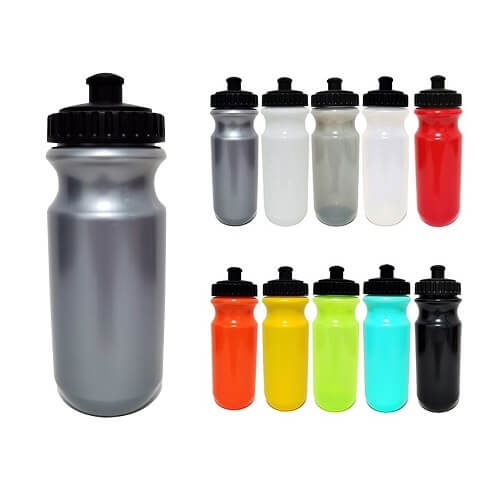
Most of the models organisers shortlist from our customised water bottle KL range are chosen on this basis rather than on unit cost. If you want the reusable claim to be more than a slogan, three decisions carry it. Give participants the bottle before the event rather than at the finish, so it is used on the day instead of collected. Provide refill points and signpost them on the route map. And choose a bottle a person would keep — a good cap, a size that fits a car, and decoration that will not look shabby in six months. A giveaway bottle that is used twice and discarded is worse for your sustainability story than handing out nothing at all.
Plan the leftovers before you plan the handout
Every volume event ends with surplus, because you ordered a buffer and not everyone collected. Decide the destination in advance: a staff welcome pack, the next quarter’s roadshow, a school or community partner. The one decision to avoid is dating the artwork. A bottle printed with an event name and year is unusable the following Monday; the same bottle printed with the organisation’s logo and a neutral campaign line has a second and third life. If the event branding is essential, put it on the packaging or a hang tag rather than on the bottle itself.
Frequently asked questions
How far in advance should we order bottles for a marathon or sports day?
Begin roughly 14 weeks out. Production takes 20 to 30 working days after artwork approval and shipping adds around 15 days, and the remaining weeks absorb mockups, sponsor approvals, goods-in checks and pre-event staging. Express production in 10 working days is available on limited styles, but treat it as a rescue option rather than the plan.
How should bottles be stored before an event in Malaysia?
Indoors, off the floor, out of direct sun and no more than five or six cartons high, and never overnight in a vehicle. Heat and humidity soften corrugated cartons and stress surface decoration, and a leaning stack crushes the bottom layer. Transport in the cooler part of the day and unload on arrival.
What is the minimum order for event water bottles?
From 200 pieces per design. If you are running several colourways or several sponsor variants, each design counts separately, which is worth knowing before you promise every sponsor its own version.
Should the event year go on the bottle?
Only if you are certain of the quantity. Dated artwork makes surplus stock unusable, and surplus is near-certain on a volume event. Put the organisation’s mark on the bottle and the event details on the packaging or hang tag, and the leftovers become next quarter’s stock instead of a write-off.
Give us the event date and we will work backwards from it
Send us your event date, expected participants, distribution plan and artwork, and we will return a free digital mockup with a dated production schedule that hits your handover day — usually within one business day. Minimum order from 200 pieces per design; production 20 to 30 working days after artwork approval, plus around 15 days shipping; express in 10 working days on limited styles. Shortlist a model from our water bottle printing KL range and tell us how many volunteers you will have at the table.
Aquaholic Gifts Malaysia · AS80, Jalan Hang Tuah 4, Taman Salak Selatan, 57100 Kuala Lumpur · nationwide delivery, SST invoicing, ePerolehan-ready for government buyers.